For twenty-two months and six days, Lily Ashford lived in a world measured not by distance but by thresholds. The lip of the drawing-room rug. The first stair. The line where the garden’s gravel began like a pale sea she could never enter. She knew every crack in the flagstones, every knot in the oak of the veranda railing, because her eyes traveled where her legs would not.
The doctors arrived in polished cars and left with polished excuses. They brought diagrams, braces, plans for operations that sounded like prayers and ended like invoices. Some spoke gently, as if softness could replace certainty. Others spoke with brisk confidence, the sort that men used when they could not bear the thought of failing. Richard Ashford paid all of them. He paid because love, when it is trapped, starts to look for doors in every wall.
“Again,” he would say, his voice raw around the edges, as Lily gripped her forearm crutches and lowered her weight onto them. “Just try again.”
Lily did try. She learned the rhythm of her own disappointment: lift, shift, breathe, and accept. When the muscles in her legs refused to answer, she would smile anyway, because her father’s eyes were always searching her face for hope as if hope were a thing he might steal from her expression.
By late summer, she stopped asking when it would end. She began spending her afternoons in the garden, where the hedges were clipped into soft walls and the roses blushed as if embarrassed for her. Near the back of the estate, beside a stone bench warmed by sun, sat an old copper tub once used for washing muddy boots after hunts. The servants used it now for tools and weeds. Lily liked it because it held water without asking questions.
That evening, the light turned honey-thick, slipping between the branches and gilding the gravel path so it looked like something from a storybook—something meant for other children. Lily stood at the edge of it, her crutches sunk slightly into the soil, and stared at the glittering stones as if they were a locked gate.
The side gate clicked.
Lily’s head lifted. Visitors came through the front, announced by the bell and a butler’s careful voice. Whoever entered by the side gate came like wind, uninvited and urgent.
A boy stepped into the garden, thin as a reed, with hair that looked as if it had been cut by accident rather than intention. His clothes were the color of dust and worn through at the knees. One shoe had a split along the seam, the mouth of it yawning with each step. He paused when he saw Lily, as if he had reached the final page of a map.
“Are you… Lily?” he asked. His voice was quiet, but it carried the weight of something practiced.
Lily tightened her grip on the crutches. “Yes. Who are you? How did you get in here?”
The boy swallowed. “Noah.” He looked past her at the house, then back, as if expecting someone to appear and drag him away. “I’m supposed to be here before the sun goes down.”
Lily glanced toward the long shadow stretching from the hedges. “Why?”
Noah’s hands clenched, then opened again. “Because my mother told me.”
He took a step closer, stopping at a respectful distance. His eyes, wide and strangely steady, fixed on Lily’s feet—on the shoes she wore more for dignity than function. “Can I… can I wash your feet?” he asked, the words tumbling out as if they had been trapped in his throat too long.
Lily blinked. “Wash my feet?”
Noah nodded quickly, as if afraid she would refuse before he could explain. “In water. In that tub.”
“That’s ridiculous,” Lily said, but her voice held no cruelty. It held the tired caution of a girl who had been promised too much.
“It has to be before sunset,” Noah insisted. He reached into his pocket, pulled out a small cloth, and held it like a talisman. “Please.”
Lily looked at him—the dirt, the scraped knees, the stubborn resolve that didn’t belong to a child. Something in her chest shifted. Not belief. Not exactly. More like curiosity softened by loneliness. “Fine,” she said, surprising herself. “But don’t expect miracles.”
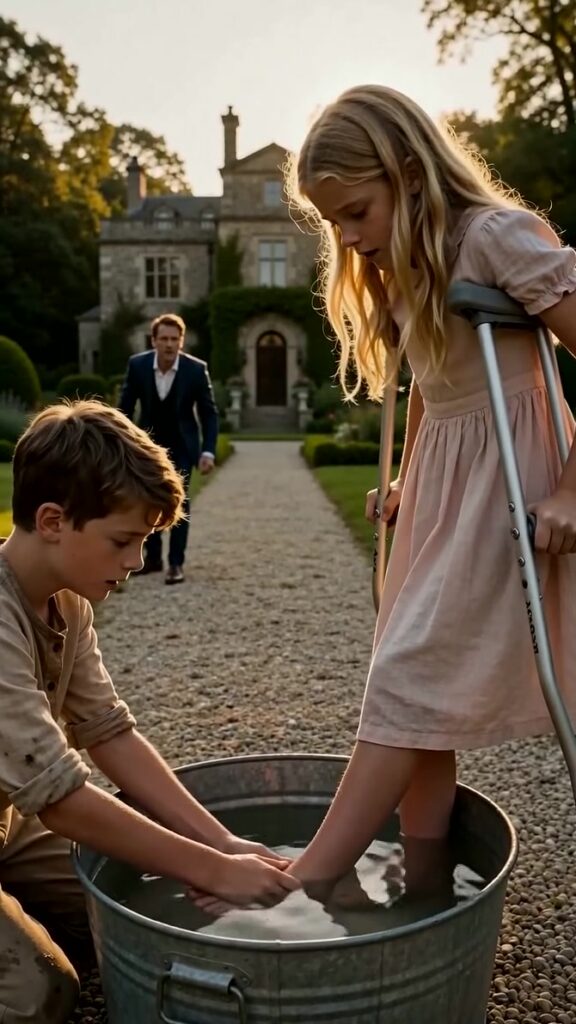
Noah moved with careful purpose, dragging the copper tub a little closer. He fetched water from the nearby pump, each trip stealing more of the sun’s remaining glow. Lily lowered herself onto the stone bench with effort, her arms trembling. When she removed her shoes, her feet looked small and pale against the tarnished copper.
Noah knelt in the gravel as if it were a church aisle. He lowered Lily’s feet into the water slowly, watching her face.
The cold made Lily inhale sharply. “It’s freezing.”
“That’s good,” Noah whispered, as if cold were a sign.
He dipped the cloth and began to wash, gentle at first, then with a steadier pressure. His hands were rougher than hers, but his touch was oddly respectful, as though he were handling something breakable and sacred.
Lily stared down at the ripples spreading across the water. “Why are you doing this?” she asked, her voice smaller than she intended.
Noah did not look up. “My mother worked here. Long time ago.” He paused, swallowing hard. “She got sick. She said, ‘If you ever find the girl in pink, you wash her feet before the sun hides. And if she feels the water, you give the letter.’”
“The girl in pink?” Lily glanced at her dress—soft rose-colored cotton, chosen because it made her father smile. “That’s… me.”
Noah nodded once. “She made me promise.”
Before Lily could ask more, the back doors of the estate flew open with a crack like thunder. Footsteps struck the veranda boards, fast and furious.
Richard Ashford stormed into the garden, his suit jacket unbuttoned, his tie loosened like he’d been strangled by the day. His gaze snapped to the boy on his knees, to Lily’s bare feet in water, and fury lit his face like a match. “Lily!” he shouted. “Get away from him! Who are you? What do you think you’re doing?”
Noah flinched so hard the cloth slipped from his fingers. But he didn’t run. He held still, eyes wide, hands hovering over the water as if moving might break something.
Lily’s heart hammered. She went to lift her feet out, to obey, because obedience was the safest place in their house. But as her toes curled instinctively against the cold—just a reflex, just a twitch—she froze.
Because it wasn’t a twitch.
It was sensation, bright and unmistakable, climbing up her foot like a spark searching for tinder.
“Dad,” Lily breathed, her voice cracking. “Wait.”
Richard halted mid-stride, anger caught in his throat. “Lily, don’t—”
“I felt it,” she whispered, staring at her own toes as if they belonged to someone else. She flexed again. A faint movement answered her intention, hesitant but real. “I… I felt the water.”
The garden went unnaturally quiet. Even the birds seemed to hold their breath.
Richard’s face drained of heat, then of color. His mouth opened, but no sound came out.
Noah’s eyes filled, not with triumph, but with terrified relief. He reached into the neckline of his shirt and pulled out an envelope protected by the warmth of his skin. Its corners were soft with handling, the paper creased as if it had been unfolded and refolded a hundred times. He held it up in both hands like an offering.
“Then my mama was right,” he said, his voice shaking. “I have to give you this. She said it’s for her father.”
Richard took one step closer. Then another. The gravel crunched beneath his shoes, loud in the hush. He stared at the envelope, at the looping handwriting on the front.
It was a hand he had watched sign wedding certificates, birthday cards, and notes tucked into his suit pocket on hard days. A hand he had held as it grew cold.
His dead wife’s name was written there as if she had stepped out of the grave to leave it behind.
Richard’s knees seemed to forget their purpose. He steadied himself on the stone bench with one palm, eyes locked on the ink. When he finally spoke, his voice was a broken thing. “Where did you get this?”
Noah’s chin lifted despite the fear trembling through him. “From her. Mara.” He swallowed. “She told me to find the girl. She said you’d know why.”
Lily sat rigid, feet still in the water, sensation fluttering through them like a startled bird. She looked from Noah to her father, and for the first time in nearly two years she saw her father not as a pillar holding up their world, but as a man standing on the edge of collapse.
Richard reached for the letter with hands that did not feel like his own. His fingers closed around the paper. The sun, slipping toward the horizon, struck the envelope and made it glow.
Somewhere deep inside Lily’s legs, something stirred again—uncertain, awakening, as if the body had been listening all along and was finally ready to answer.
And Richard Ashford, with his wife’s handwriting burning against his palm, realized the miracle he had been buying might never have been sold at all. It might have been waiting—patiently, painfully—in the hands of a boy who had come through a side gate carrying nothing but a promise.