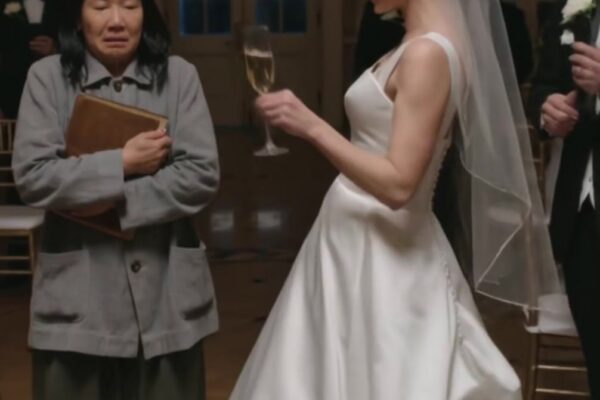
The lobby of the Miravel had been designed like a beautiful lie. Gold leaf clung to the ceiling like sunlit dust. Marble floors reflected people the way polished water reflects the sky—without admitting what lived beneath. Perfume and fresh lilies floated in the air, so clean and sweet it felt like the building itself had never heard a sob.
That was why the sound of a hand striking skin seemed impossible at first, like a note the piano couldn’t play.
“You filthy fraud—don’t you dare go near my husband’s suite!” The woman’s voice tore through the velvet hush. She wore pearls that sat on her throat like a promise, and her manicure was as pale as bone. Her palm had already left a red mark on the cleaner’s cheek.
The cleaner stumbled backward. Towels slid from her arms, fanning out across the marble in soft white squares, as if the floor had sprouted snow. Guests stopped mid-step. Someone’s wheeled suitcase tipped, then slowly spun in a lazy circle, as though the lobby itself was deciding whether to pretend nothing was happening.
The woman seized the cleaner’s wrist and yanked her toward the reception desk. “Tell them,” she hissed, nails digging in, “tell them why you were in four-seventeen.”
“I wasn’t—” the cleaner tried, her words catching on panic. She was young, hair pinned tight beneath a plain cap, uniform too large at the shoulders. Tears gathered fast, as if her body had been waiting for permission.
“Liar!” The rich woman’s shout echoed off marble and crystal.
Behind the desk, the receptionist had gone still, smile locked in place as if it had been painted on. The pianist’s hands hovered above the keys, unsure whether to keep playing. Phones rose like periscopes among the guests; their screens glowed, hungry.
Then the old concierge lifted his head.
His name was Mr. Sava, and he had stood in that lobby longer than most of the furniture. His posture was always perfect, his suit always pressed, his expression always set to the gentle neutrality of a man paid to absorb other people’s chaos. But now his gaze fixed on the cleaner’s wrist—and something in his face broke.
A key hung there on a thin cord, swinging from the struggle. Not a modern plastic card, not even the brushed-steel key fob used for the Miravel’s heritage suites. This one was brass, heavy and old, the tag engraved with an ornate 417 that had been polished so often it looked newly minted.
Mr. Sava’s lips moved without sound at first. Then, in a voice like brittle paper, he whispered, “No.”
The rich woman turned, triumphant. “Yes,” she snapped. “She stole it. Arrest her.”
But Mr. Sava wasn’t looking at the woman. He wasn’t looking at the guests. He stared only at the brass tag as though it were a ghost with a familiar face.
“Suite four-seventeen was sealed,” he said, and the lobby heard the words like a door closing. “The night she vanished.”
A different silence followed—thicker, more dangerous. Even the air-conditioning seemed to soften, as if the hotel feared making noise.
From the edge of the crowd, a man stepped forward. He had the confident build of someone used to being obeyed, a tailored coat, a watch that flashed like a small blade. His eyes moved from the cleaner’s tear-streaked face to the key, and his mouth tightened.
“What is this?” he demanded, and his voice carried the authority of money.
The rich woman’s grip loosened slightly. “Adrian, I told you—this girl has been stalking—”
Adrian didn’t look at her. He reached out, snatched the key from the cord, and held it close. The engraved numbers stared back. His fingers, steady a moment ago, trembled once, barely visible, like a flaw in the film.
He swallowed. “This… isn’t from the new lock.”
Mr. Sava’s throat bobbed. “It’s the original tag,” he said. “From the old mechanism. The one removed twelve years ago.”
The rich woman’s lips parted. The pearl necklace at her throat suddenly seemed too tight. “That’s impossible,” she said, as if saying it hard enough would make it true.
The cleaner gathered the towels with shaking hands, then stopped, as if remembering she no longer had permission to be invisible. She lifted her face. “My mother told me to open it only if he was about to marry again,” she said, voice thin but clear.
Adrian’s gaze snapped to her. “Who are you?”
She looked at him the way someone looks at a portrait they’ve been forced to hate and secretly mourn. “My name is Mara,” she said. “My mother’s name was Elena.”
A soft, involuntary sound escaped from somewhere in the crowd. Someone covered their mouth. Someone else whispered, “Elena—” as if the name belonged to the building itself.
Adrian’s face drained of color in slow motion. “Elena died,” he said. “They said—”
“They said a lot,” Mr. Sava interrupted, and his voice held something it never held: judgement. “They said she ran away. They said she was unstable. They said the police searched.” He looked at Adrian as if seeing him at twenty-six again, arrogant and frightened. “But your mother ordered me to seal four-seventeen that night. She paid for the lock change in cash. She told me never to let anyone inside.”
The rich woman’s hand went to her own chest, to her diamonds, as if checking that the world was still arranged correctly. “Adrian,” she whispered, “tell me you don’t believe this.”
Adrian’s breathing had changed. It wasn’t the smooth inhale of someone used to controlling rooms. It was the uneven breath of a man approaching a cliff in the dark.
Mara held out her palm. “The key isn’t mine,” she said. “It came to me the day my mother disappeared from the shelter where she was staying. A woman delivered it. She said, ‘When he tries to make a new bride, remind him what he did to the old one.’”
Adrian’s eyes flickered, a fast flash of recognition that was almost fear. “That’s—” he began, and stopped.
Mr. Sava leaned forward, ancient hands braced on the desk. “Only three people knew that suite remained sealed,” he said. “Your mother. Me. And Elena.”
Mara’s fingers found the brass tag in Adrian’s hand. She didn’t snatch it; she asked for it with the gentleness of someone reclaiming something stolen. For a heartbeat he refused—then his grip loosened, as if the metal had become too hot.
She flipped the tag over. On the back, hidden beneath a decorative flourish, was a seam so fine it could pass for ornament. Mara pressed her thumbnail into a notch. The tag clicked open with a sound that seemed far too loud for such a small object.
Inside was a folded strip of paper, thin as a confession.
The lobby stopped breathing.
Mara unfolded it carefully. Her lips moved as she read, silently at first. Then her voice came out raw, like it had been scraped on the way up. “If you’re reading this,” she read, “it means I didn’t get to walk out on my own.”
Adrian made a low, strangled sound. His wife stared at him as if he had changed species.
Mara continued, each word landing like a dropped stone. “Adrian says he loves me, but his mother loves control more than she loves her son. Tonight she brought me tea. It tasted of almonds. She smiled and told me the engagement would be perfect.”
A murmur spread—people knew that detail, that bitter folklore about poison and sweetness. Phones shook in hands now, no longer steady.
“She said if I insisted on marrying him,” Mara read, “I would regret it. I told her I would not be purchased, I would not be managed. She laughed. She said she had already arranged the room.”
Mara’s eyes lifted from the paper to Adrian’s face. “This is dated,” she said, and her voice nearly cracked, “the same night she vanished. It says, ‘They locked the door from the outside. Mr. Sava was told it was maintenance.’”
Mr. Sava flinched as if struck, shame and horror crossing his features. “I didn’t know,” he whispered. “God help me, I didn’t know.”
Mara read the last lines, and the lobby seemed to tilt toward her, desperate for an ending. “There is a second door behind the wardrobe,” she read. “If anyone finds this, don’t look for me in the suite. Look for the tunnel. Look for what the Miravel was built over. I hear water. I hear them moving something heavy.”
Her hands lowered, paper trembling. “There’s a tunnel,” she said. “And my mother believed she would not survive it.”
The rich woman backed away from Adrian as if the floor between them had become glass. “Adrian,” she breathed, “tell me where the tunnel is.”
Adrian’s mouth opened, but no sound came. His eyes darted, not to Mara, not to his wife—down the corridor where guests weren’t supposed to go, toward the private elevator behind the velvet rope, the one that only the family used.
Mr. Sava straightened, suddenly taller than his age. The concierge’s neutrality fell away like a discarded coat. “Call the police,” he said to the receptionist, and the words rang with the force of a verdict. “Now. And unlock four-seventeen.”
The receptionist’s fingers finally moved, fumbling for the phone, for protocol, for salvation.
Mara wiped her cheek with the back of her hand, smearing the red mark left by the slap. She stepped away from the towels, from the role she’d been forced into, and looked around at the glittering lobby—the chandeliers, the marble, the staged calm.
“You built all this,” she said softly, not only to Adrian but to the hotel itself, “so that truth would feel out of place.”
Then, as sirens began to rise in the distance like an approaching storm, the Miravel finally did what it had been designed never to do.
It let the ugly truth survive.