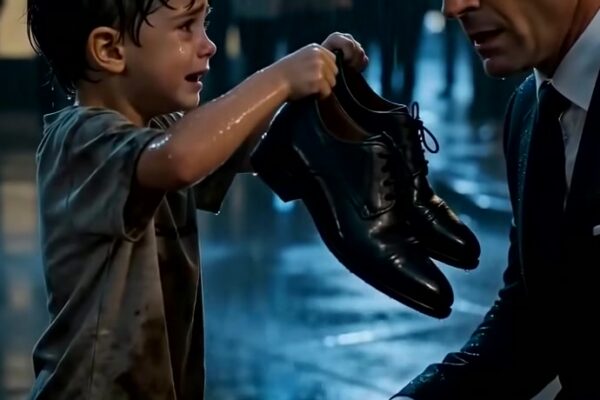
The bus stop was crowded, cold, and loud with the tiredness of evening. Rain had stopped an hour ago, but the street still wore it: slick black asphalt, puddles that shivered whenever a car swept past, the white hiss of tires cutting through water like an impatient whisper. Under the shelter’s scratched plastic roof, people stood in a line that wasn’t quite a line, shoulders hunched, collars raised, eyes lowered into glowing screens as if the light might warm them.
It was the hour when everyone wanted to become invisible. The office crowd, the retail workers, the students with damp hair and heavy backpacks—each of them pressed into their own pocket of silence. The air smelled like wet wool and cheap coffee. A digital sign blinked an apology: DELAYED.
Near the edge of the shelter stood a child who didn’t fit into anyone’s careful ignoring. She was small enough that her coat swallowed her, a thin thing with a zipper missing teeth. Her shoes were too big, the heels folding in as she shifted from foot to foot. She kept both hands tight against her chest, holding an old photograph like it was a fragile bird she was afraid would die if she loosened her grip.
Her face was pinched in a way that didn’t belong to childhood. It wasn’t only the cold. It was the kind of stillness that comes from counting seconds and trying not to fall apart inside them.
A woman in a pale wool coat approached with the unhurried confidence of money. Her scarf was knotted neatly, her hair smoothed into place, her boots clean despite the puddles. She had the glossy exhaustion of someone who had been catered to all day and found it insufficient.
She glanced at the girl’s hands and, without asking, reached out. Her fingers were jeweled, nails shaped and shining. She snatched the photograph as if it were a crumpled flyer being pressed on commuters.
“This isn’t a theater,” she said, loud enough that the nearest heads lifted. “People are tired. Put your sob story away.”
The girl’s mouth opened soundlessly. Her hands rose, empty, then reached forward as though the photo still hovered in the air where it had been. Someone in the crowd let out a short, sharp laugh—more nervous than amused. A phone came up, its camera lens catching the shelter lights and turning them into pale halos.
“Please,” the girl said. The word came out thin. “Please give it back. My mom—she told me to show it to the man who rides this bus every Friday. She said he would know. She said he would help.”
The woman’s eyes flicked over the photograph with theatrical disgust, as if the paper itself might stain her. “That’s what they all say,” she replied. “Here, I’ll save you the trouble.”
She gripped the photo between both hands, thumbs set like blades. Paper fibers complained. In a single decisive motion, she tore it down the middle, not neatly, but in a jagged rip that left a white scar through the image.
The girl made a sound that seemed to come from deeper than her lungs, a small broken noise that froze the breath in the shelter. Her knees buckled and she caught herself on the bench, fingers clawing at the air toward the torn halves.
For a moment, no one moved. Even the phones wavered, as if the people holding them suddenly forgot why they had lifted them.
Then the bus arrived with a sigh of brakes and a shudder that traveled through the pavement. Its headlights washed the crowd in dull gold. The doors opened. Warm air spilled out, smelling faintly of diesel and stale upholstery.
An older man stepped down first, careful with his footing, one hand on the rail. He wore a dark overcoat and a hat pulled low, but the way he looked at the shelter was not the casual glance of a commuter. His eyes searched faces as if they were pages he had read before and wanted to find again.
His gaze landed on the torn photograph.
The fashionable woman had paused with the two halves still in her hands. Perhaps she meant to drop them, perhaps she meant to wave them like evidence of her righteousness. But the man’s expression changed so abruptly it seemed to drain the color from the air around him. His mouth parted. A tremor passed through his jaw.
He took one step closer, then another, not looking at the woman at all—only at the torn image. His voice, when it came, was not loud, but it carried with the force of something finally breaking after years of strain.
“That picture,” he whispered. “Where did you get that?”
The woman blinked, thrown off her script. “It’s… some scam,” she said, but the certainty in her tone had thinned.
The girl stared at the man, eyes wide, cheeks wet, lashes clumped with tears. “My mother gave it to me,” she managed. “She said it was proof. She said… she said it was the only thing they didn’t take from her.”
The man’s hand rose as if to touch the photograph, then stopped in the air between him and the woman, as though he feared it might vanish if he breathed wrong. “That was taken,” he said, and his words shook, “the night they told me my daughter and her baby never made it home.”
The shelter went silent in the way an entire room can become silent when a truth drops heavy between strangers. Even the traffic seemed to recede. No one laughed now. The phone that had been recording dipped, forgotten.
The fashionable woman’s face tightened. “Sir,” she began, defensive, “I don’t know what you think—”
But the man wasn’t listening to her. He was looking at the torn halves and seeing what the others could not. The photo showed a young woman, smiling despite hospital lighting, her hair pulled back, her eyes bright with a tired kind of joy. In her arms was a newborn wrapped in a blanket, the tiny face turned toward the camera. Beside her, barely in frame, was the man himself, years younger, one hand hovering over the baby as if he couldn’t believe he was allowed to touch.
He swallowed hard. “They told me there was an accident,” he said to no one and everyone. “They showed me papers. A closed casket. They told me it was mercy. And I… I signed what they wanted because I couldn’t… I couldn’t fight and keep breathing at the same time.”
The girl edged closer, shivering, her hands clenched into fists inside sleeves too long. “My mom said you didn’t know,” she whispered. “She said you would if you saw this. She said you used to hum a song when you thought nobody heard.”
The man’s eyes filled. He reached for the girl, slow, giving her time to pull away. When she didn’t, he took her cold hands in his, and his fingers were warm and unsteady. “What’s your name?” he asked.
“Lena,” she said. “My mom called me Lena. She said your name was Arthur.”
At his name, his shoulders sagged, as if the sound carried weight he had been carrying alone. “Lena,” he repeated, tasting it like a prayer. He looked up at the woman still holding the torn photo, and his grief sharpened into something else—an old, practiced fury that had nowhere to go until now.
“Give it,” he said, his voice suddenly firm.
The fashionable woman’s cheeks flushed. For the first time, she looked uncertain of the audience she had assumed would back her. She stared at the crowd for support and found only eyes watching—no longer bored, no longer detached. People had stepped closer without realizing it. Someone had lowered their phone entirely, as if ashamed of having treated the moment as entertainment.
The woman’s fingers loosened. The two halves fluttered toward the pavement. Arthur caught them before they hit the wet ground, hands trembling as though he were rescuing something alive.
He pressed the torn pieces together, aligning the rip with careful precision. The jagged white line remained, but the faces met again: mother, baby, father. A family interrupted, not erased.
Arthur looked at Lena, really looked, tracing her features as if searching for echoes. “Where is your mother?” he asked, and the question contained both hope and dread.
Lena’s gaze dropped. “She told me she couldn’t come,” she said. “She said people would make her disappear again. But she said you might know how to stop it.” Her voice cracked. “She said you were the only one who ever fought for her, even when everyone called her difficult.”
Arthur closed his eyes briefly, and when he opened them, something in him had settled into place. “Then we’ll find her,” he said. He looked around at the watching commuters, at the bus driver who had stepped out and was listening with a hand on the door. “I don’t know what story you all thought you were witnessing,” Arthur said, “but this is not a child begging. This is a child delivering a message that someone tried very hard to bury.”
No one spoke. But a woman in a supermarket uniform moved first, pulling off her own scarf and wrapping it around Lena’s thin neck. A man in a suit offered his gloves without a word. The driver cleared his throat and said quietly, “You can sit up front. Both of you.”
The fashionable woman backed away, her posture stiff, as if leaving might restore her authority. She looked at the wet pavement, at the torn photo now in Arthur’s hands, and for a moment her expression flickered—regret, or fear, or simply the shock of being seen clearly. Then she turned and walked into the night, heels clicking too fast.
Arthur guided Lena onto the bus, shielding her from the wind with his body as if he’d been doing it her whole life. Before he stepped inside, he glanced once more at the shelter where everyone had stood pretending not to notice pain. Now they watched, faces sober, as though they had been handed a responsibility and could not set it down again.
The doors hissed shut. Warmth wrapped around Lena, and she exhaled shakily, the first full breath she had taken in hours. Arthur sat beside her, holding the photograph carefully in his lap like a map to a place he had been told no longer existed.
Outside, the bus pulled away from the curb. The streetlights smeared gold across the wet road. And in that moving pocket of light, an old man and a shivering child rode forward—not toward comfort, but toward truth, the kind that does not ask permission before it changes everything.