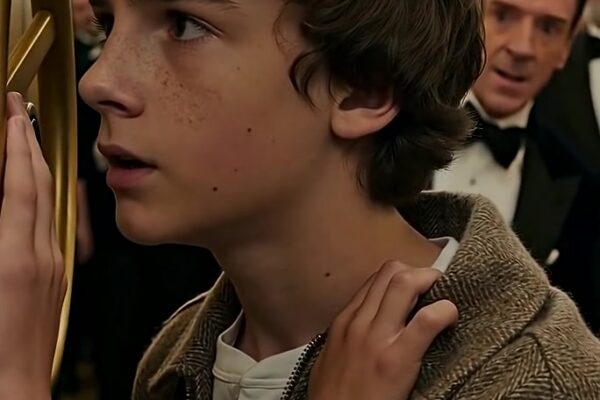
The rain started the way it always did in Blackmere—quietly, as if asking permission—then turned into a hard, scolding curtain that slapped the cobblestones and made the lanternlight stutter. Inside the Iron Cask, the air was thick with wet wool, cheap ale, and the unspoken agreement that no one crossed Garrick Vane.
Garrick sat near the hearth with his boots on the bench and his coat still on his shoulders like a banner. He was not the biggest man in the room, but he carried his size as if it were enough to fill every corner. His knuckles were scarred, his jaw squared by a life that had never asked his consent, and his voice—when he chose to use it—made people lean away as though the words could bruise.
“One more,” he said, and the barmaid slid a mug toward him without meeting his eyes.
At the far end, men played at cards with fingers that trembled less from drink than from caution. A few eyes cut toward Garrick and then away. Someone laughed too loudly at nothing. Someone else pretended to find the ceiling beams interesting. The Iron Cask survived on routines: pay your tab, keep your head down, don’t ask what Garrick did when he left town for a week and came back with blood on his cuffs that wasn’t his.
The door opened with a gust of rain and cold. For a moment, the room’s warmth was torn open like a seam.
A boy stepped in.
Not a boy in the way men used the word when they meant a grown man they could dismiss—this was a boy in truth, perhaps fifteen, maybe sixteen at most, with rain-dark hair pasted to his forehead and a coat too thin for the season. He carried no weapon anyone could see. He carried nothing at all except a small satchel clutched to his chest, like it was the last piece of him he hadn’t lost.
He paused just inside the doorway as if listening for something beneath the noise. Then his gaze traveled across the room and settled, unblinking, on Garrick Vane.
The barmaid’s hand froze mid-wipe. A card player’s smile broke apart. Even the fire seemed to hush.
Garrick looked up slowly. He studied the boy the way a hawk studies a rabbit: mildly curious, entirely confident the outcome would be hunger satisfied.
“You’re lost,” Garrick said. “Go find your mother.”
The boy walked forward anyway. Each step was careful, measured, as if he were stepping across thin ice. He stopped at Garrick’s table, where the hearthlight painted his wet cheeks gold and made his eyes look too old for his face.
“I’m not lost,” the boy said. His voice held no tremble. “I’m looking for you.”
A murmur moved through the room, soft as a draft. Garrick’s mouth lifted, not into a smile but into a shape that suggested amusement had been carved out of stone.
“Then you found me,” he said. “And you should leave before you ruin the rest of your life.”
The boy’s fingers tightened on his satchel. “My life was ruined when you took my father.”
Garrick’s eyes narrowed, but only slightly. “I’ve taken a lot of things,” he said. “You’ll have to be specific.”
The boy swallowed once. “Soren Harrow. The ferryman. You dragged him out of our house because he wouldn’t let you use the river at night. You said the water belonged to whoever had the nerve to claim it.”
The Iron Cask seemed to tilt. The name fell into the room like a coin into a deep well. Some remembered that night: the sound of boots on planks, the ferryman’s shout, the little sister’s wail, the river swallowing the rest.
Garrick leaned back, as if the chair were a throne. “And?”
The boy lifted his chin. “And I challenge you.”
Silence snapped into place. Garrick stared at him for a long moment, then laughed—a low, rolling sound that made two men at the bar flinch.
“You challenge me,” Garrick repeated, savoring the absurdity. “To what? A duel? A game? A prayer?”
“To the river,” the boy said. “At midnight. You and me. One crossing.”
Garrick’s laugh died. That, at least, was interesting. The river at midnight wasn’t a boy’s fantasy; it was Blackmere’s superstition sharpened into fear. The current changed without warning. Fog rose in sudden walls. More than one boat had come back empty, rocking softly like an answer no one wanted.
“You want to drown,” Garrick said, voice flat now. “There are easier ways.”
“I want you to cross it the way my father was forced to,” the boy replied. “No lantern. No crew. No rope. Just you, your hands, and whatever courage you brag about.”
Garrick’s gaze flicked, quick as a blade, to the boy’s satchel. “What’s in there?”
“Proof,” the boy said. “That you’re not as untouchable as everyone pretends.”
The barmaid found her voice, thin with alarm. “Eli,” she whispered, as if the boy’s name itself could be pulled back like a child from a ledge. “Don’t.”
So he had a name: Eli Harrow. Garrick tasted it in his mind, an old, bitter thing.
“You’re brave,” Garrick said, and the room knew it was not praise. “Or you’re stupid. Which one should I punish?”
Eli didn’t look away. “You don’t get to punish me. Not anymore.”
For a moment, Garrick considered simply standing up and ending it—one hand around the boy’s throat, a lesson delivered swiftly and publicly. That was what everyone expected. That was what the town had trained itself to accept.
But something in Eli’s stare held steady, like a nail driven deep. Not defiance alone—calculation. A boy who had measured his own fear and decided it was not the largest thing in the room.
Garrick leaned forward until the firelight cut sharp edges into his face. “You think you can shame me,” he said softly, for Eli alone. “You think you can make me do what you want because the tavern is watching.”
“No,” Eli said. “I think you’ll come because you can’t stand being laughed at. And because you’re curious what I have in this bag.”
Garrick’s eyes flashed. There it was—the hook. The boy knew him. Or he’d learned fast.
“Midnight,” Garrick said, rising. The bench legs scraped the floor like a warning. “At the old ferry.”
Eli nodded once, as if the agreement had already been signed in blood. He turned to leave, and for the first time his shoulders sagged, just a fraction. Not from relief. From the weight of what he’d set in motion.
As the door shut behind him, the tavern exhaled in a rush of frightened talk. Garrick didn’t listen. He stared into his ale as if it might show him the future.
He told himself it was simple. He would go, he would laugh in the boy’s face, and he would end this story before it grew teeth.
Yet when midnight came and the rain eased into a mist that crawled low over the streets, Garrick found himself walking toward the river with his coat buttoned and his hands bare. The town followed at a distance, moving like a guilty conscience. No one spoke. Even the dogs stayed silent.
The old ferry landing was a dark mouth open to the water. The river slid past, black and quick, carrying secrets on its back. Fog thickened in folds, swallowing the far bank until the world ended in gray.
Eli stood at the edge of the planks, waiting. He looked smaller out here, without walls and fire to frame his courage. The satchel hung at his side now, heavy, damp. His face was pale, but his eyes were steady.
Beside him sat the ferryboat, half-rotted, rope coiled like a sleeping snake. Eli didn’t reach for it.
Garrick stopped an arm’s length away. “Well,” he said. “Show me your proof.”
Eli’s fingers went to the satchel flap. He hesitated just long enough for Garrick to feel the first true prick of uncertainty. Then the boy drew out not a weapon, not a document, but a lantern—small, old, its glass clouded by river silt.
Garrick’s breath caught despite himself.
He knew that lantern. Everyone in Blackmere did. Soren Harrow had carried it every night on the ferry, a stubborn star that made the crossing seem safe. The last time it was seen, it had swung from Soren’s hand as Garrick dragged him, shouting, down the bank.
Eli held it up, and inside, impossibly, a faint light stirred—dim, blue, like a heartbeat underwater.
“It washed back,” Eli said. “Weeks after my father died. It shouldn’t have lit again. But it did.” He swallowed. “I think the river keeps what it’s owed.”
The fog pressed closer, as if listening.
Garrick’s throat felt tight. He forced a sneer onto his face like armor. “Ghost stories,” he said.
Eli stepped nearer, lantern between them. “Then cross without it,” he whispered. “Prove you’re not afraid of a story.”
Behind Garrick, the gathered townspeople stood in a rigid semicircle, their faces pale ovals in the mist. They weren’t watching Eli now. They were watching Garrick, waiting to see if the great, brutal certainty of him could be cracked by a boy and a lantern that refused to die.
Garrick looked at the river. He had crossed it a hundred times, drunk and laughing, with men at his back and ropes in his hands. But never alone. Never without the things that made him feel invincible. Never with the town’s judgment at his shoulders and a dead man’s light in his face.
He realized, with sudden clarity, what Eli had done. The challenge wasn’t about drowning him. It was about stripping away the myth that protected him. It was about forcing the town to witness him hesitate.
Garrick Vane, who had never been challenged, not truly, had been cornered by a boy with nothing left to lose.
Eli held the lantern out, offering it like mercy. “Take it,” he said. “Or don’t. But step into the water.”
Garrick’s hands clenched. His pride roared. His fear—smaller, sharper—whispered. The river hissed against the pilings like it knew his name.
He took one step forward, then another, until the wet planks creaked under his boots. The air smelled of iron and old sorrow. Fog wrapped around him as if the world wanted to forget he existed.
He didn’t expect anyone to challenge him. Not in the tavern, not in the town, and certainly not a boy.
But as Garrick reached the edge and felt the river’s cold breath rise to meet him, he understood the final cruelty of it: the boy hadn’t come to kill him.
He’d come to make him human.
And in Blackmere, that was the most dangerous thing of all.