“Go on,” the foreman said, flicking ash toward the trench as if the ground were a mouth he could feed. “Don’t waste our time.”
The men behind him laughed in the dry, practiced way of people who had learned to laugh at anything so they wouldn’t have to think. Their boots made a shallow half-circle around me, heels pressed into the clay. Somewhere beyond them, the city’s new transit line was a scar of rebar, gravel, and ambition. It was too early for the sun to have warmth, but already the air tasted like hot metal and dirt.
I nodded as if I was just another contractor with an odd request. In my hand I held a slim case—black, hard, scuffed at the corners like it had been taken out and put away a hundred times. The foreman’s eyes lingered on it the way gamblers look at a deck, suspicious and hungry.
“You sure this is even allowed?” he asked, though his voice made it sound like he wanted me to say no. He wanted a story to tell at lunch. “We’re behind schedule.”
“Five minutes,” I said. I had rehearsed those words. I’d rehearsed smiling. I hadn’t rehearsed the way my stomach tightened when I saw the trench.
It was deeper than I’d imagined. The utility maps had shown a narrow corridor, a place the old neighborhood once called the Gulch, where a creek used to run before it was sealed and forgotten under concrete. Now it was open again, raw as a wound. At the bottom, water had gathered in a thin line, black and still. The excavator’s bucket hung overhead, waiting like a blunt jaw.
“Five minutes,” the foreman repeated, waving his hand toward the pit. “Then we close it. We’ve got inspectors in at ten.” He leaned forward and lowered his voice. “And don’t start anything. People get ideas when they stand around a hole.”
I didn’t tell him that this wasn’t a hole. Not to me.
I climbed down the temporary ladder, the metal rungs slick with morning dew and something darker. Every step down felt like walking into a memory I hadn’t lived yet. Above me, the men’s voices blurred into a single sound: impatience.
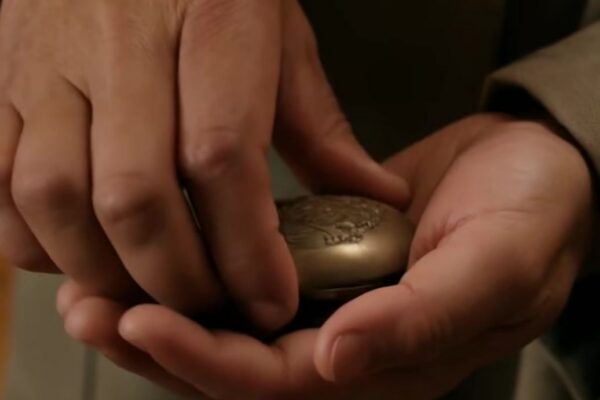
At the bottom, the air changed. It was colder, the way basements are cold in summer, and it smelled faintly of wet paper. I knelt where the clay was packed and smooth, like a wall had once been pressed there and then removed. The case clicked open in my hands. Inside was a small device the size of a paperback book, with a lens on one end and a dial on the other. The dial was marked not with numbers but with dates, hand-etched in fine, uneven script.
My father had made it in the years after the fire, when the neighborhood was already ash and people had started saying things like “revitalization” and “progress.” He was a watchmaker by trade and a man who believed stubbornly that time was something you could fix if you found the right spring and the right patience.
I hadn’t believed him, not until last week, when the city posted the excavation notice and the address made my mouth go dry. Not until I found his notebook hidden under the false bottom of his workbench, the pages filled with diagrams and frantic sentences: Anchor points exist in places where memory is dense. Return requires a witness. Return requires a cost.
I set the device on the clay. The lens stared up into the narrow strip of sky. I turned the dial to a date I’d tried not to say out loud for ten years.
Above me, the foreman called, “You done yet?”
“Almost,” I said, and my voice sounded too calm to belong to me.
I pressed the button.
There was no flash, no theatrical hum. Just a small click like a clasp closing. Then the world tightened.
The men’s chatter stopped mid-syllable. A pebble kicked from someone’s boot hung in the air like it had been pinned. Dust motes froze, suspended, each one a tiny planet. Even the excavator’s chain, which had been swaying lazily, halted in an impossible curve.
My breath came out in a soft cloud that didn’t drift away. I reached up and touched it. It was cold, solid enough to feel like silk stretched thin.
Time hadn’t slowed. It had been gripped, held in a fist.
I should have felt triumph. Instead, fear poured through me, heavy and immediate. My father’s notebook had not prepared me for the silence. The city above, usually full of distant horns and engines, was suddenly a painting.
I climbed out of the trench easily, because nothing moved and no one could stop me. The foreman’s face was caught in an expression of disdain, his mouth half-open, a flake of ash suspended at his lip. I could have laughed. I didn’t.
I walked across the site. Workers were frozen in their gestures: one man mid-sip from a coffee cup, one woman bent over a clipboard, one apprentice turning his head toward a shout that would never finish. It struck me then that this was what the fire must have felt like to people who didn’t get out in time—motion arrested, the moment of realization stretched until it became everything.
I crossed the temporary fencing and stepped into the street. Cars were stopped in a neat line at a red light. A dog stood with one paw lifted, ears pricked toward a pigeon stuck in mid-flap. A child on a scooter leaned forward, about to push off, cheeks puffed with an unfinished laugh.
It should have been peaceful. It was obscene.
I didn’t have long. The notebook’s margins were full of warnings: Hold too long and you fracture what you meant to mend. But it had also said the anchor point was here, exactly here, under the future station where the old Gulch ran like a buried vein. My father had written one line over and over until the ink bled through the page: Bring her back.
Her. The word was a nail driven into my chest.
I turned down the block where the old neighborhood had been, before it was flattened into parking lots and speculative drawings. I walked past a glossy billboard showing smiling commuters in a station that didn’t yet exist. The billboard’s slogan—ON TIME, ON TRACK—made me want to tear it down with my bare hands.
Where my house had stood was now an empty lot fenced with chain-link, weeds pushing through gravel. The gate was padlocked, but the padlock, caught in its moment of being swung shut, was loose enough for me to slip through.
The lot was quiet, the quiet of erased places. I stepped carefully, as if the ground might remember my weight. In my mind, the house rose again: the porch steps, the chipped paint, the wind chimes that sounded like thin bells. I could see my mother in the kitchen window, turning as if she had sensed me coming home.
I knelt and placed my palm on the gravel. “I’m here,” I whispered, though no sound traveled. The silence swallowed my words whole.
My father’s notebook had described a method: find the densest memory, speak it, and open the seam. A witness required, a cost required. I had thought the cost would be money, or years, or blood. I hadn’t considered that it might be something simpler and more brutal: the willingness to trade the future for the past.
I pulled the device from my pocket. The dial’s dates shimmered faintly, as if the etched lines were liquid. I set it on the ground and turned it further back, past the day of the fire, past the days after when sirens became background noise, past the day my father stopped fixing watches and started breaking time instead.
As the dial moved, the air around me thickened. The stillness grew so intense it felt like pressure behind my eyes. The gravel beneath my hand warmed, then cooled, then warmed again, as if it couldn’t decide what season it belonged to.
Somewhere far off, a sound began—not moving through time, but pushing against it. A faint crackle, like paper catching flame.
I froze. The memory wasn’t just waiting. It was hungry.
“No,” I said, and this time my voice seemed to have weight. It dented the silence. “Not like that. Not again.”
I stared at the device, at the date I was approaching, and understood with a clarity that made me sick: stopping time didn’t make you safe from what had happened. It only trapped you with it. The fire would still be there, waiting in its moment, ready to bloom the instant I stepped into it. If I went back, I wasn’t saving her from the past. I was walking myself into the same burning room.
A witness requires a cost.
I thought of my father’s hands—steady even when his heart wasn’t. I thought of the way he’d looked at me the last time we spoke, the way his eyes had been full of apology and insistence at once, as if he were asking me to forgive him for the thing he was demanding.
I could turn the dial back and try to pull my mother out. I could also tear something open that would never close, turning the city into a jar with a lid sealed on a single, eternal second.
Behind my ribs, my heart hammered against a world that wouldn’t let it move forward.
In the frozen street beyond the fence, the red light glowed without flicker. In the trench, the foreman’s contempt waited to finish becoming a word. Everything was poised on the edge of continuing, of pretending nothing had happened.
My fingers tightened around the dial. The crackle in the distance grew louder, eager. The seam was there, just beneath my hand, a place where memory pressed hard enough to thin the fabric of now.
I closed my eyes.
Then, instead of turning back, I turned the dial forward—past today, past tomorrow, toward a date I’d never seen.
The device shuddered. The air screamed silently. For a moment, the pressure became unbearable, as if the world resented being forced to choose a direction.
And then time let go.
The pebble dropped and bounced once, unnoticed. The excavator’s chain clinked. Somewhere, a coffee cup tilted and spilled. The foreman’s voice finished itself, loud and irritated: “—waste our time!”
I was still kneeling in the lot, my palm pressed to gravel that no longer warmed and cooled. The crackle was gone. The city’s noise rushed back in, a tidal wave of engines and distant voices. Above it all, a siren wailed—not from the past, but from the present, racing toward some new emergency.
I opened my eyes and looked at the device. The dial had stopped on a date three months from now. The etched line glimmered like a fresh cut.
My hands were shaking. I hadn’t brought my mother back. I hadn’t even tried.
But in the moment I’d forced time to stop, I’d felt the seam—felt how close the world was to tearing. I understood, then, what my father had truly built. Not a rescue. A temptation.
Footsteps crunched on gravel behind me. I turned sharply, expecting a worker, a guard, someone to throw me out.
It was a woman in a city inspector’s jacket, clipboard under her arm. Her hair was pinned back, her eyes sharp and tired. She looked down at me, then at the device, then back at my face as if matching me to a picture she’d memorized.
“You felt it,” she said quietly.
My throat went dry. “Felt what?”
She crouched, close enough that I could see a thin scar along her wrist, like a burn that had healed wrong. “The stop,” she said. “The hitch in the world. We have sensors. We have people who watch for it. Because when time stutters, it’s never an accident.”
I swallowed. “Who are you?”
She didn’t answer directly. Her gaze flicked to the lot, to the empty space where my house used to be, and something like recognition softened her mouth. “Someone who knows what it costs,” she said. “And someone who knows you don’t get to do it alone.”
In the distance, the construction site roared back into its routine. Men shouted. Metal clanged. The foreman barked orders. The city, blind and relentless, kept building over its own buried veins.
The woman extended her hand—not to help me up, but to claim the device if I tried to run.
“You can come with me,” she said. “Or you can keep pretending you’re the only one who misses what burned.”
I looked at the date on the dial—three months from now—and felt cold spread through my chest. Whatever I’d done by turning forward, I’d set something in motion. A future had been marked.
“What happens in three months?” I asked.
The woman’s eyes didn’t blink. “Either you learn to live with the past,” she said, “or the past learns to live with us.”
Behind her, the red light at the intersection turned green. The line of cars surged forward, finally released. And for the first time since I’d pressed the button, I understood why the foreman’s words had sounded like a dare.
Time didn’t like being threatened.
And it always demanded payment.