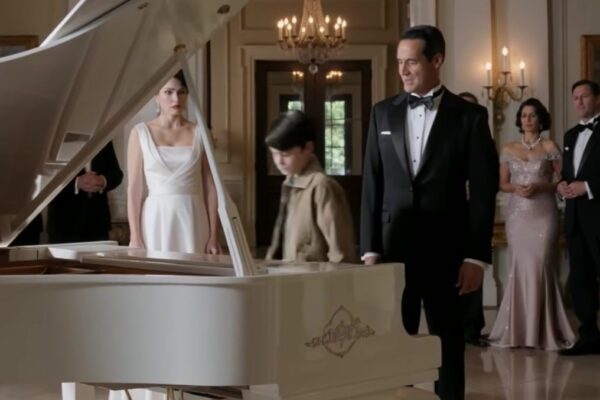
The first time Jonah Hale walked into the Marlowe Conservatory, the air seemed to tighten around him like a dress shirt borrowed from a stranger. The lobby glittered with polished stone and framed portraits of benefactors whose smiles looked practiced. Boys in pressed blazers passed in flocks, their laughter bright and effortless. Jonah’s sneakers, cleaned as best as his foster mom could manage, squeaked once—just once—and it was enough.
At the reception desk, a woman with a silver pen and a softer-than-satin voice looked past him as if searching for the adult who must have brought him. “Deliveries use the side entrance,” she said without lifting her eyes from the tablet in front of her.
“I’m not a delivery,” Jonah replied, steadying his backpack strap with both hands. Inside the bag, he carried a folder with his name printed at the top in thick black ink, the letters slightly smeared from where he’d traced them with his thumb while waiting on the bus.
The woman finally looked up. Her gaze traveled over him the way a librarian might inspect a book with a torn cover. “Are you lost?” she asked.
“I’m here for the admissions meeting,” Jonah said. “They told me to come at four.”
Her mouth tightened into a line that tried to become a smile and failed. “Admissions,” she repeated, as if tasting an unfamiliar word. “Name?”
“Jonah Hale.”
She tapped the tablet, paused, and tapped again with sharper movements. “I don’t see you.”
Behind Jonah, the glass doors opened to admit a family that seemed to bring its own light. A father in a tailored coat, a mother with a scarf that could have been art, and a girl Jonah’s age whose hair fell in a smooth curtain. They did not look at Jonah. They did not have to. The receptionist rose slightly, her posture changing as if a switch had been flipped.
“Harringtons,” she said warmly. “Welcome back.”
Jonah stepped aside so they could pass, and the girl’s eyes flicked over him for a second—curious, not cruel, yet still like a fingertip pressing a bruise.
When the doors closed again, the receptionist’s warmth vanished. “If you’re here for a scholarship audition, those are held on Saturdays,” she said.
Jonah swallowed. “It’s not an audition. It’s a meeting.” He slid the folder onto the counter, careful and precise, like offering something fragile. The receptionist did not touch it.
At that moment, a man in a gray suit appeared from a hallway lined with trophies. His shoes were the kind that clicked with authority. He glanced at Jonah and the unattended folder, then at the receptionist. Something unspoken passed between them—an agreement, perhaps, that Jonah was not the sort of problem worth addressing.
“Can I help you?” the man asked Jonah, but his eyes drifted away mid-sentence, already deciding the answer should be no.
Jonah’s voice came out smaller than he wanted. “Admissions meeting. Four o’clock.”
The man’s lips pressed together. “Parents?”
“Foster,” Jonah said. “She’s at work.”
That word—foster—landed like a dropped utensil in a formal dining room. The man’s gaze sharpened with something that wasn’t anger but almost worse: dismissal.
“We require a guardian present,” he said. “If you don’t have one, we can reschedule.”
Jonah’s cheeks burned. He knew the rules; he’d read them three times. He also knew the email he’d received two days ago, the one that said he could come alone because of his circumstances. He tried to explain, but the man was already turning his attention toward the hallway, toward appointments that felt more real to him than Jonah did.
“Please,” Jonah said quickly. The word sounded too desperate in the marble lobby. “I took the bus across town. They said it was okay.”
Before the man could answer, a second door opened—heavier, older, with a carved crest—and an elderly woman stepped through. She moved slowly, but the room rearranged itself around her presence. The receptionist straightened, hands clasping the silver pen like a ceremonial object. The man in the gray suit softened his face.
“Mrs. Marlowe,” he said, stepping forward. “We weren’t expecting—”
“I’m not fond of being expected,” the woman replied. Her voice was quiet, and it somehow carried farther because of it. She looked at Jonah. Not past him. At him. “Who is this child?”
The man cleared his throat. “A misunderstanding. He’s—”
“Jonah,” Jonah said before anyone could decide his name for him. “Jonah Hale.”
Mrs. Marlowe’s eyes, pale and sharp as winter, narrowed. “Hale,” she repeated. “And why are you being made to hover in my lobby like a stray?”
The receptionist began to speak, but Mrs. Marlowe lifted one gloved hand. The gesture was gentle and absolute. Silence fell.
Jonah’s fingers found the edge of his folder. “I have a meeting,” he said. “Admissions.”
Mrs. Marlowe turned to the man in the gray suit. “You have his file?”
“Apparently there is no—” he began.
Mrs. Marlowe’s gaze slid to the receptionist. “And you,” she said calmly, “have been telling him he doesn’t exist.”
The receptionist flushed. “It’s not that, ma’am. It’s just—”
“Just what?” Mrs. Marlowe asked, her voice still quiet. “Just that he arrived without polish? Without a surname you recognize? Without an entourage?”
The lobby seemed to hold its breath. Jonah stared at the floor, at the dark veins running through the marble like hidden rivers, and tried to make himself small enough to fit into the space they were offering him.
Mrs. Marlowe stepped closer to the counter and picked up Jonah’s folder. Her gloved fingers were careful, respectful. She opened it, scanned the first page, then the next. The lines in her face shifted—not into softness, but into focus.
“You’ve been corresponding with our office,” she said to Jonah. “Who approved this meeting?”
Jonah shook his head. “It was an email. Signed ‘C. Wren.’”
Mrs. Marlowe’s eyes flickered. “Clara,” she murmured, almost to herself. Then she looked at the receptionist. “Pull up his record,” she said.
“I couldn’t find—”
“Try again,” Mrs. Marlowe said, and the words were not loud, but they cut. “Or I will ask someone who knows how to use a keyboard.”
The receptionist’s fingers moved fast, tapping and swiping. The man in the gray suit leaned over her shoulder, his confidence thinning. Jonah watched their faces change as the screen revealed something that was not supposed to be there.
“There,” the receptionist said, her voice suddenly brittle. “Found him.”
The man stared at the tablet. “That can’t be correct,” he whispered.
Mrs. Marlowe held out her hand. The receptionist hesitated, then passed the tablet over. Mrs. Marlowe’s eyes moved once, twice, and then she looked up. For the first time, her composure cracked—not into surprise, exactly, but into recognition that felt heavy.
“Four hundred eighty-seven thousand,” she said softly, reading the figure displayed beside Jonah’s name. “Two hundred sixty-three dollars.”
The number hung in the air like a bell that had been struck. Jonah’s stomach flipped. He had known there was money—he’d been told there was a trust from his mother’s life insurance, managed by the state until he turned eighteen. He had never seen it. Never touched it. It had always been a rumor that belonged to paperwork, not to him.
But the room heard the number and changed its mind about Jonah in the span of a heartbeat.
The man in the gray suit cleared his throat again, this time as if polishing his voice. “Jonah,” he said, warmer than before, “of course. Yes. We do have you scheduled. My apologies for the confusion.”
The receptionist’s smile returned, strained at the corners. “Would you like some water while you wait?” she asked, as if Jonah might now be capable of thirst in a more acceptable way.
Jonah looked from face to face. The Harrington family reappeared from the hallway, pausing when they sensed the tension. The girl glanced at Jonah again, but this time her mother’s eyes narrowed with interest rather than indifference.
Jonah felt something harden behind his ribs. It wasn’t pride. It wasn’t relief. It was a cold, clear understanding.
Mrs. Marlowe set the tablet down gently. “Money does not make a child belong,” she said, her quiet voice pinning everyone in place. “It only reveals how eager you are to pretend he always did.”
The man’s face tightened. “Mrs. Marlowe, we would never—”
“You already have,” she interrupted. Then she turned to Jonah. “Tell me,” she said, “did you come here because you want what we offer? Or because you want to prove something to people who don’t deserve the effort?”
Jonah’s throat tightened. He thought of his foster mom, Deirdre, standing at the kitchen sink with cracked hands, telling him he was allowed to want things. He thought of his mother’s voice in a memory that felt like a photograph left too long in the sun. He thought of the bus ride, the folder on his lap, the hope he’d tried to protect by keeping it quiet.
“I came because I want to learn,” Jonah said. His voice steadied as he spoke. “I want to play in your orchestra one day. Not because of… that.” He nodded toward the tablet without looking at it. “Because I can do it.”
Mrs. Marlowe’s gaze held his for a long moment. Then she nodded once, as if sealing an agreement. “Good,” she said. “Then you will meet with admissions as planned. And I will be in the room.”
The man in the gray suit opened his mouth, then closed it. The receptionist swallowed. The Harringtons watched, suddenly unsure whether they were witnessing charity or judgment.
Jonah picked up his folder when Mrs. Marlowe handed it back. His hands were no longer shaking. The money on the screen had not given him power so much as it had exposed what everyone else had been measuring him against.
As he followed Mrs. Marlowe down the trophy-lined hall, Jonah heard the lobby’s murmur resume behind him—whispers, assumptions, recalculations. He knew the number would travel faster than his name.
But in the heavy quiet of the corridor, Mrs. Marlowe walked beside him, not ahead, not behind. And Jonah decided that if he ever belonged anywhere, it would be on terms that could not be bought, and could not be taken away by the tilt of a stranger’s smile.
At the end of the hall, the door to the admissions office stood open. Light spilled out, warm and ordinary, as if the world could be fair without anyone announcing it.
Mrs. Marlowe paused with her hand on the frame. “Jonah,” she said, “that account may open doors. But what you do after they open will be the only thing that matters.”
Jonah nodded, stepped forward, and crossed the threshold—not as a number, not as a mistake, but as himself.