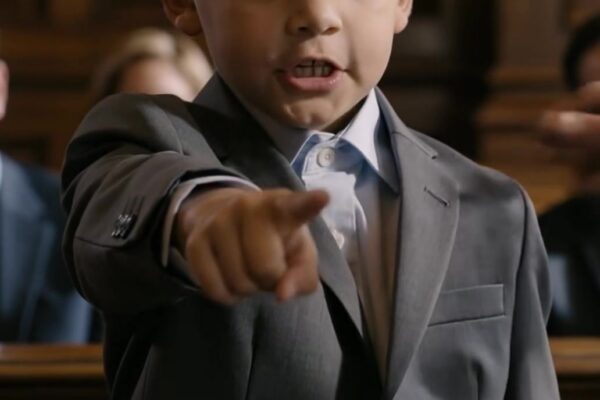
They noticed his shoes before they noticed his face.
The soles were thinning, the rubber at the toe peeled back like a tired eyelid, and the laces had been knotted so many times they looked like gray tendons. He stood in the fluorescent hallway of Westbridge High with a folder pressed to his chest and rainwater darkening the cuffs of his jeans. Students streamed around him as if he were an inconvenient chair—something to step past, not someone to see.
“New kid,” someone said, like it explained everything. “From the south side.” Another voice followed with a soft laugh. “From somewhere.”
He didn’t flinch. If he heard them, he gave no sign. His name was Eli Reyes, and he moved with the careful economy of someone who had learned to take up as little space as possible. Only when the guidance counselor, Ms. Hardin, shepherded him into Room 214 did the room pause long enough to let him exist.
Mr. Pell, the economics teacher, was mid-sentence about compound interest when the door opened. His chalk hand froze. Thirty heads turned. Eli stood in the doorway, shoulders wet from the downpour, and the class did what teenagers do best: they took inventory. Shoes. Jacket too thin for October. Hair trimmed at home. Backpack that had seen better years.
“Class, this is Eli,” Mr. Pell said. “He’ll be joining us. Please be…,” he searched for a word that could hold both kindness and authority, “decent.”
A few halfhearted nods. A couple of smirks. Eli’s eyes passed across the room without settling. He chose a seat in the back, near the window where the storm made the glass shiver.
For the next two weeks, Eli became a rumor shaped like a person. He ate alone. He said “yes, ma’am” and “no, sir” with unsettling politeness. He never joined the laughter when someone’s phone played a stupid video. In group work, he listened more than he spoke, and when he did speak it was so precise people didn’t know whether to be impressed or irritated.
Then came the day Mr. Pell announced the semester project: a mock investment pitch. Teams would research a company, present a proposal, and defend their numbers against questions from a panel of volunteer parents and local business owners. The best pitch would earn a scholarship fund donated by the Westbridge Alumni Association.
“This isn’t about who can talk the loudest,” Mr. Pell said, tapping the board. “It’s about who can prove their assumptions.”
Teams formed quickly, friends clustering into familiar shapes. Eli stood at his desk with the same folder, waiting as if patience could make a space appear. No one beckoned. Even the kids who liked to perform kindness for teachers avoided him; he didn’t offer social credit. He offered discomfort.
Mr. Pell watched the room with a tightening jaw. Finally, he said, “Eli, you can work with Nora’s group.”
Nora Whitaker looked up as if woken. She was the kind of student everyone assumed would succeed—clean handwriting, steady eye contact, a father who sat on the school board. Beside her were Cam and Lila, both polished, both already irritated at the idea of an extra variable.
“We’re doing Phoenix BioTech,” Cam said, not bothering to hide his sigh. “We already started.”
“I can catch up,” Eli replied.
Nora’s gaze lingered on his shoes, then flicked away like she’d touched something hot. “Sure,” she said, because she was trained to be agreeable. “Just… don’t slow us down.”
They met after school in the library. Cam did most of the talking. Lila scrolled through articles and read headlines aloud. Nora typed into a slide deck with professional detachment. Eli sat quietly, reading the company’s filings on an old phone with a cracked screen. The silence around him was different from his usual—tighter, edged with evaluation.
“Phoenix is a no-brainer,” Cam declared. “New cancer treatment. Huge market. We just show projections and we’re done.”
Eli’s finger stopped scrolling. “Their debt is structured wrong,” he said softly. “And their trial data isn’t as clean as the headlines.”
Cam blinked, offended. “What are you talking about?”
Eli angled the phone, showing a paragraph highlighted on a PDF. “Their Phase II results include a subgroup they didn’t disclose in the press release. It’s in the appendix. Their cash burn doesn’t match their runway claims unless they raise at a worse valuation.”
Lila leaned in despite herself. Nora’s hands paused above the keyboard.
“How do you even know to look for that?” Nora asked.
Eli shrugged, too small a movement to be a shrug. “You read what they don’t want you to read.”
Cam scoffed, but the scoff was thinner now. “Okay, genius. What do you suggest?”
Eli didn’t answer immediately. His eyes went to the window where dusk pressed against the glass. “If you want to win,” he said at last, “don’t pitch Phoenix. Pitch the company that supplies their manufacturing. The one that makes the polymer. It’s boring. That’s why it’s safe.”
“Boring doesn’t win,” Cam said.
“Numbers win,” Eli replied.
Against Cam’s protests, Nora asked Eli to show them. He pulled out his folder—creases, water stains, a careful sort of mess—and spread papers across the table. Not schoolwork. Spreadsheets printed in small fonts. Charts drawn by hand. Notes in tight, slanted writing.
Nora frowned. “Is this… your own analysis?”
Eli nodded.
“Why do you have all this?” Lila asked, suddenly cautious, as if the papers might accuse her of something.
Eli’s mouth tightened. “Because I needed it.”
They worked until the librarian turned off half the lights. Eli explained how supply chains held power like a hidden spine. He traced risk like a map. He showed them the small company—Harridan Materials—that no one talked about, with contracts stitched into future revenue like invisible thread.
Cam’s resistance slowly became silence. Nora’s typing turned frantic, as if she were trying to catch up with a moving train.
On presentation day, the panel sat at the front in suits and careful smiles. Parents in the audience held phones poised for photos. Mr. Pell wore a tie that looked too tight. Eli sat behind his team, hands folded, expression flat.
Cam began with confidence, but it was Nora’s calm that carried them. Their slides were clean, their projections argued with receipts. When the panel asked about risk, Nora nodded toward Eli without thinking. “Eli can explain the sensitivity analysis.”
Heads turned again. The worn-out shoes under the desk, the quiet kid in the back, suddenly offered a microphone. Eli stood, and for the first time his posture changed—less apologetic, more inevitable.
He spoke without flourish, but every sentence landed like a gavel. He answered questions before they were finished. He described failure scenarios with a surgeon’s precision and then showed why their thesis survived them. The panelists leaned forward. Someone in the front row stopped recording and simply watched.
When it ended, the room did not erupt immediately. There was a beat—one long inhale where everyone recalibrated what they thought they knew about a boy in cheap shoes.
After the applause finally came, Mr. Pell escorted the team to the side office where the scholarship paperwork waited. “The alumni fund requires a financial verification,” he explained, voice lowered as if the walls could gossip. “It’s routine.”
Nora and Cam exchanged glances. Eli said nothing, just handed over his transfer packet and the bank information Ms. Hardin had requested earlier. Mr. Pell logged into the portal on his computer, squinting at the screen. The hum of the fluorescent light seemed louder in the small office.
He typed. Clicked. Waited.
The account loaded.
Mr. Pell’s shoulders stiffened. Nora’s lips parted. Cam made a small sound he didn’t seem to recognize as his own. On the screen, in stark black digits, sat a balance that did not belong to any story they’d assigned to Eli Reyes.
$487,263.
No one spoke. Not because it was impolite. Because the number was a door slamming, and they were standing on the wrong side of it.
“That can’t be right,” Cam whispered, as if accusing the monitor of lying.
Eli’s eyes stayed on the floor. “It’s right,” he said. His voice was steady, but something in it had the weight of a long-held breath. “It’s not… it’s not what you think.”
Mr. Pell cleared his throat. “Eli, I don’t—”
“My mom got sick when I was eleven,” Eli continued, words now spilling as if the silence had finally cut him. “We lost our apartment. My dad left. I started delivering groceries, then fixing phones, then doing odd jobs. One of my customers was an old man who traded stocks from his kitchen. He said I asked better questions than the analysts on TV.” Eli’s fingers curled at his sides. “He taught me. Not because he was generous. Because he was lonely.”
Nora’s expression softened, and then tightened again with shame. “So… you made that?”
“Not all of it,” Eli said. “Some of it was his. He died last year. He left me the account.” The words fell like stones. “His family fought it. Said I manipulated him. Said I was—” He stopped, swallowing hard. “The will held. But the lawyer told me I should move somewhere quieter. Somewhere no one knows.”
Mr. Pell stared at the balance as if it might burst into flames. “Eli,” he said carefully, “why are you applying for the scholarship?”
Eli finally looked up. His eyes were not triumphant. They were exhausted. “Because money isn’t the same as safety,” he said. “And because I don’t want to spend my life proving I deserve to exist.”
In the hallway afterward, the news moved faster than rainwater. People glanced at Eli differently, as if wealth had polished him. Some smiled too widely. Others stepped aside. The same students who had watched him like a misplaced object now watched him like a prize.
He walked past them all, shoes still worn, laces still knotted. Nora followed, catching up near the lockers. “Eli,” she said, breathless, “I’m sorry. For… everything.”
Eli paused. The corridor buzzed with whispers, and his name slid through them like a razor. He looked at Nora for a long moment.
“Don’t be sorry you didn’t know,” he said. “Be sorry you needed a number to care.”
Then he turned and kept walking, each step quiet, each step deliberate, as if he were crossing a bridge no one else could see—out of the story they’d written for him, and into the one he’d built in secret, line by line, while the world kept staring at his shoes.