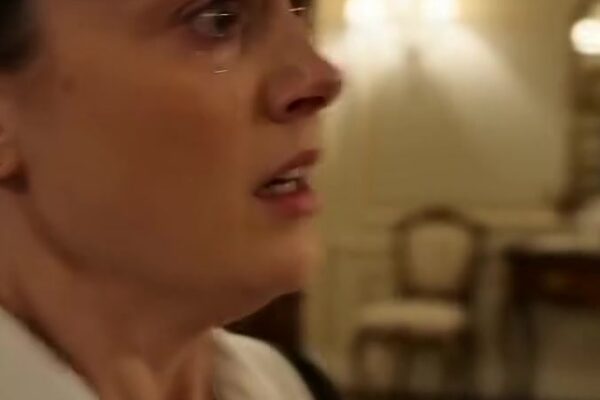
The courthouse steps were the kind of stone that held cold even in spring. Jonah Mercer stood on them with his hands tucked into the pockets of a thrifted coat, shoulders slightly rounded as if bracing for weather that wasn’t there. People moved around him in a steady current—attorneys in crisp shoes, clerks carrying cardboard boxes, reporters hunting for anything that looked like a headline. Jonah looked like none of them. He looked like a man who had wandered in by mistake.
Inside, Courtroom B smelled faintly of lemon cleaner and old paper. The benches were nearly full because the case had been teased for weeks: Marlowe Properties v. Tenants of Blackwell Row. A clean, confident suit of a corporation against a block of families who did not, in the eyes of the city, look like an investment worth saving.
Jonah was seated in the second row, alone. No legal team huddled around him. No friends. Just a battered messenger bag at his feet and the calm, contained stillness of someone who had learned the value of waiting. When his name had appeared on the tenant petition, many assumed he was another signature, another desperate hope. Even the other tenants had muttered, polite but dismissive, when he offered to help “gather records.”
At the front, Victor Marlowe’s attorney, Lyla Finch, arranged her binders like a display in a boutique—heavy, immaculate, confident. Victor himself sat behind her, silver hair swept back, a smile fixed in place as if he had practiced it in a mirror. Across the aisle, a city-appointed defender shuffled a thin file and avoided meeting anyone’s eyes.
When the judge entered, the room rose. Jonah stood with everyone else, and the bailiff’s call echoed off the wood paneling. The judge, Hon. Miriam Caldwell, had a reputation for impatience with theatrics. She sat down, adjusted her glasses, and began.
“Ms. Finch,” she said, “you may proceed.”
Lyla Finch’s voice was steady and bright, like polished metal. “Your Honor, Marlowe Properties lawfully purchased the Blackwell Row parcel. The tenants were given notice of termination consistent with municipal code. My client intends to renovate and bring the property into compliance. The opposing side has no legal right to remain.”
She spoke of codes, permits, schedules. She presented photographs: peeling paint, sagging porch rails, a stairwell light hanging like a broken tooth. Every image was a careful accusation. The city defender rose, offered a few tired objections, and was brushed aside.
Jonah watched without blinking. The faces around him tightened. A woman in the back hugged her purse to her chest as if she could protect her home with her grip. A man with paint-stained hands stared at the floor.
“Any response?” Judge Caldwell asked, looking at the defender.
The defender stood, cleared his throat, and made a brief argument about hardship, about time, about finding other housing. It landed in the room like a feather. Victor Marlowe’s smile widened, just a fraction.
Judge Caldwell sighed. “I understand the human element,” she said, “but hardship alone doesn’t create a legal right. Unless there is evidence of fraud, breach, or unlawful conduct—”
“Your Honor,” Jonah said.
The interruption cracked through the room. Heads turned. The bailiff stiffened. The defender glanced at Jonah with panic, as if he feared the wrong kind of desperation.
Judge Caldwell’s gaze narrowed. “Sir, are you represented?”
“No, ma’am,” Jonah said. His voice wasn’t loud, but it didn’t shake. “I’m one of the tenants. And I have evidence.”
Lyla Finch’s mouth twitched as if she had tasted something sour. “Your Honor, this is highly irregular.”
Judge Caldwell held up a hand. “Mr…?”
“Mercer. Jonah Mercer.” He stepped forward into the aisle. Under the fluorescent lights, he looked thinner, almost washed out. The kind of man a person might forget moments after passing him on the street.
“You understand you can’t just—” Lyla began.
“I understand,” Jonah said, turning slightly, not to confront her but to acknowledge the room. “I’m not here to make speeches.” He reached into his messenger bag and pulled out an envelope.
It was plain—manila, thick, edges worn from being handled. It didn’t look dramatic. It didn’t look like salvation. Jonah held it as if it were something that could cut.
“What is that?” the judge asked.
Jonah walked to the clerk’s desk and placed the envelope down carefully. “Documents,” he said. “Originals. Obtained legally. I’d like them entered into the record.”
Lyla Finch stood. “On what basis? This court cannot accept—”
“Ms. Finch,” Judge Caldwell warned. She looked at Jonah. “Where did you get these?”
Jonah took a breath. “I used to work in the city archives,” he said. “Records, microfilm, deed transfers. When Marlowe Properties filed for accelerated eviction, I checked the parcel history. Something didn’t match.”
Victor Marlowe shifted, a small movement, but it carried a ripple of unease. Jonah saw it and felt a strange, cold clarity settle into him. Doubt had been a constant companion in the past months—doubt in the system, in the future, in himself. But doubt was not what he carried into the courtroom today.
The clerk opened the envelope. The sound of paper sliding out was loud in the hush. Judge Caldwell leaned forward as the clerk brought the first sheet to her. Her eyes moved across the page, then to the next. Her expression didn’t change quickly. It changed the way a sky changes before a storm—quietly, then all at once.
“This is a deed restriction,” the judge said, and her voice had hardened. “A covenant attached in 1968. ‘Blackwell Row shall remain residential housing for low-income families for a period of ninety-nine years…’” She looked up over her glasses. “This restriction appears to be absent from the filing provided by the plaintiff.”
In the second row, a tenant inhaled sharply, as if a room they didn’t know they were holding their breath in had suddenly been given air.
Lyla Finch stepped forward. “Your Honor, that can’t be correct. These covenants are often—”
“Often inconvenient,” Jonah said, and then stopped himself. He didn’t want to perform. He wanted to end this. “There’s more.”
The clerk handed over another page. Judge Caldwell’s jaw tightened as she read. “This is correspondence,” she said slowly, “between Marlowe Properties and the city’s compliance office.” Her gaze lifted, pinning Victor Marlowe in place. “Mr. Marlowe requested an expedited review and was advised the covenant existed. Yet your complaint states the property is ‘unencumbered.’”
Victor Marlowe stood up so abruptly his chair scraped. “Your Honor—”
“Sit down,” Judge Caldwell snapped, and he did, the confident smile gone now, replaced by something brittle. The room had shifted; people felt it in their bones. This wasn’t a struggle between power and pleading anymore. This was the moment when a lie discovered itself under bright light.
Lyla Finch’s voice sharpened. “These documents could be fabricated.”
Jonah reached into his bag again and produced a smaller envelope, sealed with red wax. He held it up. “Certified copies from the county recorder,” he said. “Ordered two weeks ago. They arrived yesterday.”
Judge Caldwell signaled for the clerk to take it. When the seal broke, it felt like hearing a lock give way. The judge studied the certification, the embossed stamp catching the light. She set the pages down and looked at Lyla Finch with a stare that could strip paint.
“Ms. Finch,” she said, “your client has submitted filings that omit material encumbrances and misrepresent compliance status. This court does not tolerate that.”
The tenants behind Jonah began to murmur, a sound of disbelief trying to turn into hope and not quite knowing how. Jonah remained standing, hands relaxed at his sides, as if any sudden movement might shatter what he’d placed in motion.
Victor Marlowe’s face had gone pale, and for the first time he looked his age. “We can explain—”
“You can explain to the state bar and, if necessary, the district attorney,” Judge Caldwell said. She turned her attention back to the bench. “I am issuing an immediate stay on all eviction proceedings related to Blackwell Row. Further, I am ordering discovery into the plaintiff’s representations and communications with the city. This matter is continued.”
The gavel came down once. One sound. Final as a door shutting on a corridor of easy victories.
As the courtroom erupted into movement—people rising, talking, crying softly—Jonah felt a hand touch his shoulder. It was the woman from the back, eyes wet, lips trembling with a gratitude too large to fit in her body. “How did you…” she began, but her voice broke.
Jonah didn’t answer right away. He watched Victor Marlowe being shepherded out by his attorney, watched the silver hair, the stiff spine, the way power looked when it was forced to retreat. He thought of all the nights he had sat at his kitchen table with stacks of photocopies and a failing lamp, chasing a thread through decades of paper. He thought of how often he had been told, kindly, that he was wasting his time.
“I read,” Jonah said finally, softly, as if the word were both weapon and prayer. “And I didn’t stop.”
Outside, the cold stone steps no longer felt like they belonged to someone else. Jonah stepped down into the daylight with the messenger bag strap across his chest, and behind him the tenants spilled out in small groups, voices rising—still cautious, still bruised, but alive with the first taste of something that had seemed impossible that morning.
He had stood there underestimated. And then, with a plain envelope and the weight of truth inside it, he had turned doubt into disbelief.