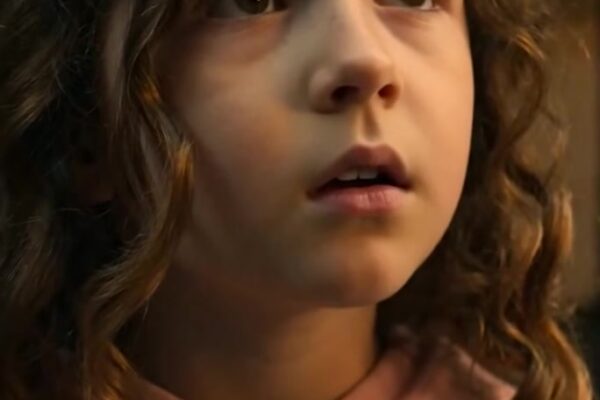
The first thing Rowan noticed was the whispering. It wasn’t loud enough to qualify as conversation, not enough to earn the dignity of being called gossip. It was the sound people made when they wanted their words to land but not their names. Soft, feathered syllables that slid under the pews and pooled at his shoes.
He sat in the third row of St. Brigid’s, hands folded the way his mother had taught him—thumbs crossed, as if he were holding himself together. He kept his eyes on the altar cloth, on the thin gold thread stitched into the edge. The church smelled of wax and damp stone and the last of the winter coats. Outside, the town’s river ran dark and swollen with snowmelt, pressing against its banks like something impatient.
Rowan was eleven. His blazer didn’t quite match the other boys’, and his tie was knotted too tightly. A bruise—purple turning yellow—peeked from the collar line on his neck, hidden badly. The woman behind him leaned toward her friend and breathed, “That’s him.” Another voice added, “Poor child.” A third—sharper, brittle—muttered, “Or poor everyone else, if what they say is true.”
They were gathered for a memorial service, though no one seemed to agree on what they were memorializing. Officially, it was for Mr. Hale, the school’s music teacher, who had been found in his car at the quarry road after dawn, the engine still warm. Unofficially, it was for the town’s peace of mind—something to fold and tuck away so they could walk into Monday pretending the ground was solid again.
Rowan had come alone. There were no parents flanking him, no aunt patting his shoulder. His mother worked the morning shift at the care home and his father—well, his father had stopped showing up in the ways that counted long before he stopped showing up at all. The empty spaces beside Rowan seemed to amplify him. People looked as if they expected him to move on his own, like a chess piece pushed forward by an unseen hand.
The organist tested a chord. It came out like a throat clearing itself. Rowan’s fingers tightened, then relaxed. He concentrated on the small noises: the creak of a pew as someone shifted; the whisper of a tissue being pulled from a box; the faint click of a lighter extinguishing as a candle caught. He wondered, as he often did, what it would feel like to be ordinary in a room.
He knew what they were saying. He had heard it in the corridor outside the principal’s office, in the hush that followed him through the cafeteria line, in the way adults suddenly found reasons to speak more quietly when he passed. He had been the one to tell. The one to write the letter and slip it under the counselor’s door. The one whose account had made the police show up with questions and careful voices. And in a town where silence was treated like virtue, telling the truth sounded too much like betrayal.
The priest began the service with words meant to settle everyone into their roles—grieving, forgiving, moving forward. He spoke about Mr. Hale’s love of music, about his talent for making reluctant children sing. “We are here,” the priest said, “to remember what was good, and to place what was painful into God’s hands.” At the word painful, several heads turned toward Rowan as if pulled by the same string.
Rowan stared straight ahead. The altar candles wavered, their flames bending in an unseen draft. His throat felt too small for air. He remembered Mr. Hale’s classroom, the smell of brass polish and old sheet music. He remembered the way Mr. Hale’s hand had lingered on his shoulder too long when no one was looking. He remembered the way his own voice had vanished in his chest, as if swallowed. And then he remembered the moment he had found it again—small, trembling, but his.
During the hymn, the whispers grew braver. “He ruined a good man,” someone hissed, close enough that Rowan felt the breath of the words. Another voice, older and tired, replied, “Or he saved the next boy.” The first voice scoffed. A few seats away, a woman dabbed at dry eyes as if grief were expected of her, required like an offering. Rowan couldn’t tell who believed him and who didn’t. He could only tell that many people were angry, and they needed somewhere to put it.
The priest invited anyone who wished to share a memory. A man stood and spoke about Mr. Hale staying late to coach the choir before the winter concert. A former student described the teacher’s laughter, how it filled the auditorium. Each tribute landed like a stone dropped into a well. Rowan felt them fall past him, into a darkness where their echoes went on and on.
Then the atmosphere changed—not with a shout or a slammed door, but with the peculiar hush that precedes something irrevocable. A woman rose from the back pew. She was small, but the way she stood made her seem larger than the church itself. Her hair was pinned with care, and her hands didn’t tremble on the pew in front of her. Rowan had seen her once at a school meeting, sitting alone, watching as if she were memorizing faces.
“My name is Lidia Trent,” she said, and her voice carried without effort. The priest blinked, surprised, as if he hadn’t expected the congregation to contain people with names and histories. “I taught at Hawthorne Primary twenty years ago. I left this town because I couldn’t breathe in it anymore.” A murmur stirred like wind in leaves. Lidia’s gaze didn’t flicker. “I’m here because I heard what happened. I’m here because I heard a child told the truth, and the town responded by turning its teeth on him.”
Someone made a sound of protest, half cough, half warning. Lidia ignored it. “You all loved Mr. Hale,” she continued, “because he made your daughters sing and your sons stand straighter. You loved him because he was polite, because he held doors open and spoke softly. You loved him because he looked like a man you could trust.” She paused, and the pause was a blade. “I also knew a man like that when I was a girl. I also heard people say, ‘He would never.’ And I also watched a child carry the weight of adults refusing to see.”
Rowan’s heart hammered so hard he thought it might shake loose from his ribs. He kept his eyes forward, but he felt the room pivot around Lidia’s words. People shifted. A few faces hardened, but others—some he hadn’t expected—went pale with recognition. The whispers died one by one, as if extinguished by a single breath.
Lidia stepped into the aisle, closer now. “I believe the boy,” she said, and finally she looked directly at Rowan. Not past him. Not through him. At him. “And I want to tell you something you may not realize.” Her voice softened, not with pity, but with certainty. “When a child speaks the truth in a room full of adults, and the adults punish the child for it, that is not community. That is a conspiracy.”
Silence spread outward, thick and heavy. Rowan’s hands had gone numb. He realized he was holding his breath and let it go, slowly, like easing a bruise. Across the aisle, Mrs. Evers—the librarian who always smelled of paper and peppermint—raised a trembling hand to her mouth. Tears spilled freely now, not the tidy ones people used as decoration. An older man in the front row bowed his head, shoulders shaking as if something inside him had finally broken open.
The priest cleared his throat, but the sound seemed embarrassingly small. “This is… not appropriate,” he began. Lidia turned toward him with a look that stopped the sentence mid-air. “It is the most appropriate thing that will happen in this building today,” she said. “If you want to place pain into God’s hands, you must first stop placing it on the child.”
Rowan felt the room’s attention settle on him like sunlight after a long winter. It was not gentle. It was not comfortable. But it was real. He could feel something in the air shift—an old agreement, unspoken yet binding, beginning to loosen. The whispers that had used him as their secret now had nowhere to hide.
Lidia walked down the aisle and stopped beside Rowan’s pew. She didn’t touch him without asking. She simply stood near, a human barrier against the coldness that had crept close. “You did what you were supposed to do,” she said quietly, for him alone. “You told the truth.”
Rowan finally looked up. The gold thread on the altar cloth blurred, then sharpened again as his eyes adjusted through tears he hadn’t known were there. He saw faces turned toward him—some ashamed, some angry, some lost. But he also saw, in a few of them, the beginning of something like understanding. And in that moment, with his lungs full and his spine straight, he realized the story people whispered about him was no longer theirs to tell.
He rose from the pew. The movement was small, but it seemed to tilt the whole room. He didn’t speak. He didn’t need to. His standing was enough: a quiet refusal to be folded into their convenient silence. Beside him, Lidia stood like a cornerstone. And somewhere in the back, a child—another boy, younger than Rowan—stopped fidgeting and watched with wide, startled eyes, as if memorizing what courage looked like when it didn’t shout.
The service continued, awkwardly, changed forever. The hymns sounded different in the new air, less like performance and more like confession. And when it was over, when people filed out into the gray afternoon, the river still ran dark beyond the churchyard—but Rowan walked past the whisperers without lowering his gaze, carrying nothing now but the simple, searing truth that had finally begun to change the atmosphere around him.