The parking garage felt too big for two children. It wasn’t the kind of bigness that came from open sky and distance—this was weight and echo, a concrete mouth that swallowed sound and refused to give it back. The air tasted like old rain and exhaust. Somewhere above them, a sprinkler pipe ticked with a slow, anxious rhythm, and the fluorescent light over their heads buzzed as if it were irritated to be asked to stay awake.
Cal sat on the small wooden box like it was a lifeboat. His gray hoodie hung heavy with damp, cuffs darkened where he’d wiped his face too many times. Beside him, Owen’s denim jacket had stiffened with drying tears and grit. The boys’ knees knocked together; they had long ago stopped pretending they could leave space between them in a place that seemed eager to pry them apart.
Owen’s hands shook in his lap. He tried to press them flat against his thighs, like flattening them would stop the trembling, but it only made his fingers quiver harder. His cheeks were raw from crying and from the sleeve of his jacket scraping at the same spots over and over. His eyes fixed on the dark ramp leading down into the levels below, where the garage deepened into a blackness that felt alive.
“I’m scared,” Owen whispered, barely a sound in that vast hollow.
Cal swallowed so hard it hurt. He had already swallowed his own fear until it sat inside him like a stone. “She’ll come back,” he said, but the words came out thin, as if they’d been chewed too many times before he tried to use them.
Owen tilted his head toward Cal like a plant seeking the only light. “You said that before.”
Cal didn’t answer. He looked down at Owen’s sneakers—one lace undone, the end of it dark with garage grime—and he wanted to kneel and tie it, wanted to do something small and sensible that belonged in a world where moms returned and shoes stayed clean. Instead he lifted a trembling hand and rested it on Owen’s shoulder.
“Don’t cry,” Cal whispered. “I’m here.”
They sat with their foreheads almost touching, breathing the same air, trying to borrow steadiness from each other. The silence pressed in, thick and patient. Then, far off, a low engine hum rose from deep in the structure, like something waking.
Both boys froze. Owen’s breath snagged. Cal’s fingers tightened on Owen’s shoulder hard enough that Owen flinched.
The hum grew louder, swelling and dipping as if the vehicle were climbing or turning. Tires whispered over wet concrete. A faint, cold wind followed the sound, stirring a candy wrapper across the floor until it stopped against Cal’s shoe like a warning.
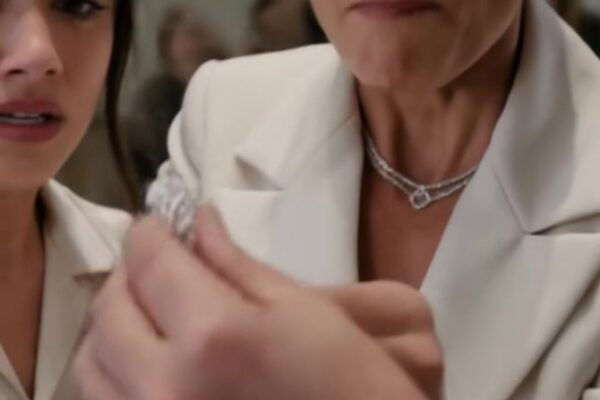
Cal’s heart kicked against his ribs. He reached into the pocket of his hoodie with shaking fingers, searching for the one thing his mother had pressed into his palm before everything fractured. The chain was thin and warm from his skin. When he pulled it free, the tiny gold pendant swung once and caught the fluorescent glare.
Owen’s eyes locked onto it, wide and wet. “That,” he breathed.
Cal closed his fist around it so tightly his knuckles whitened. “Mom said if someone sees this… they’ll know us.” He didn’t add what she had said next—that knowing could be rescue or it could be the opposite. That was a sentence he had decided Owen didn’t get to carry.
The engine sound rounded the corner of the level. Light began to creep along the concrete floor first—a pale beam, then a brighter wash. Headlights flared, harsh and white, and the garage that had been empty for hours suddenly had edges again: pillars, painted arrows, oil stains like bruises.
Owen shrank into Cal as if he could crawl into his hoodie and hide there. “Is it him?” he whispered, and it came out cracked, like his voice was breaking the way ice breaks on a puddle.
Cal didn’t know who “him” was anymore. In the last day, “him” had changed shape in the stories adults told with tight mouths. Him was the man their mother had tried not to name. Him was a shadow at the edge of their apartment hallway. Him was the reason she’d grabbed their hands and run down the stairwell instead of waiting for the elevator. Him was the reason they were in a parking garage at all, sitting on a wooden box under an angry light, because she had said, “Stay here. Don’t move. If anyone comes, Cal, show them this.”
The vehicle rolled into view: a dark sedan, too clean for this place, gliding as if it belonged. It slowed as it approached their light. Cal could see his own small reflection in the windshield—two hunched shapes, a flicker of gold in a clenched fist.
The sedan stopped. The engine idled, low and steady, like a throat clearing.
No one got out right away.
Owen’s nails dug into Cal’s sleeve. Cal felt the sting but welcomed it; pain meant he was still here, still capable of feeling something other than fear. He kept his fist closed around the pendant, but a sliver of gold escaped between his fingers, enough to catch the headlights and throw back a sharp glint.
The driver’s door opened at last. A man stepped out into the light, and the brightness carved him into hard angles: long coat, dark hair, posture too controlled. He shut the door softly, as if sound mattered to him, and stood still for a moment, letting his eyes adjust. His gaze found the boys immediately.
Cal’s mouth went dry. He held his breath, waiting for the man to call a name, to say something that would make sense of the last hours. Instead the man walked forward with measured steps. His shoes made a faint, wet squeak with each step, the only sound besides the idling engine and the fluorescent buzz above Cal and Owen.
When he was close enough, Cal could see the man’s face clearly. Not angry. Not kind. Carefully arranged, like a mask. His eyes dropped to Cal’s fist. “You have something,” the man said, voice quiet but sharp enough to cut through the garage’s emptiness.
Cal couldn’t speak. His throat felt sealed. Owen’s breathing was fast and shallow against Cal’s shoulder.
The man crouched a few feet away—close enough to reach them, far enough to seem like he was choosing restraint. “Show me,” he said.
Cal’s fingers trembled so hard the chain rattled softly. He wanted to hide it, wanted to swallow it, wanted to throw it down a drain. But his mother’s words—if someone sees this—were the only map he had left. He opened his fist.
The pendant lay against his palm, a tiny crest engraved with an unfamiliar pattern: a bird with spread wings over a shield, a circle of thorn-like lines around it. Under the headlights it looked almost alive, as if it might flutter away on its own. The man’s gaze sharpened. Something shifted in his expression—recognition, yes, but also calculation.
“Where did you get that?” he asked, and the gentleness of the question felt false, like a blanket thrown over a trap.
Cal forced air into his lungs. “My mom,” he managed. His voice sounded too small to belong to him. “She said… if someone saw it… they’d know us.”
The man’s eyes flicked to Owen, then back to the pendant. “And where is your mother?”
Cal’s mind flashed with images like broken glass: their mother’s hand pushing them behind a concrete pillar; her phone pressed to her ear; the sudden siren far away; her whispering, “Don’t move. No matter what.” Then footsteps, and her face turning, tight with decision. “I’ll be right back.”
“She went to get help,” Cal lied, because the truth—that she had gone toward danger—was too heavy to set down between them. “She’ll come back.”
The man didn’t smile. He reached into his coat slowly, deliberately, and for one wild second Cal thought he was pulling out a weapon. Instead he withdrew a leather wallet and opened it. Inside, tucked behind cards, was a photograph. He held it out at arm’s length so the boys could see.
In the photo, their mother stood between two men in suits, her smile bright but her eyes cautious. One of the men, younger, held the same crest pinned to his lapel. The other man—older, stern—rested a hand on their mother’s shoulder like it was a claim.
“That crest belongs to my family,” the man said. “And if your mother gave it to you, she didn’t do it because she trusted me. She did it because she needed you found.”
Owen made a small sound, not a word, more like a wounded animal. Cal tightened his grip around the pendant again. “Are you… are you going to take us to her?” he asked, each word scraping its way out.
The man’s eyes held Cal’s. In them, Cal saw something that made his stomach turn—not cruelty exactly, but inevitability. “I’m going to take you somewhere safe,” the man said. “And then we will talk about your mother.”
Safe. Cal had learned in the last day that safe was a word adults used when they couldn’t promise anything else.
The fluorescent light above them flickered once, twice, and for a heartbeat the garage dimmed, the man’s face blurring into shadow. In that brief darkness, Cal felt Owen’s hand slide into his. Owen’s fingers were icy and desperate, and Cal clasped them back with everything he had.
When the light steadied again, Cal made a decision he didn’t know he was capable of: he lifted the pendant and let it hang from his fingers where the headlights could see it, not as surrender but as proof.
“If you know what this is,” Cal said, surprising himself with the steadiness in his tone, “then you know our names. Say them.”
The man’s gaze narrowed. The engine idled. The garage waited, vast and listening.
After a long beat, the man spoke, and the sound of their names in his mouth felt like a door opening—or a lock turning. Cal couldn’t tell which. But he squeezed Owen’s hand and held the pendant up like a small, defiant star, because in a place this big, two children needed something to be brighter than the dark.