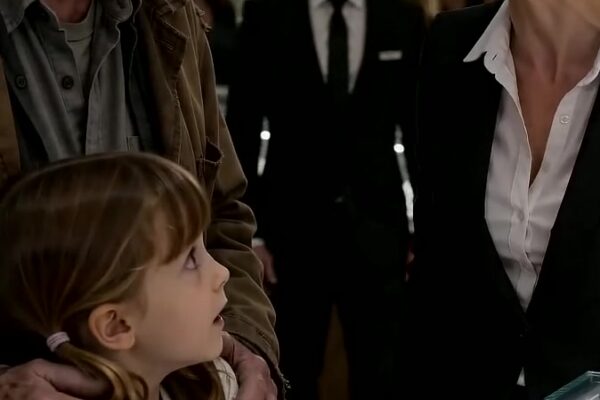
The restaurant was a shrine to excess: chandeliers that fractured light into cold diamonds, table legs lacquered like wet ink, cutlery so polished it held faces like tiny mirrors. A quartet breathed velvet into the air, and the city beyond the tall windows looked like it had been scrubbed clean for the evening. Waiters moved as if they were part of the décor—silent, precise, almost unreal.
At the far end, behind a screen of carved brass, a single table sat slightly raised, as if the room itself made room for it. That was where Alistair Vane dined when he was in town, and he was in town tonight: white hair swept back, a cane leaned against his chair though he seldom used it, and a presence that asked for nothing and received everything anyway. The bread basket beside his plate was untouched. The butter softened into a perfect, unused curl.
It was beside that private table that the child appeared, as if the street had cracked open and let her through. She wore an oversized brown jacket with frayed cuffs that swallowed her wrists. Her hair was a dark snarl as though she had slept in wind. Dirt smudged her cheeks in uneven bands, and her eyes—too large for her narrow face—did not wander to the chandeliers or the silver, but locked onto the bread as if it were a door she could walk through.
Her voice, when it came, was small enough to fit between notes of the violin. “Can I sit here?”
Alistair’s hand paused over his glass. He had been thinking about nothing in particular, which was how he liked it—how he survived it. Before he could answer, a security officer slid in from the edge of the brass screen, a tall man in a black suit with an earpiece coiled like a secret. His grip closed around the girl’s shoulder with the practiced certainty of someone who removed problems before they became scenes.
“You can’t be here,” the guard said, not unkindly but with the implacable tone of policy. “Come on. Out.”
The girl flinched so sharply it seemed to tighten every thread in her jacket. Yet she didn’t bolt. She did not plead with the room. She looked only at Alistair, lips trembling as if they had forgotten how to shape brave words.
“I’m just hungry,” she whispered.
The music thinned. The soft clink of forks paused. Heads turned with the slow fascination of people who paid to be insulated from need and were now forced to witness it. The guard began to pull her back, and the chair legs made a small scraping protest.
Alistair lifted one hand. The gesture was not dramatic. It was simply inevitable.
“Wait.”
The guard froze as though an unseen cord had been pulled. The air around the private table stiffened, expectant. Alistair looked at the child properly—at the grime tucked under her fingernails, at the bruised shadow beneath her eyes, at how she was trying to keep her chin from wobbling. His expression did not soften into charity. It changed into recognition, the kind that hurt in places no one could see.
“Sit,” he said, and the word carried the weight of permission in a world built on doors. “Eat. Stay.”
The girl stared at him as if kindness were a trap more dangerous than any hand on her shoulder. Then, inch by careful inch, she slipped into the empty chair beside him. The upholstery swallowed her thinness. Alistair broke a piece of bread—warm, pale, tearing with a sigh—and placed it on the plate in front of her. The smell alone made her eyelids flutter, but she did not reach for it.
Instead, she dug both hands into the depths of her jacket as if she were pulling something up from a well. When she brought them out, she held a folded napkin, creased tight and handled so often the fabric had gone soft at the corners. She extended it toward him with solemn care, like an offering that required steadiness.
“My mom said to give this to the man with white hair,” she said.
Alistair frowned. In his life, things were delivered to him daily—contracts, gifts, threats disguised as invitations—but nothing arrived like this, carried by a child who looked as if the world had been chewing on her. He took the napkin with fingers that had signed away whole neighborhoods without trembling. The moment he unfolded it, his hand betrayed him.
A ring lay in the fabric’s hollow: old gold worn to a matte shine, a small stone set into it that caught the chandelier light with a muted green flicker. The ring was not expensive. It was worse than that—it was familiar. It was a shape that lived in the deep, sealed part of his memory, behind the words he had learned to say to keep guilt quiet.
Color drained from his face in a slow wave. For a heartbeat he could not breathe without tasting the past.
He saw a cramped apartment with steam on the windows, a woman’s hands—ink-stained from work she did at night—turning that ring as she spoke. He heard her voice, not pleading, but tired in a way that no amount of love could fix. He remembered the day he had left, telling himself it was temporary, telling himself he would come back when the chaos settled, telling himself lies with the smooth confidence of a man who had never been punished for them.
His eyes lifted to the child’s face and searched for anything that might disprove what his body already knew.
“Where is your mother?” he asked, and the question came out smaller than his wealth, smaller than his name.
The girl swallowed. She did not glance at the bread. She did not look around at the watching tables. Her gaze stayed on him, steady with the strange bravery of someone who has learned there are no extra chances to waste.
“She’s not coming,” the girl said. “She said she couldn’t bring you to us, so she sent me to bring you to the truth.”
Alistair’s throat tightened. “What truth?”
Her fingers worried the torn edge of her jacket. “She said you left us here,” she answered. “And I didn’t understand, because I never met you. But I understand now that leaving can last a very long time.”
A murmur rippled through the room, quickly smothered by the sudden presence of the guard shifting uneasily, not sure if he should be listening to a confession. Alistair stared down at the ring as if it had turned into a key and he did not know what door it opened.
“What’s your name?” he managed.
“Mara,” she said. “Mom called me that when she was happy, and when she wasn’t, she just called me ‘love’ like a habit.”
Alistair pressed the ring into his palm until its edges bit his skin. “Mara,” he repeated, and something in him broke with the sound. He pictured the woman again—Elena—her laugh from years ago, before exhaustion sanded it down. He had paid people to locate her once, long after he’d built walls of money around himself, but the reports came back vague: moved, unreachable, vanished into the city’s folds like countless others.
“Is she…?” The rest of the question refused to take shape, as if his mouth could protect her by not speaking it.
Mara’s eyes shone, but she did not cry. “She got sick,” she said simply. “The kind of sick where you can’t work and you can’t pay and everyone starts talking like you’re already gone. She kept that ring in a box. She said it was proof you existed. She said it was also proof you didn’t.”
Alistair’s vision blurred. The chandeliers above him turned into halos he didn’t deserve. “Why did she send you here?” he asked, though he already knew: because pride had held Elena upright until it couldn’t anymore, and desperation always found a crack.
Mara glanced at the bread finally, then back to him. “She said you would understand the ring,” she whispered. “She said if you were still you, you’d help. And if you weren’t… then at least I’d know.”
Alistair looked at the child—his child, the word arrived like a verdict—and realized the room had been built to worship comfort, yet nothing had ever felt so sharp. He set his glass down with a carefulness that felt like penance. His voice, when it came, carried to the nearest tables and beyond the brass screen, steady only because he forced it to be.
“No one is touching her,” he said to the guard, to the staff, to the whole glittering, listening world. “Not now. Not ever.”
Then he turned back to Mara and slid the bread closer, gentler than a man like him had any right to be. “Eat,” he said. “And then you’re going to take me to your mother. If she’s still breathing, I will be there. If she isn’t…” He swallowed the iron taste of regret. “Then I will still be there. I don’t get to leave again.”
Mara stared at him for a long moment, measuring his promise against a lifetime of hunger. Finally, she picked up the bread. Her hands shook as she brought it to her mouth, and the first bite looked like relief and grief braided together.
Alistair watched her chew as if each movement tethered him to a reality he had avoided. In the hush of crystal and gold, with strangers witnessing the unmasking of a powerful man, he held the ring in his palm and felt the weight of the years he had misplaced. Somewhere inside him, a door he had bolted shut began, painfully, to open.