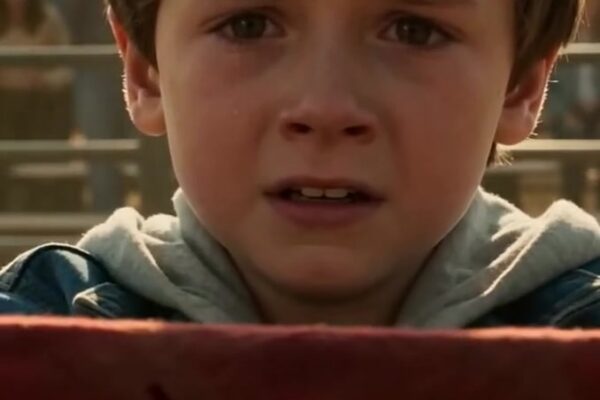
The courtroom was quiet in the heavy way that makes every breath sound too loud. Even the ceiling fans seemed to turn with restraint, as if the air itself understood that any careless motion might knock loose something sacred. People sat in rows like carved figures—stiff backs, hands folded, eyes trained forward—waiting for the next word to decide what kind of world this would be.
On the highest bench sat Judge Elspeth Marr, the oldest judge in the county and the most feared. Not because she raised her voice—she never did—but because she had learned the weight of silence, and she used it like a gavel. Her wheelchair was a dark, polished thing with worn armrests, pushed into place by a bailiff who now stood at attention beside her. Elspeth’s legs lay under a wool blanket, neatly arranged, immovable as stone. Her hands rested on the papers before her, the day’s case file already memorized, already judged in the private chambers of her mind.
The defendant stood at the table with his court-appointed attorney. His name was Daniel Rusk. Thirty-two, factory worker, no prior convictions. Charged with theft of controlled medication from a local pharmacy. The prosecutor had spoken of precedent and deterrence, of the need to protect the community, of the line between hardship and lawlessness. Daniel had stared at the floor the whole time, jaw clenched, the muscles in his neck tight as wire.
Elspeth had been ready to announce a sentence. It would not be cruel, she told herself. It would be correct.
Then the bailiff cleared his throat and led a child to the front.
She was small enough that the bench rose above her like a wall. A worn green coat hung on her thin shoulders, too big in the arms, frayed at the cuffs. Her hair was tied back with a string rather than a ribbon. When she stepped to the rail, she gripped the wood with both hands as if it might tilt and throw her into the space between decision and consequence. Her knuckles blanched. Her lips trembled. Tears were already on her cheeks, sliding steadily, but she held herself upright with a strange, stubborn pride, like collapsing would be a luxury she could not afford.
“State your name,” the clerk prompted softly, as if afraid of startling her.
“Lena,” the girl whispered. Then, louder, because she had come to be heard: “Lena Rusk.”
The attorney beside Daniel shifted, his eyes widening. Daniel lifted his head sharply, and whatever composure he had managed broke. He shook his head once, urgently, pleading without words. Lena did not look back at him. She stared up at the judge with the single-mindedness of someone walking into fire.
Elspeth’s gaze stayed on her. Children had testified before—ragged stories and rehearsed lines, coached by adults who wanted sympathy. This girl’s grief was too immediate to be arranged. It sat on her face like weather.
“Why are you here, Lena?” Elspeth asked, her voice level, almost gentle.
Lena drew in a breath that sounded loud in the stillness. “Your Honor… if you let my dad come home,” she said, each word coming out as if it had to climb over something sharp inside her, “I can fix your legs.”
A ripple tried to travel through the courtroom—surprise, disbelief, a scoff rising in a throat somewhere—but it died under the judge’s steady stare. Even the prosecutor stopped arranging his notes.
Elspeth’s fingers stilled over the file. “You can fix my legs,” she repeated, not mocking, only testing the shape of the claim.
Lena nodded hard, tears shaking loose. “Yes. I can.”
Elspeth studied the child’s coat, the rawness around her nose, the damp streaks on her cheeks. She had seen con artists. She had seen people perform desperation. But this was not performance; it was the last thing someone did before falling off a ledge.
“Why do you want him home so badly?” Elspeth asked.
Lena’s mouth opened and closed. For a moment she seemed to shrink, like the question had exposed the place where her strength was thin. She swallowed, eyes squeezing shut, then forced them open again. “He didn’t take it for… for bad reasons,” she said, and her voice cracked on the word “bad” as if she didn’t quite know what it meant in a world where babies stopped breathing.
She wiped her face with the back of her sleeve. The coat smelled faintly of laundry soap and cold air. “My baby brother,” she went on, the words rushing now because holding them back was worse, “he got sick and his chest wouldn’t move right. Mama tried the steam and the honey and the old inhaler, but it didn’t work. His lips were turning… turning…” She faltered, the memory choking her.
Daniel made a sound, half warning, half broken prayer.
“He stole medicine,” Lena said, and the courtroom seemed to lean closer without moving, “because my baby brother stopped breathing.”
Elspeth’s expression changed—not in a dramatic softening, not in a visible surrender, but in the subtle way ice gives under the first warmth. She looked down at the paperwork again as if it had become unfamiliar. Her sternness did not vanish. It rearranged itself.
“Where is your mother?” Elspeth asked quietly.
“At the hospital with Ezra,” Lena replied. “They said he might need a machine if it gets bad again.”
Elspeth’s throat tightened. She resisted the impulse to glance at the gallery, where so many eyes had suddenly turned wet. “And you,” she said, “you came alone?”
Lena nodded. “I came because Dad said judges don’t like excuses. So I brought… something else.”
Her hands left the rail. They shook as she reached into the pocket of her green coat. The room held its breath. She pulled out a small locket, old enough that the metal had dulled to a soft gray. The hinge looked tired. She placed it on the bench between herself and the judge as carefully as if it were a living thing.
Elspeth stared at it, puzzled at first, then… caught. Something in her eyes shifted, like a door unlatching. She leaned forward, the wheels of her chair creaking faintly. Her fingers hovered, then closed around the locket with the reverence of someone touching a relic.
When she opened it, the tiny click echoed. Inside was a faded photograph: a younger Elspeth, hair dark and pinned back, holding a baby boy against her shoulder. The background looked like a porch, sunlight bleeding into the image. The baby’s face was soft and round, his fist clenched in the air, his mouth open in mid-cry or mid-laugh.
Elspeth’s breath stopped. A tremor ran through her hand, and she had to grip the edge of the bench to steady herself. For a heartbeat, she was not the judge. She was a woman who had once sung lullabies until her throat hurt.
“Where did you get this?” she asked. Her voice was thinner now, pulled taut by an old pain.
Lena’s voice dropped, almost a whisper, but it carried. “My dad kept it in a box with letters he never sent,” she said. “He told me it was from you. He told me you kissed him goodbye with it when he was little. He said you thought you’d come back for him. And then you didn’t.”
Elspeth’s eyes glistened. Her jaw worked as if she were chewing through iron. She looked past the locket to Daniel Rusk, whose face had gone ashen. The man at the defense table did not look like the child in the photograph, not at first glance. But then Elspeth saw it—the slope of the nose, the set of the mouth, the eyes that held the same storm even when lowered to the floor.
“Who is your father?” Elspeth asked, and the question did not belong to the courtroom anymore. It belonged to everything she had kept locked behind her robe.
Lena lifted her chin. Tears kept coming, but she did not wipe them. “Your son,” she said, and the words landed like a verdict.
The courtroom did not erupt. It did not gasp loudly or shout. It simply… went stiller, as if everyone had been waiting their whole lives for a different kind of judgment.
Elspeth closed the locket with a soft snap and held it to her chest. Her eyes did not leave Daniel’s face. “Daniel,” she said, tasting the name, “is that what you’re called now?”
Daniel’s throat bobbed. “Yes,” he managed. “It’s what the foster family gave me.”
“And the baby,” Elspeth whispered, hardly able to say it. “Ezra. Your son?”
Daniel nodded once. He looked like a man about to be struck. “He couldn’t breathe,” he said, voice rough. “I tried everything I could. I didn’t know what else to do.”
Elspeth sat back slowly, as if the wheelchair had become heavier. Her fingers tightened around the locket until her knuckles whitened. The law was written in ink; life was written in blood. She had spent decades pretending they were the same.
She looked at Lena again, at the child who had walked into this room with trembling hands and an impossible bargain. “And you said you could fix my legs,” Elspeth murmured.
Lena wiped her cheeks with both hands, smearing the tears like paint. “Not with magic,” she said fiercely. “With hope. Dad says hope makes people try again. If he comes home, Mama won’t be alone, and Ezra won’t… and I won’t…” Her voice caught. She clenched her fists. “Please.”
Elspeth’s eyes closed for a brief second. In that darkness she saw a boy with a suitcase too small to hold his life, standing on a porch as a car waited. She saw her own hands, younger, trembling, pressing a locket into his palm because it was the only promise she dared make. She remembered the letter she never wrote, the calls she never returned, the long, proud climb into public service that had required an equally long descent into private absence.
When she opened her eyes, they were clear in a new way. She reached for the microphone, her hand steadying as it found purpose.
“This court will take a recess,” she announced, and her voice regained its authority without losing its humanity. “Bailiff, escort the child to a seat. Counselors, approach.”
The lawyers rose like men waking from a dream. Daniel stared at Lena as she was guided away, his face collapsing into gratitude and terror and something like forgiveness he didn’t know how to accept.
As the attorneys gathered, Elspeth held the locket beneath the bench, hidden from the room, but not hidden from herself. The metal was cold. Her heart was not.
Outside, in the hall, the courthouse clock ticked on, indifferent. Inside, in the heavy quiet, a judge prepared to weigh more than a crime. She prepared to weigh a lifetime, and to decide, at last, what kind of mother she had been—and what kind of woman she still could be.