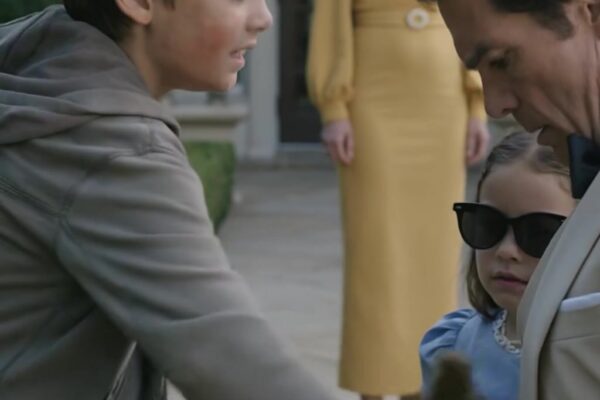
The bailiff had to lift her up the last step. The oak rail looked as tall as a wall from where she stood, and when she stretched, her fingers barely found the edge of the judge’s bench. Still, she held on with both hands, knuckles blanching, as if the polished wood were the one solid thing in a room that could swallow her whole.
Her coat—green once, now dulled to the color of rain-soaked leaves—hung a little too big on her narrow shoulders. The sleeves were frayed where she’d worried them with nervous thumbs. Tears shone on her cheeks in uneven tracks, and she blinked so hard her lashes trembled. Behind her, the courtroom murmured and shifted. People leaned forward as if they could hear better by borrowing her breath.
The judge sat high and strangely low at once. The bench rose above everything, but the elderly woman occupying it sat in a wheelchair, her robe draped carefully to conceal the wheels and the stillness of her legs. Her face was carved with years and decisions. Her mouth had the habit of refusing softness.
“Name,” the judge said, voice level. Not unkind—just practiced.
The girl swallowed. “Lena.” She tightened her grip, then forced herself to look up. “Your Honor… if you let my dad come home… I can fix your legs.”
The words landed like a dropped plate. A sharp intake went through the gallery—surprise, pity, annoyance, all tangled. The prosecutor’s eyebrows rose. Lena’s appointed defender shifted uneasily, ready to intervene, but something about the child’s gaze stopped him.
The judge studied Lena as if she were an unfamiliar clause in a familiar statute. Sternness held for a heartbeat. Then it loosened, not into kindness exactly, but into attention. “And why,” the judge asked, “do you want him home so badly?”
Lena’s lips quivered. She pressed them together, as if she could keep the words from shaking. “Because… because he didn’t do it to be bad.” Her voice broke on the last word, and she breathed in hard through her nose, trying to gather it back. “He took medicine. He took it because my baby brother stopped breathing.”
Silence poured into the room like water. Even the ceiling fans seemed to slow.
On the defense table, a man with dark hair and hollowed cheeks stared at the floor, wrists chained. His shoulders were rigid, as if he were holding himself together by force alone. When Lena said “baby brother,” his eyes flicked up—just once—then dropped again, ashamed to be seen hoping.
The judge’s fingers curled around a pen. The knuckle joints looked swollen beneath thin skin. Her expression changed in small increments, as if an internal gear had caught and begun to turn. “Medicine,” she repeated softly, tasting the word for more than its meaning.
Lena nodded, desperate now that the courtroom was listening. “He tried… he tried to ask at the clinic first. They said we needed papers. My mom—” The girl faltered, throat tightening. “She’s not here.”
No one asked why. The absence hung in the air, heavy as a draped flag.
Lena dipped her hand into her coat pocket and withdrew something small and glinting, cradled in her palm like a secret. She stretched up as far as she could and set it on the bench. An old locket, tarnished, the hinge worn.
“My dad said,” Lena whispered, “you gave him this when you kissed him goodbye.”
The judge’s composure cracked—just at the edges. Her eyes fixed on the locket with the precision of someone recognizing an old wound. She did not reach for it right away. For a moment, she seemed held in place by the memory of touching it before. Then she extended one hand, slow, as if the object might bite.
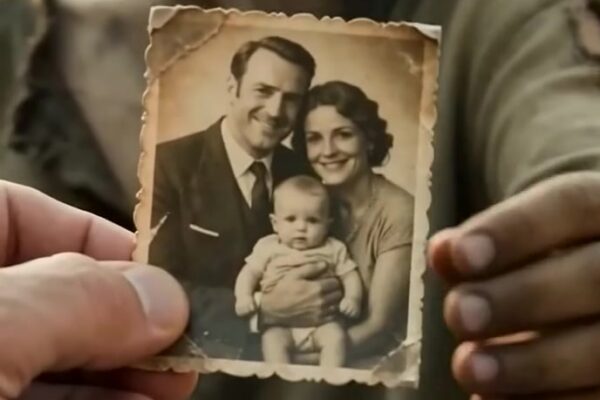
The locket clicked open. Inside was a faded photograph: a younger woman—unmistakably the judge, though her hair in the picture was dark and her smile unguarded—cradling a baby boy. The judge’s hand began to tremble so slightly that the metal caught the light in a nervous shimmer.
She stared as if she were reading a verdict written in ink only she could see.
“Who,” the judge asked, voice no longer steady, “is your father?”
Lena drew herself up, chin raised with a child’s imitation of courage. Tears clung to her lashes. “Eli Ward,” she said. Then, as if she had practiced the next part in the quiet of a bedroom with a sleeping infant nearby, she added, “He said you’re his mother.”
The judge’s breath caught—audible, sharp. Her gaze flicked toward the shackled man at the defense table. The man’s head lifted slowly, like someone turning toward a sound they’ve been afraid to hear. He looked at the photograph, then at the judge, and something in his face crumpled. A lifetime of not being chosen sat there in his eyes.
“Eli,” the judge said, and the single word contained more history than the case file in front of her. Her throat worked as she swallowed. “Eli, stand.”
The bailiff hesitated, then gently pulled Eli to his feet. The chains clinked with a cruel neatness. Eli didn’t speak. His mouth moved as if he might, but nothing came out.
The judge stared at him with an expression the courtroom couldn’t categorize. It wasn’t impartial. It wasn’t merciful. It was raw, and it frightened the people who believed courtrooms were built to keep emotion out.
“We,” she said, gripping the edge of the bench, “have procedures.” It sounded like she was reminding herself. “We have rules.” Her eyes went to Lena. “You can’t promise impossible things to sway a court.”
“It’s not impossible,” Lena insisted, suddenly fierce. “I can do it.”
A few people in the gallery shifted, skeptical. The prosecutor’s mouth tightened, ready to object. But the judge lifted a hand, and the room obeyed the motion as if it were law.
“How?” the judge asked.
Lena’s shoulders sagged with relief at being asked, at being believed enough to be questioned. “My dad says my hands are… special,” she said, fumbling for the right grown-up word. “When I touch someone, I can feel where it hurts. Like when the baby couldn’t breathe, I put my hand on his chest and I felt… tightness. Dad pushed air like the nurse showed him, and I held him, and then he cried. My dad said it was me.”
The judge’s eyes closed for a moment, as if she could see the scene: a dim apartment, a child’s small palm pressed to a ribcage, a father panicking, a baby’s silence. When she opened her eyes again, they shone.
“Eli Ward,” she said carefully, as if each syllable needed permission. “Why did you never come to me?”
Eli’s jaw worked. He looked at Lena first—as though asking forgiveness for speaking at all—then looked at the judge. “Because you already decided,” he said hoarsely. “A long time ago.”
The words struck with the bluntness of truth. The judge flinched, and for an instant her sternness returned like armor. Then it fell away, not because she chose to remove it, but because it no longer fit.
She looked down at the case file. The theft. The surveillance footage. The value of the medicine. The prior record—one old charge from years before, a fight outside a factory gate. Under the black letters of law, a story pulsed, messy and human.
The judge’s gaze moved to the wheelchair beneath her robe. She placed one hand on her own knee, as if to confirm it was still unresponsive. Then she looked at Lena’s hands, still gripping the bench, small and trembling and stubborn.
“Bailiff,” the judge said, voice suddenly crisp. “Clear the aisle. Counselors, approach.”
Lawyers moved forward, startled. The courtroom buzzed with confusion.
But the judge wasn’t looking at them. She was looking at the doors, as if expecting someone—or something—she had not dared to hope for. Her fingers tightened around the locket until the metal bit into her skin, a reminder that the past could still draw blood.
“Lena,” she said quietly, and the whole room leaned into the hush of her voice. “Come closer.”
The bailiff steadied the girl as she shuffled forward, her worn shoes whispering over the polished floor. Lena reached the judge’s side, close enough now to see the fine lines at the corners of the older woman’s eyes, the way her mouth was trying not to tremble.
The judge set the locket down and held out her hand. “Show me,” she said, almost not a command, almost a plea. “Not for the record. Not for anyone in this room. Show me because I have been sitting in this chair for twelve years, and I have told myself it is punishment I earned.”
Lena’s small hand hesitated—then settled gently on the judge’s knee through the dark fabric of the robe.
For a breathless moment, nothing happened. The courtroom held itself like a lung before a scream.
Then the judge’s face shifted—subtle, startled—and her fingers clutched the armrest. Her eyes widened as if she’d been struck by lightning, not pain but sensation. A sharp sound escaped her, half sob, half laugh, and she covered her mouth with trembling fingers.
“I can feel you,” she whispered, staring at Lena as if the child were a verdict overturning an entire life. “I can feel—”
Eli made a sound, strangled, and took a step forward before the bailiff could stop him. The chain tugged him back, a cruel leash. He stared at his mother and his daughter as if he couldn’t decide whether to believe either of them.
“Order,” the clerk called automatically, but the word sounded tiny, foolish, in the presence of what was unfolding.
The judge lifted her gaze to Eli, and in it was something she had never allowed in court: regret, naked and unguarded. “I don’t know,” she said, voice breaking, “how to undo what I did to you.”
Lena’s hand remained on the judge’s knee, steady now, as if she had found the one thing in the room that needed holding more than she did. “You can start,” the girl whispered, “by letting him come home.”
The judge drew in a shaking breath. Around her, the courtroom waited for a sentence, a rule, a familiar ending.
Instead, she reached for her gavel and did not strike it. She simply held it, feeling the weight of authority and the weight of family, and looked toward the doors again—toward the rest of the story that had been locked outside for years.
“Bring the medical records,” she said, voice firming with purpose. “Bring the clinic director. Bring whoever needs to be brought. Today,” she added, eyes never leaving Lena’s face, “we will hear the whole truth.”