The black SUV didn’t slow down. It should have—any decent driver would have eased off the gas when they saw the sheen of standing water at the curb and the lone figure moving along the sidewalk with her collar up. But it kept its nose down, headlights cutting pale tunnels through the rain, engine note rising like a dare.
Lena Sayegh felt it an instant before it happened: the pitch change, the slight drift toward the gutter, the way the vehicle’s weight committed to the puddle. She had time to do only two things—tighten her grip on the slim leather folder tucked against her ribs and turn her face away.
The wave hit her anyway. Brown water, thick with grit and the city’s tired secrets, struck her from knees to cheekbones. It slapped across her trench coat and into her hairline. Mud flecked her glasses; the world turned into a smear of lights and sound. Cold sank through fabric to skin, and for a second she could not tell if the tremor in her chest was anger or shock.
She heard tires squeal. Not a full stop—just enough to perform a thoughtless kind of mercy. The SUV rolled a few feet and paused. A window slid halfway down with a wet sigh.
“What is wrong with you?” Lena’s voice was raw, torn loose by humiliation. She stood on the edge of the sidewalk, brown water dripping from her sleeve, her dress clinging where it showed beneath her coat. Rain ran in rivulets down her lenses; she blinked it away, refusing the easy sting of tears.
The driver leaned toward the opening as if the weather had inconvenienced him more than her. He was in his forties, clean haircut, watch face glinting in the muted daylight. He didn’t apologize. He didn’t even look for long enough to remember her face.
“I’m in a hurry,” he said, and the sentence landed with the finality of a door being shut.
Then he accelerated. The SUV threw a second lash of filthy water behind it, as if the first had not been enough, and disappeared into the line of taillights streaming toward the business district.
For one heartbeat Lena stood still—rain, horns, the hiss of tires, the metallic smell of wet pavement. Mud slid down her coat in slow, deliberate streaks. Her hand rose and wiped at her cheek, smearing the grit into a darker bruise. She steadied her breathing. She did not cry. She did not shout again. The absence of tears felt like swallowing glass.
She turned and walked on.
Three blocks later, she entered the lobby of Hartwell & Crane Holdings, an edifice of marble and mirrored steel that always felt too clean to belong to the same city as the puddle that had baptized her. The revolving door caught her reflection in fragments: mud-stained trench, hair plastered in strands, glasses freckled brown. A pair of security guards at the desk looked up in alarm, then hesitated—recognition fighting with disbelief.
“Ms. Sayegh—” one began, half rising.
Lena lifted a hand, calm as a metronome. “It’s fine,” she said. Her voice had found its steadiness again, as though she’d filed the incident away in a drawer labeled LATER. “Please call Executive Services. Tell them I need the suite.”
The guard moved with immediate urgency, his fingers clumsy on the phone. Lena crossed the lobby, leaving faint muddy prints on the polished floor. People pretended not to stare; those who did quickly looked away, as if the sight of imperfection in this place might be contagious.
She took the private elevator. Inside, alone with her own reflection, Lena let herself see what the driver had seen: a drenched woman in a city storm, small enough to be ignored. Her lips pressed together. Her jaw tightened. She did not allow the storm the satisfaction of breaking her posture.
On the forty-eighth floor, a quiet team was waiting—two assistants and a wardrobe specialist who carried a garment bag like a sacred offering. The moment the doors opened, they moved around Lena with practiced discretion. Not a question asked that didn’t already contain an answer.
“Board is seated,” one assistant murmured, guiding her toward a side suite paneled in pale wood. “Media is still downstairs.”
“Good,” Lena said.
In the suite, warm air kissed her skin. A towel appeared. Her trench coat was lifted from her shoulders and vanished. Her glasses were taken, cleaned, returned. Her hair was smoothed back and pinned with minimal fuss. The mud-streaked dress was replaced with an identical one—light blue, crisp, unmarked, the same cut that suggested softness while demanding precision. A second folder, clean and dry, was placed in her hand. The first—spattered, stained—was taken away with the careful reverence reserved for evidence.
Lena looked at herself in the mirror once more. She was the same person. The difference was that now the world would be forced to admit it.
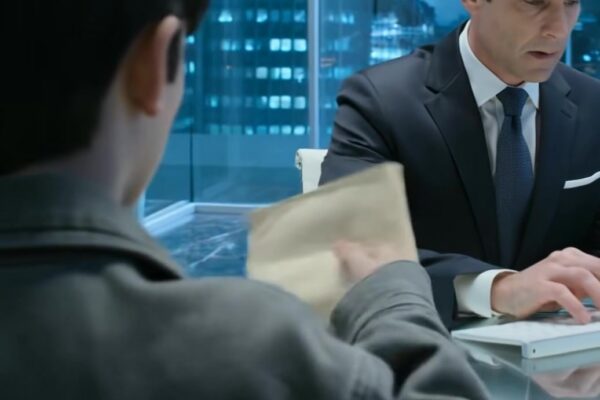
When the glass doors to the executive boardroom opened, bright white light spilled out like interrogation. A long table stretched down the room, flanked by senior executives and legal counsel, their expressions arranged in neutral layers. They were talking in hushed tones until Lena stepped into the threshold.
Conversations stopped as if the air had been cut. Chairs adjusted. Spines straightened. A man in a dark suit with a red tie rose immediately, his smile careful and respectful, as though he’d rehearsed it for months.
“Good morning,” Lena said.
Not loud. Not warm. Just present.
The man in the red tie stepped aside at the head of the table, and the motion looked less like courtesy and more like obedience to a natural law. A nameplate waited there in clean black lettering. Lena didn’t glance at it. She didn’t need to. Everyone else did.
She took her place and set the folder down. Fingers poised, she looked along the table, taking in faces that had once talked over her on quarterly calls, faces that had smiled politely and then ignored her recommendations until the numbers proved she was right. Today those faces held something new—anticipation tinged with fear. They had asked for a savior. They had not expected one with a memory.
The doors opened again behind her.
“Sorry I’m late,” a man’s voice carried in, too casual, still speaking to the person beside him. “Traffic was—”
The sentence died as he stepped into view.
It was him. The driver from the black SUV. Clean now, of course—dry suit, crisp cuffs, faint scent of expensive cologne that had never met rain. He looked at Lena the way a man looks at a ghost that has borrowed a familiar face. Confusion took him first, then recognition, then the rapid drain of color from his cheeks.
His mouth opened. Closed. Opened again, searching for a reality in which the morning’s cruelty had been consequence-free. Around the table, executives glanced between them, puzzled by the sudden silence, sensing an unseen collision.
Lena turned slowly in her chair to face him. Her expression held no anger. That absence was the sharpest weapon in the room.
For a moment, she thought about the puddle—about cold water seeping into her shoes, about the sting of grit against her skin. She thought about how easy it had been for him to declare himself in a hurry, as if that excused anything. She thought about how many decisions were made that way: fast, careless, crushing whoever stood too close to the curb.
She let none of it reach her voice.
Her lips formed a small, polite smile, the kind that belonged in boardrooms and courtrooms and press conferences. She opened her folder with a soft, decisive sound that made several people sit up straighter.
Her gaze held his, steady as a verdict.
“Shall we begin?” she said.
The room went dead silent. Only then did the driver’s eyes flick down, involuntarily, to the nameplate at the head of the table. The words seemed to burn as he read them.
Chief Executive Officer.
His throat worked. He tried to swallow. The sound didn’t come.
Lena looked away first—not because she had lost, but because she had already moved on. She addressed the room as if nothing unusual had occurred, as if the only storm that mattered was the one coming for the company’s future.
“Thank you for waiting,” she said, and her tone made waiting sound like a privilege. “We have a great deal to discuss about urgency—and what it costs.”
Across the table, the man who had been in such a hurry stood frozen a moment longer, realizing too late that the street and the boardroom were the same place after all: a narrow lane where choices barreled forward, and not everyone got out of the way in time.
Then, at last, he pulled out a chair. The scrape of it against the polished floor sounded louder than it should have. He sat, carefully, like a man who had just learned that puddles have depths and names and consequences—and that some of them wait patiently at the head of the table.