By the time the orchestra softened and the ballroom turned its attention toward the young heir in the wheelchair, the hall already felt like a performance everyone had memorized. The conductor lowered his hands as if he, too, had been rehearsed into restraint. Crystal chandeliers pooled their light on marble the color of skimmed milk. Faces arranged themselves into devotion—smiles measured to the millimeter, eyes bright with the kind of hunger that wore perfume.
Lucien Vale sat at the center of it all like the final ornament on a tree no one dared touch. Navy suit, collar immaculate, hair combed with severe tenderness. One hand rested on the joystick of his motorized chair, thumb hovering, a prince’s command rendered down to a plastic lever. The other lay pale and quiet in his lap, fingers curled as if they’d forgotten the shape of choice. Around his wrists, the cufflinks bore the Vale crest: a crown above a wolf’s head. It was meant to look noble. Tonight, it looked like teeth.
“To the future,” someone toasted too loudly. The words ricocheted off the columns and returned thinner, as if the hall itself didn’t believe them.
Lucien’s gaze traveled the room without landing. He knew what each nod meant. He knew which laughs were investments and which were warnings. He could predict the next compliments, the next sympathetic tilt of a head, the next sentimental mention of his late mother. Sometimes he wondered if he was watching a life from behind glass, and his chair was only the visible pane.
Marcus Vale stood near the dais like a shadow dressed in silver. Tall, controlled, handsome in the way blades were handsome. He spoke to ministers and patrons with effortless warmth, his hand resting occasionally on Lucien’s shoulder—a gesture that looked protective to the room and felt like a brand to Lucien.
When the doors at the far end of the ballroom opened, Lucien didn’t notice at first. The musicians shifted; a violinist missed half a note. Then the air changed. It was a small thing—the sensation of a draft where none should exist in a room built to keep the world out.
A barefoot girl stepped across the threshold.
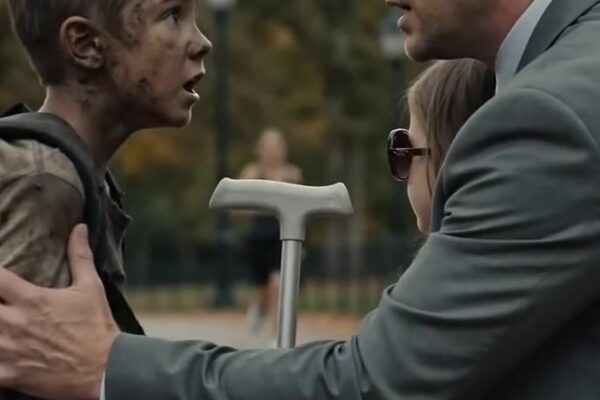
She wore a torn brown dress that had once been simple and whole. Dirt smudged her knees and the underside of her jaw. Her hair hung in damp ropes, as if she’d run through rain or fountains or both. She trembled, but she walked forward anyway, straight through the lattice of expensive gowns and tailored suits. People parted without meaning to, the way crowds did for fire.
Lucien watched, unable to decide whether she was real or some fevered metaphor his mind had finally given up and invented.
The girl reached him and took his hand.
Contact, warm and startling. Not a gloved handshake. Not a practiced touch. Her palm was rough, alive with calluses and small cuts. Her fingers wrapped around his as if she feared he might vanish if she loosened her grip.
The entire room stopped breathing in unison. Even the chandeliers seemed to pause in their glitter.
“Leave with me,” she whispered. Her voice was thin, but it carried, the way certain truths did. “And I’ll make you walk.”
For a single second, Lucien forgot the weight of eyes, forgot the polished cage of etiquette. His lungs stalled. Not because of the words—anyone could promise miracles in a palace—but because of how she said them. Like she was repeating a sentence she’d been born remembering. Like it wasn’t an offer, but a correction.
His fingers tightened around hers before he could stop himself. A small movement, a betrayal of stillness.
Across the room, Marcus noticed.
Lucien saw it in the sudden sharpness of Marcus’s posture, the way his smile snapped into place like armor. Marcus started toward them immediately, moving too quickly for a man who wanted to appear unbothered. His polished shoes struck the marble with a decisive rhythm that began to drown out the murmurs.
When he reached them, Marcus’s voice was quiet, which made it more dangerous. “Get inside now,” he snapped at the girl. “This isn’t a joke.”
The girl flinched at the sound, but her hand didn’t loosen. She didn’t even look at Marcus. Her eyes stayed locked on Lucien’s, wide with something that looked like grief and recognition tangled together.
That choice—refusing Marcus the dignity of attention—turned the ballroom colder than stone. People who had been leaning in now leaned back. The careful smiles faltered.
Marcus’s fingers closed around the girl’s arm. Not hard enough to bruise, not yet. “Let go,” he said, and the command had the weight of years.
Lucien surprised himself by gripping her hand harder. The movement sent a faint tremor up his wrist, a tiny pain like a needle, and he welcomed it. Pain meant sensation. Sensation meant he was still here.
Marcus froze, eyes dropping to their joined hands. Something in his face shifted—an old calculation, a memory of a plan gone sideways. The room felt it. The room had always been trained to sense Marcus’s moods, the way livestock sensed storms.
The girl’s voice shook now, but only from emotion. “I know what they did to him.”
Lucien’s chest tightened. His mind flashed, uninvited, with images he kept buried: the staircase in the west wing slick with candlewax; the rush of air as he fell; the moment of impact that wasn’t pain so much as sudden absence. Then the days after—doctors who spoke to Marcus before speaking to Lucien, syringes that made his thoughts blur, the official story repeated until it hardened into law.
Marcus’s face drained of color for half a heartbeat. Then he recovered too quickly, like someone yanking a mask back into place. “She’s a thief,” he said to the room, voice raised just enough to recruit witnesses. “Some gutter performer. Lucien, let go of her.”
Lucien didn’t move.
The girl lifted her free hand toward the inside pocket of Lucien’s jacket with slow, reverent certainty. Marcus took a sharp step forward, hand rising, the threat no longer hidden in manners.
“No,” Lucien said.
The single word cut through the hall, clean and shocking. Heads turned as if pulled by strings. Marcus stopped mid-motion, his expression tightening around disbelief. Lucien felt the word vibrate through his bones. He hadn’t said “no” to Marcus in years.
“My mother said the queen hid it here,” the girl whispered, tears brightening her lashes. “The last night she still trusted the wrong man.”
Lucien went very still. The word queen—his mother, Elara Vale—was spoken so rarely, and never with tenderness. The palace had turned her into a portrait and a cautionary tale. Eight years dead, and still she haunted the hallways in the form of silences.
The girl’s fingers slid into a hidden seam inside Lucien’s jacket, finding something sewn deep, something no tailor had ever mentioned. Lucien’s heart pounded hard enough to make him dizzy.
Marcus lunged, not at the girl now but at Lucien, eyes wild with an urgency that betrayed him. “Stop.”
Too late.
The girl drew out a tiny silver key, no longer than Lucien’s thumb. It was tied to a faded blue ribbon worn thin with age. A ribbon Lucien recognized so intensely it felt like a physical blow.
His mother used to knot that shade of blue around her wrist when she played piano in the west nursery, the color bright against her skin as her hands moved like water over the keys. Lucien remembered the way she’d laughed when he’d tried to steal it, the way she’d promised it was lucky.
A collective gasp rippled through the ballroom, the sound of a hundred people realizing at once that they were not watching a harmless interruption. They were watching a foundation crack.
Lucien stared at the key until the chandeliers blurred. “How do you know that key?” he managed, voice breaking at the edge of the question.
The girl’s chin trembled. “Because my mother was there when your mother stitched it into your pocket after the fall.”
Marcus’s jaw flexed. His eyes darted to the crowd, measuring exits, allies, angles. “She’s lying,” he said, but the words landed wrong—too thin, too late. People had already begun to remember other things: the locked doors in the west wing, the servants who disappeared, the way Marcus had risen in influence right after Lucien’s accident.
The girl lifted the key between them like an offering and a weapon. “She said it opens the room where your mother hid the truth,” she whispered. “The truth about why you stopped walking.”
Lucien’s breath hitched. In his lap, his pale hand twitched, fingers curling as if waking from sleep. He looked at Marcus, and for the first time he saw not a guardian or a brother, but a man standing between him and an answer.
Outside the tall windows, thunder rolled—distant, patient, inevitable. The ballroom waited, poised between applause and catastrophe.
Lucien closed his fingers around the key. The silver bit into his skin. He welcomed that too.
And when Marcus leaned in, voice a low warning meant only for Lucien, Lucien leaned back just as close and said, “If you touch her again, everyone will learn what you buried with her.”
Marcus’s smile returned, but it was all teeth. “Then let’s see,” he murmured, “if the truth can make you walk.”