The restaurant hung over the metropolis on a lattice of silver pylons and glass, a terrace of light suspended above the soot and sirens. From the street it looked impossible, a star lowered and fixed in place—an architectural promise that pain could be outpaced if you climbed high enough. Up here, crystal fixtures bled a clean, cold radiance onto marble so polished it reflected each guest back at themselves, improved. Beyond the curved windows, the skyline burned an electric blue, the kind of color that didn’t exist at ground level.
They spoke softly here. Not because it was required, but because they had learned to treat quiet as a kind of ownership. A laugh carried too far would suggest a body, and bodies were messy. Waiters moved like trained shadows between tables, smoothing napkins and lives. Even the music seemed to hover rather than play, a thin ribbon of sound that never dared to snag on anything real.
At the central table, where the view swallowed most of the city, Alden Varr sat in a wheelchair that looked sleeker than some cars. He wore a suit the color of deep water and cufflinks that caught the chandelier light as if they were tiny, trapped moons. His left leg rested in a sculpted brace, an expensive language of carbon fiber and quiet defeat. He swirled his wine without drinking, enjoying the way it stained the bowl like a bruise.
People angled their bodies toward him the way plants lean toward sun. He was the kind of man who could pause a project with a sentence, reroute a neighborhood with a signature. When they mentioned “revitalization,” they meant he could make a place unrecognizable—and call the result progress.
The elevator doors opened with no fanfare. A soft chime. A wash of cooled air. A child stepped out.
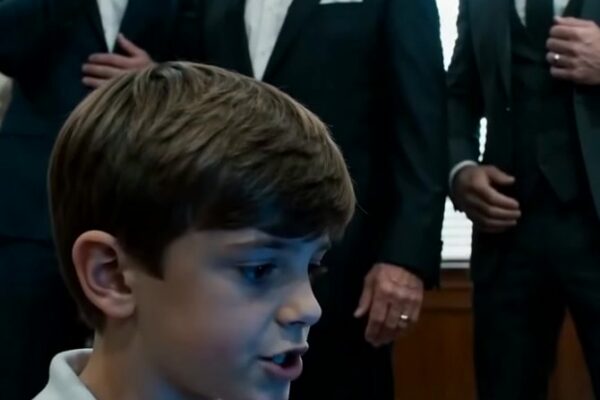
He was too small to belong to the floating restaurant and too still to be lost. Filth darkened his shins. His shirt had been mended so many times the fabric looked like a map of repairs. He walked forward past the host stand, past the eyes that noticed and then looked away as if attention could be contagious. His feet made no sound on the stone.
It wasn’t security that stopped the room, not at first. It was the child’s certainty. He crossed the bright floor as if it were his. As if the distance from elevator to center table had been measured and rehearsed. He stopped directly in front of Alden Varr and looked up.
His gaze did not flicker. It did not ask permission.
“Sir,” he said, voice thin but steady, “I can make your leg answer you.”
A ripple ran through the nearest tables: the subtle lift of brows, the quiet inhalations that signaled entertainment. Someone’s laugh tried to form and failed. A waiter froze with a tray tilted slightly, a miniature tower of glassware trembling.
Alden lowered his glass. The corners of his mouth tugged upward into a smile that carried no warmth, only appetite. “You?” he asked, as if he were being offered a joke for dessert.
The boy nodded once. No pleading. No flourish. “A few seconds.”
That, more than the audacity, drew Alden in. The promise of brevity. The idea of being amused without inconvenience. He leaned forward, elbows to table, as though he were watching a street magician from a private balcony.
“If you can do that,” Alden said, voice careful and loud enough to be heard, “I’ll give you a million.”
There was a low murmur. A million was not said here the way it was said below. It was said like a tip, like a lesson. A million was a story they told themselves to prove generosity existed.
The boy did not react to the number. He moved at once, dropping to his knees beside the wheelchair, close enough that the scent of city grime briefly pierced the restaurant’s filtered air. His hands hovered over Alden’s foot, where the shoe had been removed to accommodate the brace. The skin looked pale, kept indoors and kept above.
And then—only then—did the room begin to change.
Not in sound. The music still drifted. The glasses still clinked in the far corners. But an attention gathered, tightening the space around the boy’s hands. The skyline beyond the glass seemed to slip farther away, as if the height suddenly remembered it had nothing to do with safety.
The boy lifted his eyes. “Count,” he said.
Alden’s smile sharpened. “This is ridicu—”
The child’s fingers closed around Alden’s toes.
Alden’s body seized as if struck by a current. His hand clamped down on the edge of the marble table so hard the tendons stood out, white cords under skin. The wine in his glass shuddered into a spiral. A fork somewhere clattered to the floor, loud as a gunshot in the hush that followed.
“One,” the boy said softly.
The smile vanished from Alden’s face as if someone had wiped it away. His eyes widened, not with pain at first, but with bewilderment—the expression of a man realizing the world had broken one of his rules.
“Two.”
There it was: a twitch, undeniable, in the long-silent foot. Not a convulsion. Not the reflex of an insulted nerve. A small obedient movement, like a dog lifting its head at its name. Alden sucked in a breath so hard it sounded like a gasp. His hands flew to the chair’s armrests, gripping for solidity.
“What are you—” His voice fractured.
“Three.”
The toes curled, then uncurling with effort, as if waking from a long sleep. Alden’s shoulders pitched forward, his torso trying to follow a command his mind had forgotten how to issue. He stared down at his own foot as if it had betrayed him by returning. He looked back at the boy, suddenly careful, suddenly afraid of the child’s calm.
“How?” he whispered. The question wasn’t curiosity. It was accusation.
The boy loosened his grip but did not let go. His fingers stayed lightly on the skin, anchoring something invisible. “It remembers,” he said. “You don’t.”
Alden’s throat worked. He swallowed, the first sign of human vulnerability anyone in the room had ever seen on him. “Name your price,” he managed, voice raw. “More than a million. Anything.”
The boy’s eyes did not gleam at the offer. They held a different kind of light, one that didn’t belong to chandeliers. “My mother named it already.”
Alden frowned, searching his memory like a man searching a wallet for the right card. “Your mother?”
“Yes,” the child said, and his voice, for the first time, carried something sharper than calm. “She worked for you. In the building you emptied. The one you called ‘unsafe’ after you bought the land.”
Alden’s gaze flicked, involuntarily, to the window where the city spread out in layers. Somewhere down there, the dark. Somewhere down there, the demolition fences and the temporary shelters and the coughing children. Somewhere down there, the kind of details he paid other people to forget.
“I don’t know—” Alden began.
“You do,” the boy replied. “You just don’t keep names.”
He pressed his thumb gently beneath the arch of Alden’s foot. Alden’s whole body jolted again, not with pain but with sensation so sudden it might as well have been grief. His eyes squeezed shut. A strangled sound escaped him. When he opened them, they were wet, and the wetness looked obscene on his face, like mud on a polished shoe.
“My mother said you’d move the moment I touched you,” the boy continued. “Because you only understand things when they happen to you.”
Silence pooled at every table. No one lifted a glass. No one reached for a phone. Even the staff stood caught between training and instinct, unsure whether to protect their patron or their own futures.
Alden’s mouth trembled. He looked down at his leg, at the faint trembling along the calf where muscle had begun to remember its purpose. “What do you want?” he asked, and the words sounded like surrender, not bargaining.
The boy finally removed his hand. The foot did not go dead again. It stayed awake, small movements fluttering like a trapped heartbeat. That was the cruelest part: proof that Alden’s body had never been entirely broken. Only waiting.
“Not money,” the boy said. “Money is what you use to pretend nothing costs you.” He stood, and the room seemed to shrink around his small frame, as if the height of the restaurant had decreased. “I want you to come down.”
Alden stared. “Down?”
“To where the air tastes like metal,” the boy said. “To the place you sealed off. To the clinic that closed because your company ‘reassessed’ donations. To the shelter they turned away from your new hotel’s entrance. Come down and stand there. In front of them. On that leg.”
Alden’s jaw tightened. Pride and fear fought behind his eyes. “I can’t just—”
“You can,” the boy said. “You’re moving already. That’s the point.” He glanced at the guests, the glittering sea of wealth watching from their safe altitude. “You built this place to keep suffering out. But it climbed anyway.”
He turned toward the elevator. Halfway there he stopped and looked back, not at Alden this time, but at the chandelier light washing the marble clean. “And if you don’t come,” he added, voice quiet enough that only those closest could hear, “I can take it back. I can let your leg forget again. That part is faster.”
Alden’s hands gripped the chair, knuckles pale. The foot on the rest flexed, as if pleading or warning. Around him, the restaurant held its breath, suspended above the city like a promise finally called in.
The elevator doors waited open, patient as consequence.
In the end, it was not courage that moved Alden Varr’s wheels forward. It was the terror of being powerless under a child’s touch. The boy stepped inside. Alden followed, his expensive chair rolling toward the descent.
As the doors slid shut, the crystal light kept glowing over untouched plates. The skyline remained blue beyond the glass. But the illusion—thin as spun sugar—had cracked, and everyone still seated at their marble tables understood, too late, that height had never been the same thing as escape.