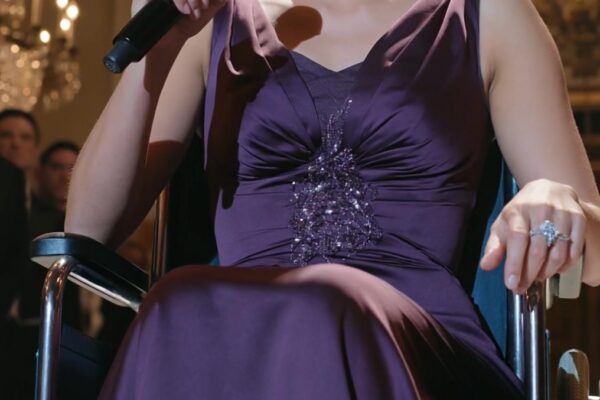
The rooftop auction glittered like a place built for people who never had to answer for the past. The tower’s top floor had been hollowed into an open terrace and dressed in glass panels that kept the wind out while pretending to let the night in. Candles shivered in rows along marble ledges; crystal glasses caught and fractured the amber light; the city beyond pulsed blue and silver, too distant to hear and therefore too easy to forget. Here, money spoke in the only language that never stuttered.
The lots were arranged like relics behind velvet ropes—paintings that had been “recovered,” jewelry with histories politely shortened, a violin from a war-era orchestra, a set of keys sealed in a lucite cube as if even the idea of a door was now collectible. The guests wore calm faces, the way people do when they have insurance against regret. Their laughter fell softly, so no one could later claim it had been cruel.
In the center of it all stood Adrian Voss, older now, immaculate in a suit that fit like a verdict. The room bent around him without touching him. People learned to lower their voices before he ever had to raise his. He didn’t need to command. His presence did it for him.
Yet his own voice had become an unreliable tool. Years ago, the stroke had taken it—left him with a thin rasp that arrived late, fell apart mid-syllable, betrayed him when the room got loud or his temper got sharp. He had adapted with a ruthless efficiency: a stylus for signatures, a tablet for instructions, an assistant who translated a glance into policy. Still, there were moments—moments like tonight, with cameras and bidders and reputations perched on the edge of a sentence—when the absence of his old weapon was a humiliation no tailor could hide.
He watched an auctioneer present Lot Seventeen: a small, dark locket on a chain, its surface scratched as if it had lived at the bottom of a pocket through a long season of running. The piece looked absurdly modest among diamonds and oil paintings, but the murmurs it stirred carried a peculiar heat. Some objects did not glitter; they simply drew blood from memory.
“Ladies and gentlemen,” the auctioneer said, “provenance documented.” He smiled, and his teeth were too white to have ever bitten through hardship. “A personal item recovered from the fire on Halcyon Street.”
A few heads turned toward Voss, careful and quick, the way people look at an open grave and then pretend they didn’t. Halcyon Street was a story most of the city had retired—an electrical blaze, an unfortunate delay in the sprinklers, an inspection missed by an exhausted clerk. The kind of tragedy that could be reduced to paperwork and then repurposed as myth. It had launched Voss from developer to savior: he had “rebuilt,” he had “revitalized,” he had “given the neighborhood new life.” The people who had lived there were rarely mentioned by name.
Adrian’s fingers tightened around the stem of his glass until the crystal creaked. He told himself the locket was simply metal and sentiment, that the auctioneer’s smile did not know what it was smiling over. He told himself this rooftop was real, and Halcyon Street was smoke.
Then the boy stepped in front of him.
Small. Thin. Ragged in a way money could not imitate. His hair had been cut with something blunt; his coat was too large and hung like borrowed weather. Wrong for the room in every possible way, as if the city’s underlayers had briefly torn open and allowed one raw thread to surface.
Security moved—two men in black, hands already lifting—but Voss raised a finger. The gesture was tiny and absolute. The men stopped at once, as if a silent leash had tightened.
The boy looked up at Adrian Voss and said, simply, “Sir.”
Adrian’s disgust came as instinct, almost relief. An intruder could be removed. A nuisance could be dismissed. His mouth shaped the word that used to slice cleanly through rooms.
“What.”
It came out frayed. The syllable snagged in his throat, a sound that should have been powerful and was not. Around them, a few guests smiled quickly, the smile of people watching a lion limp.
The boy did not flinch at the rasp. He pointed at Adrian’s throat—not rudely, not theatrically, with the certainty of someone indicating a bruise.
“I can give you your voice back.”
A laugh escaped from somewhere near the champagne tower. It was bright, almost grateful. Adrian’s lips pulled into a cold curve. He could crush this moment with money. He could buy the boy’s coat, his future, his silence.
“You?” Adrian managed, and the word sounded like grit.
The boy stepped closer instead of retreating. Close enough that the nearest guests stopped smiling. There was something unnerving about his refusal to beg. It was not entitlement. It was choice.
“How?” Adrian asked, because pride demanded he play along long enough to mock the trick.
“Just once,” the boy said.
Something in the child’s face made hesitation stir—an angle of cheekbone, a steadiness in the eyes that didn’t belong to a kid who slept wherever he could. Recognition tried to wake, but pride was faster. Adrian lifted his chin in a gesture that used to signal the end of negotiations.
The boy raised one hand and placed it lightly against Adrian’s throat.
The rooftop quieted as if the glass walls had thickened. No clinking. No murmured bids. Even the auctioneer faltered mid-breath, uncertain whether to intervene or pretend this was entertainment paid for.
Adrian’s body reacted first. A sharp inhale. A swallow that moved cleanly under the boy’s fingers. An old pathway in muscle and nerve opening like a door that had been sealed for years and still remembered the shape of a hand.
“Try,” the boy said.
Adrian opened his mouth. At first nothing came, and panic rose—hot, humiliating. Then a sound broke free, rough but solid, as if it had been waiting behind a wall and someone had finally knocked out the bricks.
“Wh—” He cut himself off, stunned by the weight of his own voice. It wasn’t the elegant baritone he’d once used to charm senators and ruin rivals. It was scarred, but it was real. It filled the air. The guests froze as if a law had been rewritten in front of them.
The boy kept his hand at Adrian’s throat one second longer. His eyes did not flicker toward the watching crowd. They stayed on Adrian, unblinking, like a witness who had waited too long for testimony.
Then the boy said, softly, “Say her name.”
Adrian went pale. Not with confusion. With understanding so sharp it felt like nausea. Her name was the one he never allowed on this rooftop, the one no auction lot could safely hold.
He tried to step back, but the boy’s touch anchored him. In the glass reflections around them, Adrian saw himself multiplied—a powerful man suddenly small, trapped in a thousand angles.
His throat moved. His mouth formed the shape before he could stop it. The voice that had returned did not belong to him alone; it carried something else, a debt.
“Elena,” Adrian said.
The name landed on the rooftop like a dropped candle, like a spark near dry paper. Every guest seemed to forget how to breathe. The auctioneer’s gavel hovered useless in the air.
The boy lowered his hand.
Adrian stared at him as if he had watched a ghost step out of the grave and borrow a child’s body. Because Elena Voss—Elena Halden before she married him—had died on Halcyon Street the night the building burned, the night Adrian had signed the last inspection waiver with a quick, impatient flourish. She had begged him to delay the reopening. He had told her not to be dramatic. He had told her he would handle it. He had promised.
He had been a man of promises then, the kind that sounded good in a room full of investors. None of them had been designed to survive fire.
“Who are you?” Adrian asked, and for the first time in years his voice carried fear without breaking.
The boy’s gaze flicked briefly toward Lot Seventeen—the locket gleaming under the auction lights. “You sold what was left,” he said. “You sold the story. You sold the street. You bought yourself a different ending.”
Adrian’s fingers trembled. The city below was still beautiful, still indifferent, still glittering. “I rebuilt,” he said, desperate, as if language could reframe ash. “I made it better.”
“For who?” the boy asked. “For the people who stand on rooftops and pretend the ground never burned?”
Adrian’s mouth opened, and the rooftop seemed to wait for him the way a courtroom waits for a confession. Behind him, the guests had become statues in tailored clothing. Security stood uncertain, because no one had told them what to do when the threat was not a weapon but a truth.
The boy reached into his oversized coat and withdrew a second locket—cheaper, dented, the chain tarnished. He held it up, and Adrian recognized it instantly. Elena’s. The one she always wore. The one he’d never been able to find after the fire.
“It was under the floorboards,” the boy said. “Where she crawled.”
The word crawled scraped Adrian raw. He heard, vividly, the sound of Elena’s hands on charred wood, nails splitting, lungs burning. He had never been there. He had been in a car, answering calls, insisting everything was contained.
“What do you want?” Adrian whispered.
The boy’s expression tightened, not with hatred but with something worse—clarity. “Your voice back,” he said, “was never a gift. It’s a summons.”
He nodded toward the crowd. “Tell them. Not the version you paid for. The one you buried.”
Adrian looked at the guests—people who had built their lives on the soft cushion of selective memory. He could see in their eyes the terror of being implicated merely by proximity. He could also see, in a few, a flicker of hunger: scandal was another kind of currency.
His restored voice sat in his throat like a coal. He realized then what the boy had done. He hadn’t healed him. He had removed the last excuse. Silence had been Adrian’s shield; now it was gone.
“I can’t,” Adrian said, and the words were truthful in their cowardice.
The boy stepped back, and the air seemed to thin. “You can,” he said. “You just won’t.”
For a heartbeat, Adrian thought the child might vanish—some supernatural messenger summoned by guilt. But the boy did not disappear. He turned and walked toward the auction table with the steady pace of someone heading toward an altar.
“Lot Seventeen,” the auctioneer stammered, trying to reclaim control, trying to weld the moment back into a transaction. “Shall we continue?”
The boy reached the velvet rope, slipped beneath it with a familiarity that startled Adrian, and picked up the displayed locket as if he had every right to touch what the wealthy had come to purchase.
“Stop,” Adrian said, loud enough that the whole rooftop flinched at the strength of it. His own voice shocked him, but it held. It held like a door finally locked from the inside.
He stepped forward, away from the safety of the crowd, toward the boy and the object that had become a mirror. “That isn’t for sale,” Adrian said.
The boy looked over his shoulder. “Nothing should have been,” he replied.
Adrian reached for the microphone the auctioneer still clutched, not gently. The metal was cold, and it felt like consequence. The room tensed, waiting for a bid, for a joke, for a dismissal. Instead Adrian brought the microphone to his mouth and, with his newly returned voice, began to speak the past into the present where it could no longer be managed.
Outside the glass panels, the city continued to burn blue and silver beneath the dark sky, as if it had never known fire at all.