The desert had a way of bleaching everything down to its bones. The café on the frontage road looked like it had been abandoned in place—tables still set, booths still bolted to the floor, a few dusty postcards curling at the edges in a rack that hadn’t been turned in years. Afternoon light slanted through the window glass and turned every floating speck into something holy, as if the air itself was trying to forgive what happened out here.
Cal Rourke sat with his back to the wall by habit, shoulders wide enough to make the booth seem small. His black vest carried the frayed patch of a club he no longer rode with and the faint outline of stitches where someone had tried, once, to cut it from him. He kept his hands quiet on the table because he’d learned a long time ago that hands made promises even when mouths didn’t.
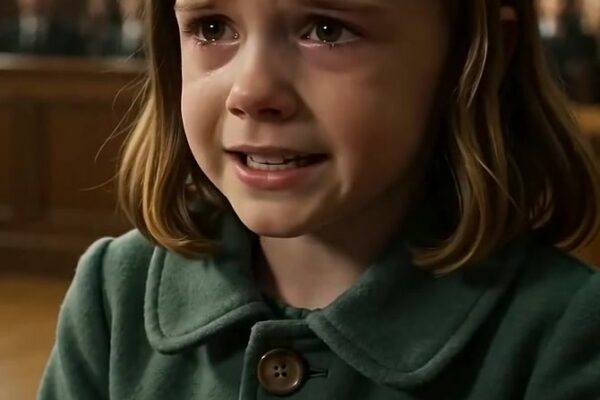
Across from him, a little girl perched on the vinyl seat like she didn’t trust it not to bite. Her dress used to be pink. Now it was the color of old gum stuck under a bench. A denim jacket hung off her like she’d stolen it from a scarecrow. One shoe had laces; the other had a strap that wouldn’t buckle. Her knees were raw, scraped open and crusted with dust. A grilled cheese sat between them, untouched, its corners cooling into hard triangles.
Cal crouched, lowering himself until his face was level with her ankle. The skin there was angry, banded, an ugly pale line where tape had clung too long. He slid a thumb under the edge and peeled slowly, one careful inch at a time, watching for the flinch that told him he was hurting her. He’d stopped counting his own injuries years ago; he couldn’t stand adding one to hers.
“You can tell me,” he said. His voice was rough from miles and smoke and words swallowed. “Where’d they keep you?”
The girl’s eyes flicked toward the windows, toward the road, toward the empty spaces that weren’t empty at all. She swallowed so hard her throat moved like a knot being forced down.
“Room twelve,” she whispered.
The sentence hit Cal like a fist to the chest. Not because of the number—numbers were everywhere, on doors and highways and bills that arrived like threats. It hit because he had been trying for eight years to turn that number into something harmless. He had told himself a room was only a room. He had told himself whatever happened there was buried with the people who caused it.
“Room Twelve,” he repeated, and the words tasted of iron. His fingers paused mid-peel. For a moment, the café fan overhead seemed to slow to a stop, as if the building itself wanted to listen.
The girl reached into the jacket pocket and drew out something that looked too heavy for her small hand. She slid it across the table without meeting his eyes. Old brass, worn at the edges, dull with years of sweat. The kind of key motels used before plastic cards and polite smiles took over. It scraped along the laminate, a sound that turned Cal’s spine to ice.
He didn’t need to turn it to see the stamped number. The shape of it was already familiar. Still, he did it. Twelve. The dents in the metal matched the dents in his memory. His fist closed around it, and for a second he couldn’t feel his fingers.
There were stories about a motel down the road, a place with a flickering sign and too much shadow under the balconies. People in this part of the state did not tell those stories loudly. They told them through looks and pauses, through the way they refused to pull off the highway at night. Cal had done security there once for cash, thinking he could ride in, keep the worst at bay, and ride out clean.
He hadn’t ridden out clean.
His brother, Eli, had been with him then—two years younger, quicker to laugh, quicker to believe in second chances. They’d taken the job because they were broke and trying to be better men. Room Twelve had been the last door Eli ever opened. When Cal found him, the room smelled of bleach and cheap cologne and the sour note of fear. The police report said overdose. The men who paid for silence called it a tragedy. Cal called it murder, but his words had never mattered much against money.
He stared down at the key until the café blurred at the edges. Then he turned it over in his palm. On the back, scratched deep enough to catch a nail, were three letters: HIS.
Cal’s breath stopped. That mark wasn’t a coincidence, not in a world that rarely gave them. Eli used to carve those letters into everything he didn’t want stolen—HIS like a joke, like a dare. He’d scratched them on Cal’s first helmet. On the lockbox under their childhood bed. On the underside of the cheap guitar he’d taught himself to play when their father was too busy being angry to notice music.
Cal held the key as if it might burn. “Where’d you get this?” he asked. The softness in his voice was gone, replaced by something sharp and shaking.
The girl’s eyes finally met his. They were not the eyes of someone who’d gotten lost. They were the eyes of someone who’d been found by the wrong people and had learned what it cost to be seen.
“He gave it to me,” she said. “He said if I got away, I had to find you. He said your name. Cal.”
The café seemed to tilt. Cal gripped the table edge with his free hand to steady himself. “He? Who?”
She hesitated, as if the name itself had weight. “He said… he was Eli.”
Outside, sound broke the moment like glass. Engines—several—coming fast. Not the lazy rumble of travelers passing through, but the hard acceleration of people who knew exactly where they were going. Dust lifted in a sudden wave beyond the windows. A white pickup shot into the lot, followed by motorcycles fanning out like teeth around it.
The girl shrank into her jacket, a silent instinct that made Cal’s blood run cold. He didn’t ask. He already knew what a child did when the predators came back.
Cal slid from the booth and yanked her down beside it, sheltering her with his body. “Stay low,” he muttered, more order than comfort. He caught the waitress’s eyes—an older woman with a tired face and a coffee pot in her hand—and she didn’t ask questions. She ducked behind the counter as if she’d rehearsed it.
At the other end of the café, three men who’d been nursing stale coffee rose in one synchronized motion. They wore plain jackets, but Cal recognized the readiness in their shoulders, the way their hands drifted toward concealed places. Old friends, or old sins. He didn’t know which, and he didn’t have time to care.
The front door banged open. Heat and dust rushed in with the first man, tall and narrow, sunglasses hiding his eyes. His boots left clean prints on the dirty floor. Behind him, two more stepped in, then another, filling the room with the smell of gas and leather and intention.
“Afternoon,” the lead man said, voice light, as if he’d come in for pie. His gaze swept the café and landed on Cal’s booth. “We’re looking for something that wandered off.”
Cal stayed crouched, key clenched so hard the brass bit into his skin. He could feel the girl trembling against his ribs. The word wandered off made his jaw tighten until it ached.
“No one here but folks trying to eat,” Cal called back. His voice carried, low and even. “Keep your business outside.”
The man’s head tipped, amused. “That you, Rourke?” He stepped closer, and Cal heard the faint metallic whisper of a weapon shifting under clothing. “You always did have a talent for getting in the way.”
Cal’s mind raced faster than the engines outside. If Eli was alive—if he’d been trapped all this time—then Room Twelve wasn’t a tomb. It was a lock. And this key wasn’t just a piece of metal. It was a message. A map. Maybe even a confession carved into brass.
He looked down at the girl’s hair, matted with dust. “What did he tell you?” he whispered, too low for anyone else to hear. “Anything. Any place. Any sign.”
“He said,” she breathed, barely sound, “that the mirror lies. That you have to look behind it.”
Cal’s throat tightened. The mirror in Room Twelve. He remembered it: stained at the corners, screwed to the wall like it was hiding something. He’d hit it once in anger and the glass had shivered but held, as if the room refused to reveal what it swallowed.
The lead man took another step. “Last chance,” he said, and the café seemed to shrink around his words.
Cal rose slowly, not because he wanted to fight in front of a child, but because sometimes standing was the only way to keep the world from stepping on you. He slipped the key into his pocket like a promise he couldn’t afford to lose.
“You’re not taking her,” Cal said. The sentence came out flat, final. “And if you’ve got any interest in leaving here breathing, you’ll get back on your bikes and ride away.”
The man laughed once, short and mean. “You think this is about her?” He leaned in, voice dropping. “It’s about what’s in that room. It’s about what’s behind that mirror. It’s about a man who should’ve stayed dead.”
Cal felt the truth settle into place with a dreadful click. Eli hadn’t survived by luck. He’d survived because he knew something. Something these men had spent years trying to bury. And now, with a child as messenger and a motel key marked HIS, the grave was cracking open.
Outside, engines idled like hungry animals. Inside, the air held its breath. Cal set his stance, shielding the booth with his body, and let the rage he’d kept caged for eight years rise to the surface—not wild, not reckless, but focused and cold.
“Then you should’ve killed me too,” Cal said, and reached into the place under his vest where the past had taught him to keep his last argument.
The first shot did not come from Cal.
It came from behind the counter, where the tired waitress stood with a trembling pistol and a face carved from decisions. The sound cracked through the café like thunder, and for the briefest second everyone froze—predators, protectors, and the child in the shadows clutching the edge of Cal’s jacket.
In that split second of stunned silence, Cal understood what Room Twelve had done: it didn’t just hold victims. It made accomplices. It created witnesses who learned to live by never speaking. And now, someone had finally decided to speak in the only language the desert ever respected.
Cal dove for the booth again, pulling the girl tight as the café erupted into chaos, and in his pocket the brass key grew warm against his skin—an insistence, a direction, a doorway waiting to be opened at last.