The garden behind the Vardens estate looked like a painting that had never known weather. White cloths lay over long tables as if draped by careful hands that had never done anything in a hurry. Silverware flashed in the late afternoon sun. Crystal caught the light and threw it back with the confidence of people who believed the world existed to be reflected.
At the center sat Lucien Varden, host and patron, king of a kingdom measured in profits and applause. He wore his tailored suit like armor and listened to donors praise him for funding an orphanage across town—funding that came with a press release and a plaque larger than the front door.
Servers moved like shadows. Guests laughed at jokes they’d already heard in boardrooms. No one asked how hunger sounded. No one wondered what it felt like to calculate how many breaths were left in a person whose medicine cost more than a month of rent.
The first sign of disruption was a murmur near the hedge. A gardener’s voice rose, sharp with alarm. Then a figure slipped through the iron gate as if he’d been poured through a crack in the world.
He was a boy—small, not yet old enough for his bones to look certain. His clothes were torn in places that told a story of grabbing and fleeing. Dirt clung to his knees and the seam of his sleeve. In his hands he held a wooden flute, the kind sold at street markets and forgotten in drawers, except this one was worn smooth where fingers had practiced.
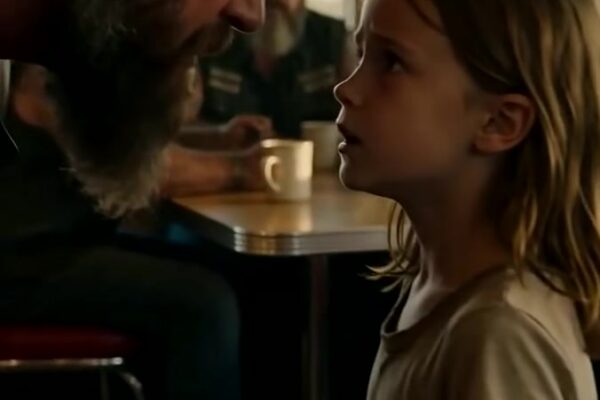
He stepped between the tables, and the garden’s laughter died. The boy trembled, not with theatrical fear, but the kind that comes from walking into a place you know was not built for you. Eyes followed him like searchlights. Someone whispered, “Where did he come from?” as though he’d climbed out of the soil.
Lucien’s irritation was immediate, honest, and public. He didn’t like surprises unless they arrived on velvet and could be claimed as his idea.
“Security,” he called, raising his hand without looking away from the boy. “Get him out.”
The boy didn’t bolt. He swallowed and forced his voice into the open air. “Please,” he said. “I need money. My mom is sick.”
A few guests shifted in their seats. A woman in pearls stared at her napkin as if it had become fascinating. A man with a watch that cost more than the boy’s entire street tilted his head, amused.
Lucien studied the child the way he studied quarterly reports: quick, cold, deciding what was worth attention. His mouth curved into something like a smile, but it held no warmth. It was the smile of someone who thought pity was a weakness others performed for applause.
“Then earn it,” Lucien said, loud enough for everyone. “Surprise us, and I might give you something.”
There was a ripple of expectation. They anticipated a squeaky attempt at entertainment, a clumsy plea, a spectacle to absolve them of guilt. Some guests leaned forward as if watching a show they hadn’t paid for and therefore could criticize freely.
The boy’s hands tightened around the flute. For a heartbeat, he looked like he might crumble. Then he lifted the instrument to his lips and closed his eyes.
The first note came out so soft it seemed impossible it could cross the space between them, but it did. It threaded through the garden and caught on the edges of conversation until everything else unraveled and fell silent. It wasn’t a cheerful tune meant to earn coins. It was a melody that carried the weight of nights without sleep and promises made in the dark.
The birds that had been hopping in the hedges went still. A fork paused halfway to a mouth. Even the fountain behind the head table sounded quieter, as if ashamed to interrupt.
Lucien’s expression changed not with appreciation but with shock—an unguarded rupture in the face he wore for crowds. His fingers tightened on his wineglass until the rim creaked under pressure.
He knew that song.
He hadn’t heard it in twenty years. He had written it once, late at night in a cramped apartment when his life fit inside a few cardboard boxes and a woman’s laughter. The melody had been meant as a lullaby, foolishly tender, something he’d hummed against the hair of the only person who had ever looked at him like he was more than ambition.
Her name had been Elara. Elara with ink-stained fingers and a stubborn kindness that made Lucien feel exposed. She had vanished from his life with a speed that left no footprints—gone after one terrible argument, gone after a night of rain and slammed doors. He’d looked for her until his search began to threaten his new career, and then he’d stopped because stopping was easier than admitting he might never understand why she left.
The last time he’d heard that lullaby, Elara had stood in the rain outside that apartment, her cheeks wet, one hand pressed over her stomach as if to protect something inside her. Lucien had been too angry, too proud, too certain he had already won the right to be cruel. He had told her to go.
Now the song poured from a boy’s flute in a garden filled with white tablecloths, and Lucien felt the past rise like water inside his lungs.
The melody ended on a note that seemed to hang in the air, reluctant to die. The boy lowered the flute. His eyes opened, dark and steady, and for the first time he looked directly at Lucien without flinching.
“Is that enough?” he asked, voice rough from holding back fear.
Lucien couldn’t answer. His throat had closed.
The boy reached into his pocket. The gesture was small, but several guests tensed as if expecting a weapon. Instead, he drew out a photograph, edges soft from being handled too many times. He held it toward Lucien with fingers that shook despite the steadiness in his gaze.
Lucien snatched it, almost violently, and then everything drained from his face. The world narrowed to a rectangle of paper.
It was him—young, lean, smiling with a kind of hope Lucien barely remembered owning. Beside him stood Elara, her head tilted toward his shoulder, her eyes bright. The background was a cheap carnival booth, a painted moon and stars. Lucien remembered the day: they’d eaten fried dough and laughed until their sides hurt, and later he’d played her the lullaby on an old piano with missing keys.
His fingers turned the photograph over. Seven words were scrawled on the back in faded ink, handwriting he would have recognized in any lifetime.
If he insults our son, show him.
Lucien’s hand began to tremble, the way the boy’s had. Around them, the garden seemed suddenly too bright, too loud with its quiet. He heard someone whisper, “What is that?” but it sounded distant, underwater.
He looked up at the boy. The shape of his mouth. The set of his jaw. The familiar stubbornness in the line of his brow. Details Lucien had never trained himself to see in strangers because strangers didn’t matter—until this one did.
“Your mother,” Lucien managed, each syllable scraped raw. “Her name.”
The boy’s chin lifted, not in pride but in defense. “Elara,” he said. “Elara Marren. She doesn’t have time for games. The clinic said if we don’t get the medicine today, it might be too late.”
Lucien’s heart kicked hard, a violent insistence. He saw, with nauseating clarity, all the years he’d spent polishing his image, building walls, signing checks for causes that never looked him in the eye. He thought of the lullaby, buried under success and bitterness, and how it had found its way back to him through a child’s breath.
He stood so abruptly his chair scraped the stone. Every guest watched, the way people watched a man about to make a scene. Lucien stared at the boy as if he were both accusation and miracle.
“Where is she?” Lucien asked.
The boy’s grip tightened on the flute. “At home. She told me not to come here,” he said, and his voice cracked for the first time. “But she also told me—if you made me earn it—then you’d deserve to know.”
Lucien looked down at his hands, at the photograph, at the proof of a life he had abandoned. His mouth opened, and for once no practiced speech arrived. All he had was the weight of what he’d done, and the terrifying chance to do something else.
He raised his head. “No,” he said, voice low, and the word carried through the silent garden like a blade. “You don’t earn her medicine. Not with music. Not with humiliation.”
He stepped away from the head table, leaving his glass untouched, leaving the donors and the polished silver behind as if they were suddenly cheap. He reached for the boy’s shoulder with trembling fingers and stopped just short, unsure if he had the right to touch.
“Take me to her,” Lucien said. “Please.”
The boy hesitated, eyes shining with fear and fury and something dangerously close to hope. Then he nodded once, sharp and final, and together they turned from the white tablecloths toward the gate—toward a past that had finally learned how to sing itself back into the open.