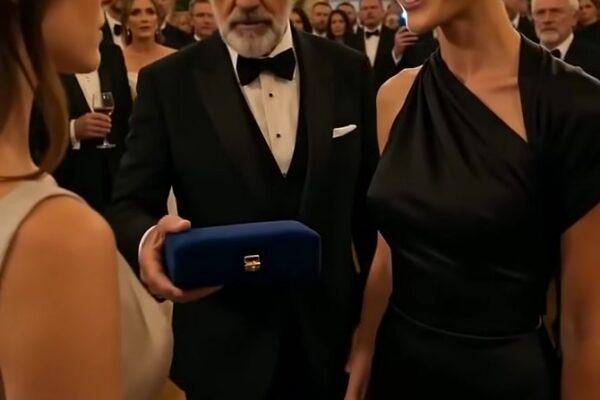
The violin stopped when the girl cried out.
It wasn’t a theatrical pause, not the kind the musician used to make the last note hover like perfume over the room. It was a hard, startled silence, as if a string had snapped inside the instrument—or inside the people listening. Candle flames shivered in their glass cups. Gold leaf on the ceiling caught the light and threw it back in fractured splinters. For a breath, the Roman dining room looked like a chapel that had just heard a blasphemy.
Lina stood at the entrance stand, shoulders squared the way her manager had taught her, palms open over the reservation ledger as though openness itself could protect her. She was twenty-two, maybe younger if you counted the way her eyes still searched the room for approval. Her name tag was pinned a little crooked, and the seam on her blazer had been mended by hand.
The woman in the dark red dress came at her like a gust from an open furnace. The dress had the weight of couture—heavy fabric, precise lines, the kind that told you it had never been worn on public transportation. A scent of expensive resin and crushed roses preceded her. She reached the stand, ignored the line of waiting guests, and seized Lina’s wrist with a grip made for getting what it wanted.
“Don’t pretend you don’t know,” the woman said, voice cutting cleanly through the soft clink of glasses. “You touched my coat. You leaned near my table. You smiled.” Each sentence came like a new accusation. “Open your hand.”
“Signora, I—” Lina tried to pull back, but the woman dragged her from the entrance into the center aisle, toward the candlelit ocean of white tablecloths and polished cutlery. People turned in their chairs. A waiter carrying a plate of truffles stopped so abruptly the scent arrived before the dish did. A few phones lifted, careful, predatory.
“Show everyone,” the woman demanded. “Show them where you hid it.” Her nails were manicured to sharpness, pale as teeth. “My diamond ring. The one my husband bought in Antwerp. The one I wore when I arrived.”
Lina’s fingers clenched tighter, not around stolen jewelry but around the instinct to protect herself. Her throat constricted. “I didn’t take it,” she whispered, and then, as humiliation began to burn behind her eyes, louder: “Please. I didn’t.”
The woman in red laughed, a short, cruel sound meant to invite the room to join her. “Listen to how sweet it sounds. Like confession in a child’s voice.” She yanked Lina’s wrist upward so everyone could see the tremble. “People like you always take. You take tips, you take glances, you take what doesn’t belong to you.”
The ugliest part was not the words, though the words were ugly enough to scrape. It was the way the room accepted the script. The diners watched with the detached interest they saved for opera—someone else’s tragedy performed at a safe distance. The violinist stood frozen beside the fountain, bow hovering, uncertain whether etiquette required music for a public unraveling.
“Open them!” the woman shouted, prying at Lina’s fingers. “Open your filthy little hand.”
Lina’s breath came in ragged pulls. She tried to speak, but it dissolved into a sob that surprised her with its rawness. She hated that sound. It made her smaller. It made the woman in red taller.
Then, as the woman forced Lina’s knuckles back one by one, something slipped free from the cuff of Lina’s blazer. It did not sparkle. It did not chime. It fluttered down like a fallen petal and landed on the marble with a soft slap.
A photograph.
The room didn’t understand at first. People leaned forward. The phones kept recording because phones always did. The woman in red paused, her eyes narrowing as if the picture were an insult.
An older man at a corner table—salt-and-pepper hair combed back, a ring of his own on a careful hand—pushed his chair away with the measured motion of someone accustomed to deciding when things began and ended. He crossed the aisle and bent to pick up the photograph, his knees creaking like the doors of an old house.
He held it beneath the candlelight, and something drained from his face so quickly it seemed to take the warmth with it. His thumb trembled as it traced the edge.
Lina stared at him, still held by the wrist, tears sliding down her chin. “Sir?” she managed. Her voice sounded foreign in the hush, like a language spoken too softly to belong.
The man lifted his gaze from the photograph to Lina’s face as though comparing two versions of the same story. “Where did you get this?” he asked. It wasn’t an accusation. It was fear wearing the mask of politeness.
“It’s mine,” Lina said, and then corrected herself, because the truth was more complicated. “It was my mother’s.”
The man’s lips parted. His eyes flicked again to the image. The photograph was old, its corners rounded by handling. In it, a woman in a wedding dress held a small child on her hip, both of them smiling at someone just out of frame. Behind them, barely visible, was the same marble pillar that stood in the restaurant’s corner now.
“This picture,” the man whispered, and in that whisper the dining room seemed to shrink, drawing in closer, hungry. “This picture was taken the night my brother married.”
The woman in red loosened her grip without meaning to. The name “my brother” carried weight in the room; it sounded like money had decided to pay attention.
The older man swallowed. “The bride disappeared before midnight,” he said, each word placed carefully, as if he feared the floor might crack beneath it. “We were told she ran. We were told she was… unstable. We were told she didn’t want the life.” He looked at Lina as if Lina were a door that should not be opened. “But I remember this moment. I remember her laughing. I remember the child—”
He held the photograph up, his hand shaking openly now. “Why are you in her arms?”
Lina flinched as though struck. Her free hand rose to cover her mouth, and her eyes widened with an old, buried terror that had nothing to do with a missing ring. “I don’t know,” she said, and the admission sounded like a confession. “I’ve asked her my whole life. She never told me. She said it wasn’t safe to ask.”
The violinist, still silent, lowered his instrument as if it had become too heavy to bear.
Lina’s gaze dropped to the photograph, and she spoke again, voice cracking. “My mother kept it in a tin box with our passports,” she said. “She said if anyone ever tried to shame me in public—if someone ever put their hands on me like this—then I should let it fall. She said the right eyes would recognize it.”
A ripple moved through the tables, not applause, not outrage—something darker, the sound of a society sensing that a secret had been placed among them like a blade.
The older man’s breathing quickened. He glanced over his shoulder toward the private dining alcove where men in tailored suits sat with their backs straight, watching in careful stillness. “If that child is you,” he said, and his voice rose just enough to reach the entire room, “then someone has lied for twenty years.”
The woman in red took a step back, suddenly aware that her performance had shifted genres. Her eyes darted toward the alcove, toward the faces that did not react because reacting would admit investment.
“The ring,” she snapped weakly, trying to drag the scene back to its original cruelty. “We’re talking about my ring.”
Lina lowered her wrist, rubbing it where the woman’s fingers had left pale marks. She looked up, and for the first time that night her gaze held steady. “No,” she said quietly. “You were talking about your ring. I was trying not to disappear.”
The older man turned the photograph in his hand as if it were a compass that had finally found north. “What is your mother’s name?” he asked.
Lina hesitated. Saying it felt like striking a match. “Giulia,” she whispered. “Giulia Marin.”
A man in the alcove shifted. Just a subtle movement, but enough. Enough to tell Lina that something in the room had recognized her too.
The older man’s jaw tightened. “My brother married a Giulia,” he said. “Giulia Marin. The family insisted she was no one. That she was lucky. That she should be grateful.” He looked at Lina’s wrist, the reddened skin. “And now you’re here, being handled like property, in the same building where she vanished.”
The candles kept burning. The phones kept recording. But the room had changed. The air was no longer full of dinner and music. It was full of witness.
At the edge of the marble pillar, the violinist lifted his bow again, not to play, but to point it, gently, toward the alcove. As if to say: there. That is where the story has been hiding.
Lina’s tears slowed, not because she was calm, but because something else had taken their place—an intention that tasted metallic on her tongue. She reached out, and the older man placed the photograph into her palm with reverence.
“If your ring is missing,” Lina said to the woman in red, her voice low and steady now, “you can search my bag. You can call the police. You can do whatever makes you feel important.” She held the photograph against her heart. “But I’m done being your entertainment.”
She turned toward the alcove, toward the men who watched too carefully, and every step she took across the marble felt like a sentence being rewritten in ink that could not be erased.
Behind her, the violin did not resume. The silence remained, held in place by the room’s collective fear of what Lina might ask next—and who, at this table of gold and candlelight, might finally be forced to answer.