The boardroom on the thirty-seventh floor had a view that made men feel untouchable. The city spread beneath the glass like a conquered map, and inside, around an oval table polished to a mirror shine, sat the people who owned the view. Their name was stitched into buildings, embossed on annual reports, whispered with a certain deference in courthouse hallways and charity galas. They were waiting to approve a deal that would turn a poor strip of riverfront into a lattice of luxury towers, and the mood was practiced certainty—murmured jokes, sleek tablets, coffee served with careful smiles.
At 9:02, the doors opened with a restrained click. No assistant announced the visitor. No security detail preceded him. He walked in as if he’d been told to, though no one remembered inviting him.
He wasn’t young, but not old enough to be discounted as harmless. His coat was clean yet worn at the cuffs, the sort of garment that had been mended rather than replaced. In his left hand he held a single, plain envelope, unmarked except for a crease where it had been gripped too tightly. He paused just inside the threshold, letting his eyes adjust to the brightness, and then looked at the people around the table one by one with a calm that was almost unnerving.
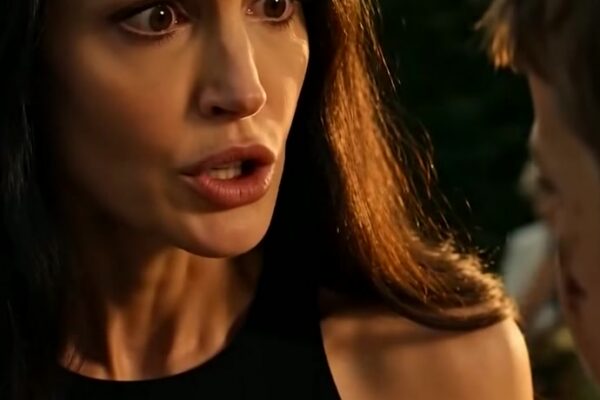
“May I help you?” the chairwoman asked. Eleanor Voss didn’t raise her voice. She didn’t need to. The room answered to her like a trained animal.
“I’m here about the Riverside project,” the man said.
A faint ripple of amusement passed between two directors. Riverside was the jewel on the agenda, the project whose public hearings were scheduled to be a formality. The chairwoman’s gaze skated over his coat, his hands, the fact that he carried no laptop, no portfolio, no badge. Nothing but that envelope.
“Public comment is downstairs,” she said. “This is a private session.”
He didn’t move. “I know where public comment is.”
The general counsel, Mr. Bram, leaned forward as if he could push the man out with the weight of his suit. “Sir, if you’re here to protest—”
“I’m not here to protest,” the man interrupted softly. “I’m here to deliver something.”
“To whom?” Bram asked, a smile thinning his mouth.
“To all of you,” the man said, and held up the envelope. “It’s for the room.”
Eleanor Voss’s expression did not change, but the muscles beneath it tightened. “Security,” she said, not looking away from him.
The door behind the man opened again. Two security officers entered with the briskness of people asked to correct an inconvenience. The man turned slightly, acknowledging them with a glance, and then faced the table again.
“Give it to your assistant,” Eleanor said. “And leave.”
“If I leave,” the man replied, “it’ll still be yours. You’ll just open it later, when you can decide how to bury it.”
The room became very quiet. It was quiet in the way a theater is quiet before the curtain rises—anticipation laced with irritation. Eleanor’s eyes narrowed. “Who are you?”
He seemed to consider how much truth to offer. “My name is Jonah Mercer.”
The directors exchanged looks. The name meant nothing to them. Or they pretended it did not.
“Jonah Mercer,” Bram repeated, with a faint shrug. “Mr. Mercer, you are trespassing.”
Jonah nodded once, a small motion of acceptance rather than fear. “I expected you’d call it that.” He extended the envelope toward the center of the table, not crossing into their space, only offering it like a test they could refuse. “Please. Before you decide I’m nothing.”
One of the security officers reached for Jonah’s arm. Jonah didn’t flinch. He merely said, “If you touch me before she reads it, you’ll regret it. Not because I’ll fight you. Because the cameras will.”
That made the officer hesitate. Bram’s eyes flicked toward the corner of the ceiling where a small dome camera blinked its indifferent red light. Eleanor’s jaw worked once. She hated uncertainty like a stain. Finally she lifted a hand, stopping security with a gesture that cost her nothing and communicated everything.
“Bring it here,” she said.
Jonah walked to the table. For the first time, the directors had to look up at him properly, had to see the steady set of his shoulders. He placed the envelope on the polished wood. It looked absurdly small against the expensive tablets and leather folios.
Eleanor turned it over, checking for explosives in a way that was more psychological than practical. There was only a flap, sealed with a strip of tape. She peeled it open, slid out the contents, and her eyes dropped to the first page.
At first, her face remained controlled. Then the control shifted. A flicker at the corner of her mouth. A tiny widening of the eyes. The faintest blanching of skin at the cheekbones, as if all the blood had made a decision to retreat.
“What is this?” she asked, though the question was for herself as much as for the room.
Bram leaned in automatically, drawn by her reaction like a moth to heat. “Madam Chair—”
“No,” she snapped, and it was the first time any of them had heard her voice crack like that. The word hit the air with the sound of a glass shattering.
Across the table, one director cleared his throat. Another smiled uneasily. “Eleanor?”
She didn’t answer. She scanned the page again, then the next. Her fingers trembled so slightly it could have been imagined—until she pressed them hard against the paper as if to pin reality in place. Jonah stood perfectly still, his hands at his sides.
“Read it,” Jonah said quietly. “Out loud.”
Eleanor looked up, and in that glance was something the room had never seen in her: fear, and behind it, recognition. “You,” she whispered, as if his face had finally found its place in a locked drawer of memory. “You’re…”
“The boy who used to mop your office after hours,” Jonah finished for her. “Back when this company’s logo wasn’t carved into marble.”
Someone laughed—a short, disbelieving burst that died immediately when Eleanor did not. Jonah’s eyes did not accuse; they simply held the truth where everyone could see it.
“Why are you here?” Bram demanded, recovering first. “If this is extortion—”
“It’s evidence,” Jonah said, and nodded at the pages. “And a confession. Not mine.”
Eleanor’s throat moved. She forced herself to read, her voice tight, each line dragged into the air like a body from deep water. The first page was a notarized affidavit from a former city inspector, detailing bribes paid for fraudulent environmental clearances. The next was a forensic accounting summary—names, dates, shell companies, sums that curved into the millions. Then photographs: rusted drums half-buried near the riverbank, taken years ago, geotagged, annotated. Then a transcript of a recorded phone call, Eleanor’s voice unmistakable, cool and decisive, instructing someone to “make it disappear before the families ask questions.”
Each piece landed on the table like a weight. Each name was familiar. Each figure circled back to someone sitting in that room. Their confidence began to fracture, hairline cracks spreading fast.
“This is fabricated,” one director said, too quickly.
Jonah’s gaze moved to him. “The city server logs aren’t fabricated. The audio metadata isn’t fabricated. And the ledger entries in your own system aren’t fabricated.” He nodded toward Bram. “He knows.”
Bram’s face had gone the color of paper. “How did you get these?” he rasped.
Jonah did not smile. “Because you were sloppy. Because you thought no one who cleaned your floors could understand what he was seeing. Because you threw away drafts and believed shredders were absolution.” He paused, and for the first time, his calm wavered—just enough to reveal the force beneath it. “My mother lived in Riverside. She got sick. She died while you were making your riverfront pretty.”
Silence spread, thick and suffocating. The city beyond the glass continued, uncaring. Cars moved like insects. The river glinted with indifferent light.
Eleanor’s voice came out low. “What do you want?”
Jonah looked around the table, at the men and women whose hands had signed papers that changed lives. “I want you to stop,” he said. “I want the cleanup to be real, not a press release. I want the clinic you promised in those community meetings to be built, staffed, funded. I want the families who are still there to be moved somewhere safe with compensation that doesn’t insult them. And I want your project permits withdrawn before another foundation goes in and seals poison under concrete forever.”
One director scoffed, but it was brittle. “You think you can force—”
Jonah reached into his coat—not a weapon, but a phone, which he placed on the table beside the envelope. The screen was lit, showing an email draft addressed to multiple recipients: state investigators, federal environmental enforcement, every major newsroom in the city, and a list of names long enough to make the room spin.
“It’s scheduled,” Jonah said. “A timed release. If I don’t cancel it within the hour, it goes out. If something happens to me later, it goes out. If I disappear on my way home, it goes out.” He glanced at the security officers, who now looked at Eleanor as if she were the trespasser. “You taught me to be careful. I listened.”
Eleanor’s hand hovered over the papers, as though she could press them back into secrecy by force. Her eyes darted to Bram, to the others, measuring who might sacrifice whom. The room that had felt untouchable a few minutes earlier suddenly felt like a cage with glass walls.
“This is insane,” Bram whispered, not because it was untrue, but because the power had shifted and he could feel it.
Jonah’s voice was steady again, almost gentle. “No,” he said. “This is overdue.”
He leaned forward slightly, not aggressive, simply certain. “You dismissed me the moment I walked in,” he continued. “You looked at my coat and my empty hands and decided I couldn’t hurt you. That was your mistake. I didn’t come in with nothing. I came in with what you forgot to fear.”
Eleanor swallowed. In the brittle quiet, the hum of the building seemed louder. She stared at Jonah Mercer—the former janitor, the son of a woman they had reduced to a line item—and she saw, perhaps for the first time, the cost of their certainty.
“If we agree,” she said slowly, each word tasting like defeat, “you’ll cancel it.”
Jonah nodded. “When the first permit withdrawal is filed,” he said. “Not when you promise. When it’s done.”
Outside, the river kept moving, carrying its secrets downstream. Inside, the people who owned the skyline sat very still, and the man with the envelope held the hour in his hands like a blade—quiet, unwavering, and sharp enough to cut through everything they’d built.