“Don’t expect much,” they whispered, the way you might warn someone about a stale piece of bread or a town that had already burned down once.
The whisper came from a woman at the bus station who looked like she’d been waiting there for years. Her coat hung off her shoulders with the resignation of fabric that had forgotten warmth. She didn’t meet Mara’s eyes when she said it—she aimed the words at the floor, as if the tiles needed the warning more than a stranger did.
Mara had no intention of expecting anything. She’d come to Graywater because the letter insisted she should. The paper was thick and rough-edged, the ink a bruised black that bled through as if it couldn’t hold its own secrets. There was no signature, only a single sentence: Come before the river changes its mind.
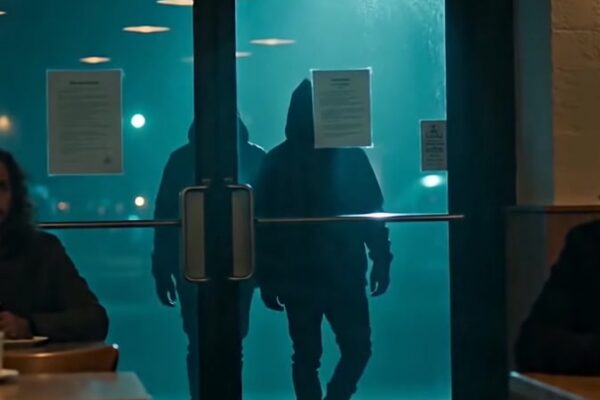
At the station, the air tasted of diesel and damp wool. Beyond the glass doors the town lay low under heavy clouds, roofs flattened against the horizon, windows like half-shut eyes. Mara carried her bag with both hands as if it might try to escape, and the letter sat in her pocket like a coal.
She asked the woman at the station, “Why?”
The woman’s mouth tightened, not in anger but in an old grief that had grown familiar. “Because if you expect something,” she said, “the town will make sure you get it. Just not in the way you mean.”
Then the woman turned her head as if listening to someone behind Mara. There was no one there. Only the gray hum of the departing bus and the hollow clap of its doors.
Mara walked into Graywater anyway.
She found the inn by accident or by the town’s quiet arrangement—one of those places whose sign always swings toward you no matter where the wind comes from. The landlord, a man with fingers stained from varnish and tobacco, gave her a key without asking her name. “Second floor,” he said. “End of the hall. Don’t open the small door on the right.”
“Why?” Mara asked again, because in a place like this you had to keep asking why, even if the answers were worse.
He shrugged in a way that made his shoulders look heavier. “Don’t expect much,” he muttered. “It’s just old storage.”
The hallway upstairs smelled of cold plaster and old perfume. Her room was spare—iron bed, thin curtains, a desk with a single drawer that stuck when she pulled it. Out the window she could see the river, broad and slow, the color of a tarnished mirror. It looped around the town like an arm that refused to let go.
She set her bag down and unfolded the letter again. The sentence stared back at her with the same blunt urgency. Come before the river changes its mind.
Mara’s mother had once told her that rivers remembered. Not with words, but with shape. They kept a record in silt and bend and floodplain, and every so often they tried to rewrite the story.
Mara hadn’t thought of her mother in years without the sting of something unfinished. There were no good last conversations, only a phone call that hadn’t been returned, a funeral she hadn’t attended, and a house that had been sold by someone else before Mara could decide what she felt.
When the afternoon thinned into dusk, she left the inn and followed the street that sloped toward the water. Graywater’s buildings leaned inward, as if they were eavesdropping. A church bell rang once without a reason. People moved past her with faces set in careful neutrality, their eyes skimming over her like she was a stain they didn’t want to acknowledge.
At the riverbank, she found a footpath beaten into the reeds. There was a fence, but its gate stood open. A sign, half-warped from weather, read: NO TRESPASSING. THE WATER IS NOT KIND. Someone had scratched beneath it in smaller letters: It’s kinder than we are.
Mara hesitated. The letter in her pocket seemed to warm against her skin, urging her on. She stepped through the open gate.
The path led to a small dock that extended into the slow-moving water. At the end of it sat a boy, maybe twelve or thirteen, legs dangling over the edge, shoes scuffed and wet. He didn’t turn when Mara approached. He stared at the river with the seriousness of someone watching a trial.
“Are you lost?” Mara asked.
“No,” the boy said. “But you are.”
She stopped a few feet behind him. “Do you know why I’m here?”
He finally looked at her. His eyes were pale and sharp, too old for his face. “You were invited,” he said, like that should have been enough. Then he leaned forward and tapped the surface of the water with his finger. The river didn’t ripple the way it should. Instead, it dimpled inward, as if the skin of it were thinner there.
“Don’t expect much,” he added, almost gently. “It doesn’t like disappointment.”
Mara’s throat tightened. “Who sent the letter?”
The boy shrugged. “The ones who couldn’t. The ones who didn’t make it out before it decided.”
A chill threaded up Mara’s spine. She looked along the river, trying to understand what he meant. The water seemed ordinary from a distance—slow, broad, patient. But standing at its edge, she noticed how it tugged at the reeds with a hunger that wasn’t quite natural, how it lapped at the dock as if counting heartbeats.
“What does it want?” she whispered, suddenly aware that the town behind her had gone very quiet.
The boy’s face tightened. “It wants what was taken from it.”
He slid off the dock and stood. He was shorter than Mara expected. When he walked past her, he smelled like rain on stone. “Come,” he said.
Mara followed him along the bank to a cluster of willows. Beneath their hanging branches was a patch of ground that looked wrong—too smooth, too undisturbed. The boy knelt and pulled aside the wet leaves as if he’d done it before. Underneath, set into the earth, was a metal hatch with a rusted handle.
Mara stared at it. “What is that?”
“Where the town put its expecting,” he said. “So no one had to carry it.”
He grasped the handle and pulled. The hatch opened with a sigh of trapped air, and a smell rose up—cold water and old paper and something like iron.
Mara peered into the darkness. A ladder descended into it. Her skin prickled. “Is this—”
“A flood shelter,” he said. “A mistake. A bargain.”
He turned his face toward the river. The water had begun to move differently. Not faster, exactly—more attentive. Like it had sensed a story loosening.
Mara’s heart hammered. She could have walked away, gone back to the inn, left town in the morning and told herself the letter had been a prank or a cruel whim. She could have accepted the whisper’s warning and expected nothing.
But the hatch was open, and the air from below felt like an exhale from something alive.
She descended the ladder.
The shelter beneath the ground was larger than she imagined, a concrete chamber with a low ceiling and a floor slick with damp. Water dripped steadily somewhere in the dark. When Mara’s eyes adjusted, she saw shelves lining the walls, and on them, hundreds of glass jars.
In each jar floated a scrap of paper, folded and sealed in wax. Names. Dates. Handwriting in different slants and pressures, the intimate evidence of many hands. Some jars held photographs, their edges curled, faces blurred by time. Some held small objects: a ring, a braid of hair, a child’s tooth, a button that looked like it came from a uniform.
Mara’s breath caught. “What is this?”
The boy’s voice came from behind her, softer in the confined space. “What people promised the river,” he said. “So it would spare them. So it would go around their houses and not through them.”
Mara stepped closer to the shelves, drawn in spite of herself. The jars were labeled with careful ink. EXPECTATIONS, the biggest shelf read, and beneath it, smaller categories: RETURNED, OWED, FORGOTTEN.
She reached for one at random. Inside, the paper was folded into a tight square. She turned the jar and saw the label: MARA LINDEN.
Her hands went numb. “That’s me.”
The boy didn’t look surprised. “It always was.”
Mara’s throat closed around the words she wanted. “I never— I didn’t—”
“Your mother did,” he said, and the name landed like a stone dropped into still water. “She wrote your name here, and she asked the river to be kind. She asked it to take something else instead.”
Mara’s knees threatened to fold. She clutched the jar as if it were the only solid thing in the room. “Why would she do that?”
The boy’s expression shifted, and for a moment he looked younger, almost afraid. “Because she expected too much from life,” he said. “And the river doesn’t like that. It collects the excess. It keeps it. It makes sure you pay.”
Mara stared at her name floating in the jar, sealed in wax like a curse preserved for later. A faint sound filtered down from above—a deep groan, like earth being dragged. The shelter shuddered slightly.
“It’s changing its mind,” the boy said. “It’s coming back for what it’s owed.”
Mara looked up, as if she could see through the concrete to the river above. “What happens if it comes?”
He swallowed. “The town floods. Not just with water. With everything it buried.”
The air thickened with the scent of damp and iron. Somewhere on the shelves, a jar trembled, then another, as if responding to a distant call. Mara held her jar tighter, the glass cold against her palm.
She thought of her mother’s voice, the way she used to say, Don’t hope too loudly, Mara. Not in this world. It hears you.
Mara had hated that sentence. She had vowed to be the kind of person who expected everything. Love that stayed. Apologies that arrived on time. A life that didn’t bend around other people’s fear.
Now, in the underground chamber of a town that had been paying its debts in secret, Mara realized the whisper had been a warning and a test.
Don’t expect much, they’d said.
But what came next—this shelf of bottled promises, this river hungry for what had been deferred—was too much to ignore.
Mara set the jar back on the shelf with deliberate care. Then she reached for the lid, pressed her fingers to the wax seal, and began to pry it open.
The boy’s eyes widened. “You can’t,” he breathed.
Mara’s hands shook, but her voice didn’t. “I’m done letting other people decide what I’m allowed to want,” she said. “If the river is coming for expectations, then it can start with mine.”
Above them, the groaning sound deepened, like a great body shifting in its sleep. Water began to seep under the hatch’s frame, thin at first, then steadier, as if the river had found the scent of what it was owed and was following it home.
Mara broke the wax seal.
The jar opened with a small, sudden pop—quiet as a breath finally released. And somewhere beyond the concrete, the river answered, not with rage, but with attention. Like it had been waiting for someone to stop whispering and speak plainly at last.
Mara unfolded the paper inside, ready to read what her mother had tried to store away—and ready, finally, to pay for it with the truth.