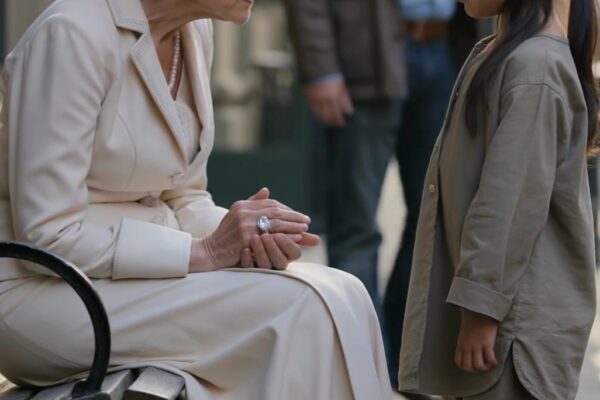
“Don’t even try,” they muttered, not loudly—just enough for the words to seep between the ribs and press on the heart like a thumb. The phrase floated in the corridor outside the council chamber, mingling with dust and old varnish, and it landed on Elias Hart as if it had been waiting for him specifically.
He paused with his hand on the door. Beyond it, voices rose and fell in practiced cadences: budgets, permits, heritage, safety. In the narrow glass pane set into the wood, he saw a sliver of the long table, the blurred movement of sleeves, the glint of water pitchers under fluorescent lights. This room had denied him before. It had denied others for decades. The city kept its miracles small and its mistakes quiet.
Elias turned to find who had spoken. A clerk in a gray cardigan stared at her clipboard as if the paper could shield her. Beside her, an older man in a maintenance uniform tightened his jaw, eyes flicking toward Elias’s folder. Their faces held the same weary sympathy: the kind people offered when they believed hope was a form of naivety, like trusting a storm to spare a roof simply because it was loved.
“Don’t even try,” the maintenance man repeated, softer this time. “They already decided.”
Elias’s folder was too thin for the weight it carried. Inside were printed sketches, structural reports, a petition with hundreds of signatures, and a photograph of the derelict building that had consumed his life for the past year: St. Brigid’s Theater, boarded and blackened, its marquee letters hanging like broken teeth. It sat at the edge of the floodplain, condemned and forgotten. To the council, it was a liability. To Elias, it was a promise he’d made to his mother in a hospital room that smelled of antiseptic and rain.
“I heard you,” Elias said. His voice came out steadier than he felt. “But I’m going in.”
The clerk’s pen hovered. “Mr. Hart… you’re not on the agenda.”
“Then they can add me,” he said, and pushed the door open before doubt could climb his spine and settle there.
Conversations snagged and stopped. The chairwoman, Lenora Voss, looked up with the calm irritation of someone whose time had always been protected. Her silver hair was pinned with mathematical precision, her glasses perched low enough to make every glance feel like judgment. She didn’t ask who he was; she knew. Everyone in the city knew the man foolish enough to campaign for a theater that had burned twice and flooded three times.
“You’re interrupting,” Voss said.
Elias stepped forward anyway, the folder clutched like a life vest. “I’m asking for three minutes.”
A councilman in a navy suit let out a laugh that tried to sound casual, as if the absurdity of Elias’s presence was an amusing aside. “We’ve heard all this,” he said. “And you’ve been told—”
“Not to try,” Elias finished, feeling heat behind his eyes. He set the folder down on the table with care. “I know. But I’m here because you’ve turned St. Brigid’s into a story you repeat whenever you want to scare people about ‘dreamers.’ You say it’s unsafe. You say it’s expensive. You say it’s doomed. And you’re right about the danger. You’re right about the cost. You’re wrong about the doom.”
The room shifted, chairs creaking, throats clearing. Elias pulled out the photograph and slid it toward Voss. “This building was built when this city still believed in gatherings. When people dressed up to sit shoulder to shoulder and watch the same light. My mother worked there as an usher when she was sixteen. She used to say the theater taught her that a crowd could breathe as one.”
Voss’s eyes moved over the photo without expression. “Sentiment,” she said. “Is not engineering.”
Elias nodded. “That’s why I brought engineering.” He flipped to the structural report. “The foundation is salvageable with piers. The roof trusses can be reinforced. The restoration plan accounts for flood mitigation. I’ve secured pledges from private donors—real money, not wishes. I have volunteer labor commitments. And I have a signed agreement from the university’s architecture program to supervise the work as an educational project.”
Across the table, Councilman Reed—the one in navy—leaned forward, elbows on the polished surface. “You don’t have enough. Not for that building. Not for what it becomes once you open the walls.”
“Open the walls,” Elias repeated, and the phrase struck like a bell. He thought of the last time he’d been inside St. Brigid’s. He’d pried a board loose, slid through the gap, and stood in the dark where the air tasted of damp plaster. His flashlight beam had crossed the stage and caught something pale hanging from the rigging: a curtain half-burned, swaying as if it remembered applause. Under the seat rows, he’d found discarded programs with dates from before he was born, and on the back of one, in his mother’s looping handwriting, a note she must have written during intermission: If I ever leave this city, I’ll miss the sound of people laughing together.
He had not left the city. She had not lived long enough to see if the city would laugh again.
“I know what’s inside,” Elias said. “Mold. Rot. A mess. But also a frame that can hold something better than what we’ve settled for.” He turned, sweeping his gaze across the council, the observers, the reporters along the wall. “You talk about ‘revitalization’ like it’s a slogan on a banner. This is the chance to do it with hands and sweat and proof.”
A murmur rose, not quite support, not quite dissent—something restless, like the city itself shifting in its sleep.
Voss tapped her pen once, a small sound that silenced the room. “Mr. Hart,” she said, “you don’t understand the pressures we face. There are developers ready to purchase that land. The tax base—”
“The land isn’t the theater,” Elias interrupted before he could stop himself. He swallowed and forced his tone back into control. “It’s easy to sell dirt. It’s harder to keep a place.”
Voss’s gaze sharpened. “We are not in the business of nostalgia.”
Elias leaned closer, the table between them suddenly feeling like a narrow bridge. “No,” he said. “You’re in the business of deciding what this city remembers. And what it forgets. You’ve been forgetting us—people who can’t buy our way into your plans.”
There was a beat of dangerous quiet. Elias felt it then: the precariousness of what he’d done. How quickly a room of power could make a person small. He imagined being escorted out, his folder returned to him like a consolation prize, the maintenance man’s pity waiting in the hallway.
And then, from the back row, a voice spoke up. “Let him finish.”
It was an elderly woman in a raincoat, her hair braided tight. Elias recognized her from the petition line; she’d been the first to sign, the one who’d said, “My husband proposed to me in the balcony.” Now her hands were clenched around her purse strap. “We’ve listened to you for years,” she continued, addressing the council, “and all you’ve done is make the city smaller.”
Another voice joined—young, sharp. “My brother plays music on the sidewalk because there’s nowhere else.”
A third: “We can’t keep losing places.”
The room, once orderly, became human. It was as if Elias’s three minutes had cracked something and the pressure behind it was finally escaping. Voss’s mouth tightened, but her eyes flickered—calculating, assessing not just Elias but the wave forming around him.
Councilman Reed glanced at the reporters. “Chairwoman,” he said carefully, “it may be wise to—”
“Wise,” Elias echoed, almost bitterly. “That word has been used like a padlock.” He inhaled, the air in the chamber tasting of paper and old coffee. “I’m not asking you to believe in me. I’m asking you to vote for a chance. A pilot permit. Ninety days. Let us secure the building, prove the plan, and show you what St. Brigid’s can become. If we fail, you can sell the land with a clean conscience. If we succeed… you’ll have to admit you were wrong.”
Voss studied him for a long moment. In her expression Elias saw the brittle border between control and fear—the fear of being the one who let chaos in. Her pen stopped tapping. “Ninety days,” she repeated, as if testing the weight of the words.
Outside, thunder rolled over the city like a warning. Elias thought of the theater again, its boarded windows facing the river, waiting through every storm. His mother’s voice came back to him, not as memory but as presence: Don’t let them tell you what’s possible.
“Ninety days,” Elias said. “That’s all I’m asking.”
Voss turned to the clerk. “Add Mr. Hart to the agenda,” she said, each word clipped, reluctant. “We will put the pilot permit to a vote.”
A collective inhale swept the room, followed by whispers that sounded like the first stirrings of a crowd learning to breathe together. Elias felt his knees threaten to give, and he gripped the table edge until the tremor steadied.
In the hallway afterward, the maintenance man caught up to him. “You’re out of your mind,” he muttered, but something in his eyes had changed—less pity, more something like respect edged with dread.
Elias looked back at the closed chamber doors. Behind them, numbers would be tallied, hands raised, power exercised. Outside, rain began to fall against the high windows, a steady percussion that reminded him of applause starting somewhere distant.
“Maybe,” Elias said. “But now they have to watch.”
And in that small shift—from being dismissed to being seen—everything had already begun to change.