The last light of October slid down the courthouse steps in tired gold, as if even the sun had grown weary of watching people get forgiven and forgotten. Mara Caldwell stood with her palms tucked into the sleeves of her coat, the paper summons folded into a hard rectangle in her pocket. She had told herself it was just another errand: show up, sign a form, confirm the accident report, leave. A checkbox day. A day meant to end with tea and silence.
Behind her, the heavy doors exhaled a stream of strangers—clerks with briefcases, lawyers adjusting their ties, couples walking too close or too far apart. The city moved around her like water around a stone. She watched the traffic crawl, watched a pigeon hop with the stubborn confidence of something that had never had to explain itself to a judge. In the distance, sirens keened and then vanished.
Her brother Eli was late. That was not unusual. Eli lived late, breathed late, made apologies late and delivered them like gifts. She checked her phone for the time and the messages that didn’t exist. When she looked up again, she saw him cutting across the plaza, jacket unbuttoned, hair a mess, a grin already assembling on his face as though this were all a prank that would end in laughter.
“Mara,” he called, lifting a hand like a boy hailing a bus. “I made it.”
“You’re ten minutes late,” she said, but the bite didn’t carry much force. She had missed him in a way she refused to name.
“Only because the parking garage ate my ticket,” he said, and held up a crumpled receipt as evidence. Then, because he couldn’t stand a solemn moment without stepping on it, he added, “I fought it. I lost. I lived.”
She shook her head, tried not to smile. “We’re not here for comedy. We’re here because you ran a red light and clipped a man’s bike.”
Eli’s grin softened at the edges. “It wasn’t a red light.”
“The report says—”
“The report says a lot,” he interrupted, and his voice turned quieter. “I don’t want to argue. I just want to get it over with. Like you said. Another moment.”
They started down the steps together. Mara kept her gaze on the pavement, the familiar cracks, the chewing-gum ghosts stuck like old regrets. She was practicing what she would say if anyone asked her to speak on his behalf. Eli had begged her to come. Not because he needed help, he said. Because he needed her presence. As if her body in a seat could anchor him to better decisions.
At the bottom of the steps, a man stood near the curb, his back turned, shoulders hunched against the cooling air. A bicycle leaned beside him, front wheel warped in a lopsided oval. He was holding a helmet in both hands as if it were something that had betrayed him.
Mara’s thoughts ran ahead of her feet. The cyclist from the report. The injured party. She expected anger, a demand for money, a look that said you’re the reason my ribs still ache. She expected the day to get uglier in a predictable way.
Eli stopped so abruptly Mara nearly bumped into him. His breath caught. “No,” he said, barely audible.
The man turned at the sound, and the world tightened. He was older than Mara had imagined, perhaps late sixties, with silver hair and a face mapped by years of weather and worry. He stared at Eli—not with fury, not with suspicion, but with the stunned, brittle focus of someone peering through glass and realizing it isn’t glass at all.
“Eli?” the man said.
Mara’s mouth went dry. She knew that voice. She had heard it in her childhood, muffled through walls during late-night calls, the voice that made her mother’s shoulders rise and fall like a collapsing tent. She had heard it last at thirteen, the night her mother threw a mug at the sink and said, He’s gone, Mara. We’re not waiting for him anymore.
“Dad?” Eli whispered.
It was a word Mara hadn’t spoken in years. It sat between them like a fragile object, impossible to pick up without breaking something. The man—Howard Caldwell, the name Mara had scrubbed from her mind like a stain—took a small step forward. His eyes moved over Eli’s face as if counting the years he’d missed.
“I didn’t know it was you,” Howard said. His voice was raw, like he’d been shouting into wind for too long. “When the officer called, they said a blue sedan. They said a young man. I came to… I came to see if you were going to show. To look you in the eye.”
Eli’s hands flexed at his sides. “I did show.”
Howard swallowed. “I’m glad.”
Mara stood frozen, a bystander in her own life. She stared at the warped wheel, at the scrape marks on the helmet. A small accident, the kind that should have ended with insurance and apologies. Yet here it was—dragging her father back out of the past like a hook snagging an old net.
“You’re riding a bike now,” Mara heard herself say, surprised by the steadiness of her voice. “Is that what you do? You… circle around?”
Howard flinched, as if the word had struck him. “I don’t circle,” he said, then exhaled and let the fight go out of him. “I didn’t plan to run into you. I haven’t lived in this city for twenty years.”
“Then why are you here?” Eli asked, and the question wasn’t about the courthouse.
Howard looked down at the helmet in his hands. A crack ran along one side. “My heart,” he said. “It’s been… unkind. My doctor says I shouldn’t be alone. I didn’t want to die without—” He stopped, as if the word die was too heavy for his tongue. “I didn’t want to leave things the way I left them.”
Mara’s chest tightened with a familiar anger, the old one she’d kept polished and ready. “You left,” she said. “You didn’t just leave the city. You left us.”
Howard’s eyes shimmered, but he didn’t look away. “Yes,” he said. “I did.”
There was no excuse after that. No story of misunderstood intentions. Just the truth, plain and brutal. The honesty should have felt like relief, but it made Mara’s anger wobble, like a chair missing a leg. She had built her life around the certainty that her father was a villain. Villains didn’t stand in autumn light, holding a cracked helmet, looking older and smaller than memory allowed.
Eli stepped forward until he was close enough that Mara could see the tremor in his jaw. “You don’t get to come back because you’re scared,” he said. “You don’t get to show up at a courthouse like this is fate giving you a second act.”
Howard nodded once, hard, as if accepting a sentence. “I know.”
For a moment, the city held its breath. A bus sighed at the curb. A pedestrian laughed into a phone. Somewhere, a door slammed. Ordinary sounds, indifferent to the fracture opening in the Caldwell family on a public sidewalk.
Mara realized then why it felt unreal: she had expected dramatic reunions to happen in living rooms, with storms outside, with music swelling at the right moment. Not here, not with the smell of exhaust and the courthouse looming behind them like a reminder that consequences were real.
Howard held out the helmet, absurdly, like an offering. “I’m not asking you to forgive me,” he said. “I’m asking you to let me apologize while I still can. And… if you’ll allow it… I’d like to fix what I can. Even if it’s only small things.”
Eli stared at the helmet, then at the bicycle with its mangled wheel. His laugh came out cracked. “You want to fix things,” he repeated, and Mara couldn’t tell if the bitterness in his voice was aimed at Howard or at the universe for its timing.
Mara took a step toward her father before she could stop herself. “We came here to sign papers,” she said, voice low. “We came here to close a file.” She met Howard’s gaze. “But you’re not a file. You’re not a report.”
Howard’s throat worked. “No,” he said. “I’m worse.”
Mara reached into her coat pocket and pulled out the folded summons, the crisp page she’d treated like a shield all day. She held it between them. “If we do this,” she said, “it’s not because we owe you. It’s not because the court says so. It’s because we decide what happens next.”
Eli’s eyes flicked to Mara, startled. She saw in them the same fear she felt: that choosing anything but anger meant risking pain again. Yet anger, she realized with a sinking clarity, had never kept her safe. It had only kept her busy.
Howard didn’t reach for the paper. He didn’t reach for her. He simply bowed his head, as if granting them space to refuse. “I understand,” he said. “Tell me what you need.”
Mara looked at the warped wheel, at the crack in the helmet, at the three of them standing like strangers under the thinning light. She thought of all the moments that had been just another moment—dinners, school plays, birthdays—until they weren’t, until they became the memories that defined a life.
“I need you to sit with us,” she said finally, and her voice shook as it left her. “In there. In public. Where it’s real. And then… we’ll see.”
Eli let out a slow breath. His shoulders sagged, not in surrender, but in the exhaustion of carrying a story alone. He nodded once, almost imperceptibly. “We’ll see,” he echoed, and it sounded like the first honest thing he’d said all day.
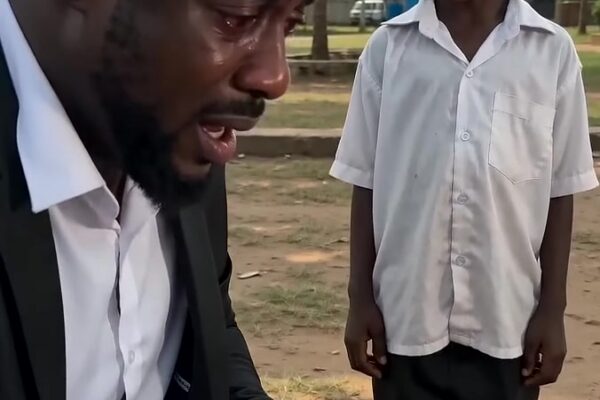
Howard’s eyes filled, and a single tear slipped down the crease beside his nose. He wiped it quickly, ashamed, then stopped and let his hand fall. He was done pretending strength was the same as silence.
Together, they turned back toward the courthouse doors. The moment they had expected to be routine stretched, deepened, and took on weight. Mara felt it settle into her bones with the certainty of something that would never be erased. Not just another moment. Something unforgettable—because it was the beginning of whatever came after the ending she’d been living inside for years.