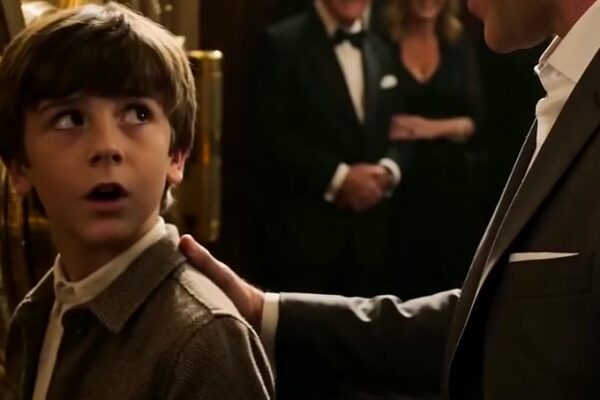
The courthouse always smelled like old paper and wet wool, as if every verdict ever spoken had been pressed into the walls and never allowed to dry. On that gray Monday, the hallway outside Courtroom B filled with the polite impatience of people who believed time belonged to them. A bailiff leaned against the door, eyes flat as a lock. A clerk stacked folders like bricks. And in the middle of it all stood a boy in a borrowed coat that hung from his shoulders like it was trying to escape him.
His name was Milo Hale. He was nine years old, small for his age, with hair that refused to lie down and shoes that shined only where someone had tried to rub away scuffs with a sleeve. The coat smelled faintly of cedar and someone else’s cologne. Next to him sat his guardian, a woman everyone called Aunt Raina though she wasn’t related by blood. She held Milo’s hand the way you hold something you’re afraid will be taken: not tightly, but with a constant awareness that it could slip away.
The case was simple on paper. Truancy. Neglect. A concerned neighbor’s call. A school report that counted absences like sins. A social worker’s checklist of “unsafe conditions.” Milo’s mother was gone—“unavailable,” the file said, which meant different things to different people but always sounded like a choice. His father wasn’t on any forms at all. So a system that loved forms did what it always did: it looked at what wasn’t there and decided it knew what was.
When they entered the courtroom, Milo felt eyes slide over him like cold rain. The prosecutor barely glanced up from her notes. The social worker’s expression had hardened into something she probably called professional. The judge, Honorable Patricia Sloane, sat high above them, black robe draped like a curtain. She adjusted her glasses and watched Milo as if expecting him to confess before he opened his mouth.
“This is about accountability,” the prosecutor said, voice practiced. “A pattern of missed school. Instability. And no clear means of support.”
Raina stood when her turn came. “Your Honor, Milo’s missed days were due to—”
“We’ll get to explanations,” Judge Sloane cut in. “First, I want to hear from the child.”
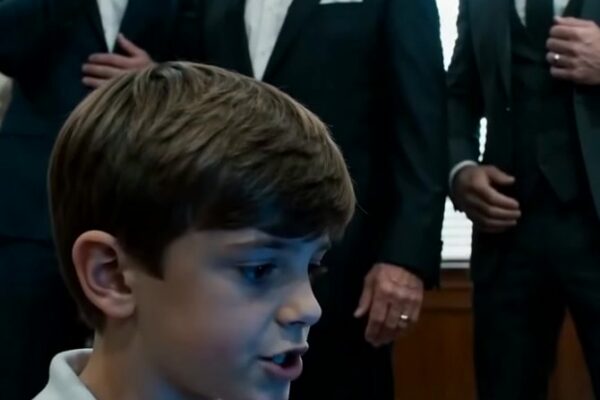
Milo’s throat tightened. It wasn’t the fear of speaking that gripped him; it was the certainty that whatever he said would be translated into the language of suspicion. He looked down at the microphone set on the table in front of him, a small metal stem with a red light like a warning.
“State your name for the record,” the judge ordered.
Milo’s mouth opened. No sound came out yet. In the pause, the room filled in the blanks: poor boy, troubled home, another case to move along. The clerk’s pen hovered. The bailiff shifted his weight, already anticipating the end.
Then the judge nodded toward the clerk. “Let’s have the financial affidavit.”
Raina flinched. “Your Honor, we filed it. It’s… it’s complicated.”
The clerk pulled a thin packet from a folder and stood. Pages rustled. A quiet, bored ceremony. The prosecutor didn’t bother to look up at first. The social worker sighed softly, as if she had already composed her report.
“According to the provided documentation,” the clerk read, “the minor, Milo Hale, is the beneficiary of an account held in trust.”
Judge Sloane’s eyes narrowed. “An account?”
“Yes, Your Honor. Current balance…” The clerk paused, as if surprised by her own voice. “Four hundred eighty-seven thousand, two hundred sixty-three dollars.”
The numbers hit the courtroom like a glass dropped in a silent church. They did not shatter, but everyone heard them break something anyway.
The prosecutor’s head lifted sharply. The social worker blinked, then straightened as if someone had pulled a string at the base of her spine. Even the bailiff, who had the face of a man who had seen everything, turned his gaze fully toward the child.
Judge Sloane leaned forward. “Repeat that.”
“$487,263,” the clerk said again, slower this time.
The air changed. Not warmer. Not kinder. Just… altered, as if the room had reclassified Milo from burden to asset.
Raina stood before anyone could speak. Her voice shook, not from nerves but from something older—rage that had lived in her bones for months. “They hear that number,” she said, “and suddenly he’s not a problem. Suddenly he’s interesting.”
“Ms. Raina,” the judge warned, “mind your tone.”
“My tone is the only thing in here that’s honest,” Raina shot back, then turned to Milo and softened. “Tell them, sweetheart. Tell them why you missed school.”
Milo swallowed. The red light on the microphone glowed like an accusation. He lifted his head. His eyes were brown and steady, the kind that learned early to measure adults by how quickly they looked away.
“I was making sure the pipes didn’t freeze,” he said quietly.
The prosecutor’s eyebrows rose, as if this were a clever story. “Explain.”
Milo’s fingers tightened around the edge of the table. “Our heater stopped. The landlord said he’d fix it. He didn’t. Mom… she wasn’t there. Not like gone-gone, but…” Milo’s voice thinned. He forced it back. “She didn’t come home sometimes. If the pipes freeze, they break. If they break, we get kicked out.”
The social worker’s expression flickered, a brief crack in the professionalism. “Why didn’t you call your guardian?” she asked.
“I did,” Milo said. “But she was working. Nights. She came when she could.” He glanced at Raina. “She always came.”
Judge Sloane’s gaze stayed on him, but it had changed too. Not softened—judges didn’t soften. It had shifted into calculation. “And this trust account,” she said, “why was it not used to address these issues?”
Raina laughed once, humorless. “Because it’s locked. Because it’s not mine and it’s not his, not really. It’s his father’s money.”
“His father isn’t listed,” the prosecutor said.
“No,” Raina replied. “He isn’t. Because he’s dead.”
The word fell heavy. Milo stared at the microphone again as if it might answer for him. Raina continued, voice steadier now that the secret was out. “His father was a firefighter. Died in the warehouse collapse on Ninth. The city fought the benefits for two years. They didn’t want to pay. When they finally did, they put it in a trust, with conditions. Education. Medical. Approval required. Milo can’t withdraw it to keep a roof over his head, even if the roof leaks.”
Judge Sloane’s lips pressed together. “So the child is wealthy on paper,” she murmured, “and poor in practice.”
“Exactly,” Raina said. “And you all looked at him like he was nothing until you heard a number.”
The prosecutor cleared her throat, suddenly cautious. “Your Honor, the existence of the trust suggests resources that could—”
“Suggests,” Raina interrupted, “is a fancy way to say you didn’t ask.”
Judge Sloane lifted a hand. Silence snapped into place. She regarded Milo again, and this time there was something like discomfort in her eyes, as if she had been forced to see the courtroom from the height of a child.
“Milo,” she said, “did you know about the account?”
He nodded. “Aunt Raina told me. She said it was for later.”
“How did that make you feel?”
Milo considered the question carefully, like it was a trick door. “Like there’s a treasure chest at the bottom of the ocean,” he said. “Everyone talks about it. But you’re still drowning.”
Something moved through the courtroom—an unease that wasn’t sympathy, exactly, but the recognition of a truth that couldn’t be filed neatly away.
Judge Sloane exhaled. “I am ordering an immediate review of the trust restrictions,” she said. “A hearing with the trustee. A report on the housing conditions. And I want the school district’s liaison involved.” She paused, then looked directly at Milo. “This court will not punish you for surviving.”
The prosecutor’s mouth tightened, but she said nothing. The social worker scribbled notes, faster now, as if speed could compensate for earlier assumptions.
Outside, when the heavy doors closed behind them, the hallway felt brighter, though the day hadn’t changed. Raina crouched to Milo’s level. Her eyes were wet but fierce. “You did good,” she whispered.
Milo didn’t smile. He looked back through the door, at the room where people’s faces had rearranged themselves around a number. “They believed me after,” he said.
Raina’s jaw clenched. “I know.”
Milo held her hand tighter this time, not because he feared being taken, but because he understood something that made his chest ache: words had weight, but money had gravity. It pulled judgments into place before anyone bothered to listen. And he was determined, in whatever way a nine-year-old could be determined, not to let it be the only thing that made him matter.
They walked down the hall together, past the bulletin boards and scuffed floors, past other doors where other children waited to be misunderstood. Milo kept his head up. He had spoken at last, and even if the room had only leaned in after hearing a balance, the sound of his own voice was something no account could measure—and no judge could lock away.