The rooftop restaurant glittered above the city like a palace in the clouds. It sat on top of the Hotel Ardent, all glass walls and polished marble, like someone had dropped a jewelry box on the skyline and decided to charge a cover. Crystal chandeliers hung over every table and threw tiny stars onto champagne flutes. Somewhere near the bar, a violin duo played something soft and expensive-sounding, the kind of music that made people speak in lower voices so they didn’t feel underdressed.
I was supposed to be invisible. That was the job. Smile, pour, nod, vanish. My manager, Lyle, always said the guests didn’t want “service,” they wanted the illusion that luxury just happened around them, like the weather.
I drifted between tables with a tray balanced on my palm, keeping my shoulders loose like I wasn’t carrying other people’s night in my hands. I could do this in my sleep now. Table seven liked their martinis bone-dry. Table nine pretended they weren’t arguing. Table twelve—table twelve was a whole different species.
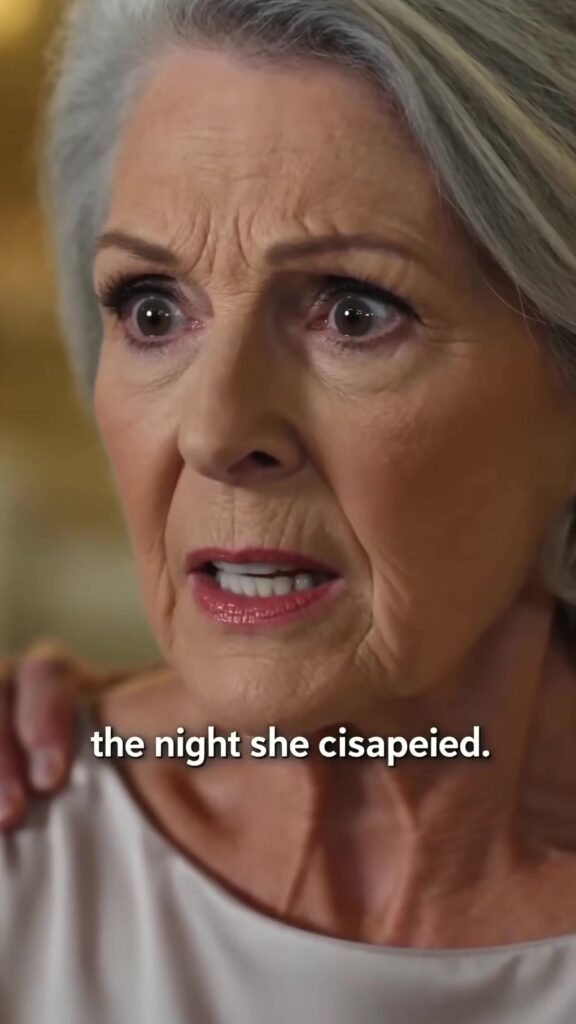
At table twelve sat an elderly woman who looked like she’d been born with pearls on her throat. Her hair was silver and smooth, pinned back like she was stepping out of another decade. The man beside her—tall, clean-cut, in a tuxedo that fit like armor—kept glancing around the room as if he was timing something. Not bored glances. Inventory glances.
I approached with a bottle of white and that practiced smile that meant nothing. “Good evening. Would you like to try the—”
The elderly woman didn’t look at the wine. She stared at my necklace.
I’d worn it forever. A thin chain with a small pendant—two shapes twisted together, like a leaf and a teardrop, or two commas refusing to separate. It was the only thing I’d ever owned that felt like it belonged to me, not to a donation bin or a lost-and-found drawer.
Her lips parted, and for a second the restaurant noise fell away like someone turned the volume down in my skull.
Then the scream came.
It wasn’t mine. It ripped from the elderly woman’s chest, sharp enough to slice through the violin music. A beat later, a wine glass exploded against the marble floor near my shoes, sending a spray of shards that glittered like ice. People gasped and swiveled in their seats. One of the violinists missed a note so badly the other stopped playing out of sheer mercy.
I stood frozen beside table twelve, my tray suddenly too heavy, my heart doing that horrible rabbit-thrashing thing.
The elderly woman stared at my necklace like she’d seen a ghost sitting on my collarbone. Her hand trembled so violently her bracelet clinked against the table.
“Where did you get that necklace?” she whispered. Her voice was small, like she didn’t trust herself to be loud.
I took an instinctive step back. “I’ve had it my whole life,” I said, because it was true and because I didn’t have anything else ready.
The tall man moved. Fast. One moment he was sitting, the next he was on his feet and gripping the elderly woman’s arm hard enough that her sleeve pulled tight.
“That’s enough,” he hissed. “You’re confused.”
He smiled at the table like they were sharing a cute misunderstanding, but his fingers dug in like claws. I saw the woman wince.
She didn’t look at him. She refused to look away from me. Tears sprang up in her eyes as if they’d been waiting for permission.
“No…” Her voice broke. “My daughter wore that necklace the night she disappeared.”
The restaurant went quiet in that way expensive places do—silence that feels purchased. Chairs stopped scraping. Forks paused in midair. Even the bar seemed to hold its breath.
I swallowed so hard it hurt. “I grew up in an orphanage,” I said quietly. “I don’t know who my parents are.”
The man’s jaw tightened. He leaned closer to the elderly woman, his smile still in place for everyone else, like a mask glued on wrong. “And that’s exactly where this story should end,” he said.
I blinked. “What does that mean?”
The elderly woman wrenched her arm free with surprising strength and grabbed my hand instead. Her skin was thin and warm. Her grip was desperate, like she was afraid I’d evaporate.
“Your real name isn’t Emily,” she said.
My lungs forgot how to work. “What?”
She leaned in as if sharing a prayer. “It’s Rosemary.”
The name landed in me with a dull, familiar thud, like I’d heard it through a wall in some other life. My mouth went dry. My fingers went numb around my tray.
The man’s expression didn’t change, but his right hand slid inside his jacket. His elbow tucked in close to his side, subtle, controlled. Under the edge of the tablecloth, metal flashed once—small and dark.
He pointed it under the table where nobody could see and kept his voice low, velvet over steel. “If either of you says another word,” he muttered, “someone dies tonight.”
My eyes locked onto his hand and then, because my brain was doing that panicked pattern-matching thing, onto his wrist.
He had a birthmark there. A crescent-shaped smudge, like someone had dabbed ink and tried to wipe it away.
I had the same one.
I’d seen it every day of my life and never thought it mattered. Now it screamed at me from his skin.
I opened my mouth, but no sound came out. The elderly woman’s thumb rubbed the back of my hand like she was trying to reassure both of us at once.
“Look at her,” the woman said, voice shaking. “Look at her wrist. She’s—”
That’s when the restaurant lights went black.
The chandeliers died with a soft, collective click. The glass walls became mirrors reflecting only darkness. Someone shrieked at a nearby table. Another person laughed nervously, like this was a planned dramatic moment, like rich people had paid extra for the thrill.
In the pitch, I felt rather than saw the tall man shift. I heard fabric whisper, a chair bump. The elderly woman’s grip tightened so hard it hurt.
“Don’t let go,” she breathed.
“I can’t see,” I whispered back, which was obvious and stupid but my brain was running on pure fear.
Emergency lights should’ve kicked in—this was a hotel, there were rules. But nothing happened. Not even the exit signs. That was wrong in a way that made my stomach drop. This wasn’t an outage. This was someone choosing darkness.
A new sound slid through the room: the soft, wet squeak of rubber soles on marble. Not waitstaff shoes. Security shoes.
Then, close to my ear, the tall man spoke again, barely audible. “Rosemary,” he said, tasting the name like it was poison. “You should’ve kept your necklace under your collar.”
I flinched at the way he said it—like he’d known the name long before tonight. Like he’d been waiting for it to surface.
The elderly woman pulled me closer, using her body like a shield. I could smell her perfume—powdery and expensive, with something herbal underneath, like crushed leaves. For a second, the name Rosemary didn’t feel like a stranger. It felt like a key.
Across the darkness, someone’s phone screen lit up, a pale rectangle. It caught the edge of the man’s face, the line of his tux, and the gun in his hand. His eyes flicked toward the light, and in that brief glow I saw something that chilled me more than the weapon.
Recognition.
Not mine. His.
He looked at me like he’d been afraid of me for years.
The phone screen went dark again, and footsteps rushed toward us. The elderly woman squeezed my fingers until my rings—cheap costume jewelry I wore to feel grown-up—bit into my skin.
“Listen,” she whispered, breath trembling. “If he takes you, you run. You run to the service stairs by the kitchen. There’s a door with a gold handle. I had it installed.”
“Why?” I whispered.
She swallowed. “Because I never stopped looking.”
The tall man cursed under his breath, and something heavy moved—like a bodyguard stepping in. I heard Lyle’s voice somewhere distant, trying to calm people down, trying to pretend he was in control of anything at all.
My necklace felt suddenly hot against my throat. I slipped my hand up and clutched the pendant, the metal slick with my sweat, and a thought flickered through me—stupid, desperate, bright.
If my whole life started with this necklace, then maybe it could start again with it too.
I yanked the chain over my head, the clasp scraping my skin. In the dark, I pressed it into the elderly woman’s palm.
“Hold onto it,” I said. “If I get away, you’ll have proof I was here.”
She made a small sound, half sob, half laugh. “Oh, Rosemary,” she breathed, like she’d been saying the name for years into empty rooms.
Somewhere near the table edge, the tall man’s gun clicked—either the safety or his patience. “Enough,” he snapped. “Now.”
And then, finally, the emergency lights flickered to life in a dim red wash, turning everyone into shadows with sharp edges.
In that bloody glow, the service corridor sign glimmered faintly at the far end of the room, just beyond the bar. I looked at it like it was the only star in the sky.
I squeezed the elderly woman’s hand one last time and whispered, “If my name is Rosemary, then I’m not done yet.”
Then I ran.
Behind me, a chair slammed over. Someone shouted. The violinists—bless them—started playing again, but the notes were frantic now, warped into a chase soundtrack nobody asked for.
I sprinted toward the kitchen, heart hammering, and as I dodged between stunned guests and overturned glasses, I caught one last glimpse of the tall man’s wrist, that matching crescent mark flashing under the red lights.
He wasn’t just trying to silence a story.
He was trying to erase a family.
And for the first time in my life, I wasn’t invisible anymore.