The ballroom shimmered under golden light, like someone had poured sunshine into a building and told it to behave. Every surface had been polished to the point of vanity—mirrors that made you stand taller, marble that made your shoes click with authority, and chandeliers that dripped crystals like they were showing off. The guests looked like they’d been dressed by a committee that feared wrinkles and silence in equal measure.
It was one of those charity galas that cost more to attend than it cost to fix the problems it claimed to solve. People laughed in that practiced way, the kind that rises and falls on cue. A string quartet stood near a fountain that had never known real water pressure, sliding through a waltz as waiters drifted with trays of sparkling drinks. Somewhere, someone was telling a story about “that time in Capri,” and everyone nodded like they’d been there too.
In the center of it all sat Leona Harrow, the guest everyone said they’d come to see—even if they came for the photos and the dessert tower. Leona was sixteen and famous in the way tragedy makes you famous. A year ago, a fall from a horse had snapped something in her spine and then snapped the easy assumptions of her family right after. Her father, Alden Harrow, had built a fortune on precision and control, and now he carried himself like a man trying to control gravity.
Leona’s wheelchair had been turned slightly so she faced the dance floor. Her dress was a deep, patient blue, the kind that looked calm even when you weren’t. Her hair was pinned up with a few stubborn curls escaping, and her eyes moved over the room like she was watching a play she’d seen too many times. People visited her in little clusters: compliments, pity dressed up as admiration, promises to pray. She accepted it all politely, like she was collecting stamps she didn’t want.
When the music shifted into something lighter and guests began pairing off, the laughter swelled—until it didn’t. It wasn’t dramatic at first. Just a small wobble in the sound, like a needle skipping. A few heads turned. A few conversations stopped halfway through a sentence. The string quartet kept playing, because musicians are trained to ignore everything short of a fire.
Then the barefoot boy stepped out of the crowd.
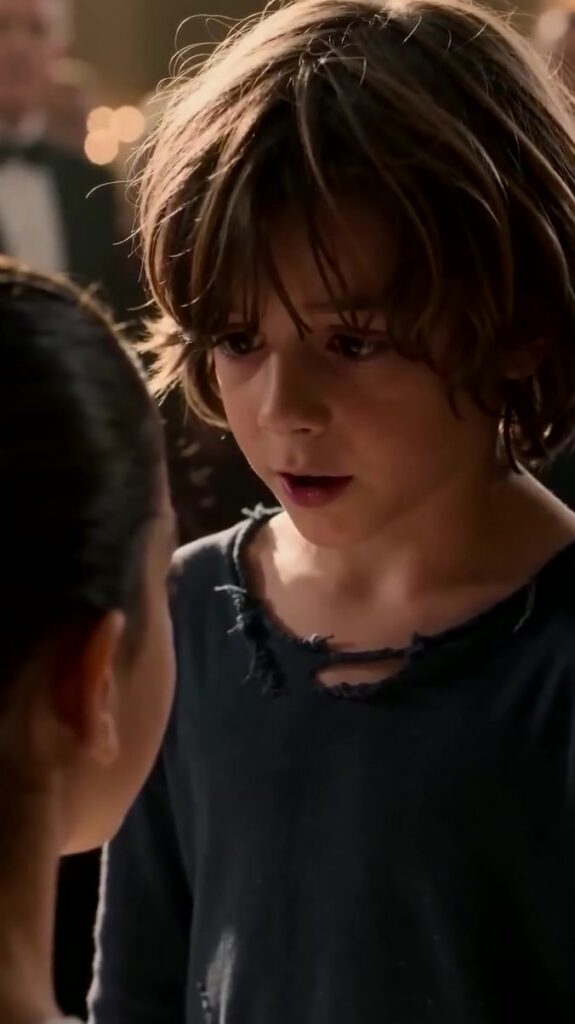
He didn’t belong in any logical way. His clothes looked like they’d been arguing with fences and losing. A shirt with a tear at the shoulder, pants hemmed by fate rather than a tailor. His feet were bare, dusty, and completely unashamed. He moved through the ballroom as if the marble didn’t intimidate him, as if chandeliers were just lights and not symbols.
Whispers trailed him immediately, soft and sharp. “How did he get in?” “Is this some stunt?” “Call security.” A woman with a diamond necklace that could have funded a small hospital grabbed her clutch like it was an alarm button. Someone laughed nervously, as if the boy were part of the entertainment.
But he wasn’t wandering. He was walking straight toward Leona.
Alden Harrow spotted him before anyone else could act. It was probably instinct—fatherhood mixed with the kind of vigilance that comes from knowing people want things from you. He stepped forward with the speed of a man who had negotiated hostile takeovers and dinner reservations with the same cold efficiency. In one clean move, he positioned himself between the boy and his daughter.
“Don’t touch her,” Alden said, not loud, but firm enough that the nearest guests flinched anyway.
The boy stopped. He didn’t recoil. He didn’t argue. His chest rose and fell fast, like he’d been running for a while. His gaze flicked briefly to Alden’s face, then past him, straight to Leona. Like Alden was a door and Leona was the room.
Leona watched him back. Not with fear. Not even with suspicion, which surprised the people closest to her. It was curiosity—pure, unfiltered, like she’d finally seen something in the ballroom that wasn’t predictable.
“Sir,” the boy said, and his voice sounded too gentle for the room. It was a voice used to asking permission from people who rarely gave it. “Let me dance with your daughter.”
Alden blinked once, slowly, like the sentence needed time to land. “This isn’t a—” he began, then stopped when he noticed the way the boy held himself. Not arrogant. Not pleading. Certain, in a quiet way that didn’t match the torn clothes.
The boy swallowed. His fingers flexed at his sides like they remembered music. “And I’ll make her walk again.”
Silence hit the room like someone had turned off oxygen. Even the string quartet faltered for a heartbeat before stubbornly continuing, their bows moving as if their hands hadn’t gotten the memo. A laugh tried to escape somewhere and died instantly. Glasses stopped clinking. A waiter froze with a tray halfway between two guests.
Alden’s face changed in layers. Disbelief first, then anger, then something colder, something with a thin crack down the center. Shock. Fear. Hope he refused to admit he owned.
“You think you can stroll in here and—” Alden started, but his voice couldn’t find its usual authority. Because Leona’s hand was already lifting from the armrest.
It rose slowly, like it had weight beyond physics. Her fingers hesitated midair, then extended toward the boy. The whole room seemed to lean in without moving. Alden’s hand twitched, ready to block, to protect, to keep the world from making another promise it couldn’t keep.
But Leona didn’t look at her father. She looked at the boy, and there was something in her gaze that said, I want to see what happens when the script changes.
The boy lifted his own hand, careful, like he was approaching a skittish animal. Their fingers met. His touch wasn’t dramatic—no sparks, no sudden miracle lightning. Just skin against skin, warm and real.
“What’s your name?” Leona asked softly, as if names mattered more than claims.
“Soren,” he said. “I heard about you. In the park. People talk.”
“People talk everywhere,” she replied, almost smiling.
Alden found his voice again. “Security,” he called, and two men in dark suits started moving, trying to look calm while everyone watched.
Soren didn’t look at them. He looked at Leona. “Will you let me try?” he asked her, not her father. “Just one song.”
Leona’s eyes flicked to her father, and for the first time that evening, she looked tired of being protected like glass. “Dad,” she said, and her voice carried more command than most of the adults in the room. “Let him.”
Alden’s jaw tightened. He looked at Soren’s bare feet, at the tears in his clothes, at the audacity of his request. Then he looked at Leona. He saw, in her expression, the same thing he’d seen when she was small and determined to climb a tree: a refusal to be told no when yes might be possible.
He lifted a hand, not quite a surrender, more like a ceasefire. The two security men slowed, uncertain, waiting for a clearer order.
The quartet, sensing drama, drifted into a waltz that sounded like someone opening a door. Soren stepped closer to Leona’s chair. He crouched slightly, so his face was level with hers. “I won’t hurt you,” he said, like a promise he’d practiced.
“I’m not fragile,” Leona whispered back, though her hands trembled a little as she held his.
Soren nodded as if that was the most important information he’d heard all day. Then he did something that made a few guests inhale sharply: he offered his arm the way dancers do, formal and old-fashioned, as if they were in a different century where miracles were less embarrassing to discuss.
Leona glanced at the dance floor, then down at her own legs, hidden beneath the blue fabric. The room was waiting, and waiting can feel like pressure on your ribs. She took a breath and placed her hand on his forearm.
Soren leaned in. “Trust me,” he said, barely audible.
“That’s a big ask,” she murmured, but she didn’t pull away.
He positioned himself beside her chair, and instead of trying to lift her—no dramatic hero move—he guided her carefully, like he understood balance and fear and dignity. His hands were steady. He spoke under his breath, counting softly, not numbers exactly, more like rhythm words. “Here. Now. Easy. Again.”
Alden stood so still it looked painful, like moving might break whatever fragile possibility was forming. The guests watched with the kind of attention they usually reserved for auctions and scandals.
Leona’s shoulders tightened. Her fingers gripped Soren’s arm. Her face pinched with concentration, then with something else—surprise, maybe, or anger at her own body for not cooperating sooner. Soren’s voice stayed calm. “You don’t have to do it all at once,” he said. “Just tell your feet what the music is saying.”
“My feet haven’t been great listeners lately,” she whispered, breath shaky.
“Then we’ll teach them,” he replied, like it was the simplest thing in the world.
And in that moment—before any miracle could prove itself, before anyone could claim victory or call it a trick—something already changed. Leona wasn’t being watched anymore. She was choosing to be seen. Alden wasn’t guarding an injury anymore. He was standing at the edge of a chance.
Soren guided her forward, inch by inch, and when the blue fabric shifted, the ballroom collectively forgot to breathe.
Because Leona’s toe found the floor.
Not a step. Not yet. Just contact. Just proof that the night hadn’t ended where it always ended.
Soren looked up at her, eyes steady. “Ready for the rest of the song?” he asked.
Leona swallowed, her eyes bright, and nodded once.
On the dance floor, the golden light didn’t seem quite so polished anymore. It looked alive. It looked like it might flicker. It looked like something could happen.
And somewhere behind the chandeliers and the whispers, a door that had been locked in Leona’s life creaked open—quietly, stubbornly—just wide enough to let in the music.