The bell above the bakery door rang softly, but it still turned a few heads. Not because it was loud—it wasn’t. It was the kind of bell that sounded like a polite apology, like it was asking permission to exist. But the bakery was quiet in that rich, cushioned way, and the bell was a rip in the fabric.
Mara paused with one hand on the door, the other anchored by the small, warm grip of her son. Theo stood half behind her leg like her shadow had learned to breathe. His eyes were fixed on the glass case as if it contained something magical and alive: cakes with mirror-smooth frosting, strawberries arranged like jewels, little chocolate curls standing at attention. There were candles in a jar near the register—thin, bright sticks waiting to be lit for people who didn’t have to plan their joy down to the penny.
Mara’s shoes, scuffed at the toes, squeaked faintly on the floor. The place smelled like butter and vanilla and money. The counters shone. The employees’ aprons didn’t have flour stains—they looked freshly pressed, like costumes. Even the chalkboard menu had handwriting so perfect it might’ve been printed.
She’d told herself she would only ask. Asking was free. Being told no was free too, even if it hurt like a bill you couldn’t pay.
They waited at the counter. No one hurried. A woman with a sleek bun finished arranging macarons into neat rows with tiny tongs. A man in a crisp white jacket wiped a spot on the espresso machine that Mara couldn’t even see. Theo’s fingers tightened around Mara’s. His other hand held a folded sheet of paper, creased and re-creased until the corners were soft.
Mara cleared her throat. “Excuse me,” she said, keeping her voice small. She hated how practiced it sounded, as if she’d rehearsed being invisible.
The man behind the counter finally looked over, eyes flicking to her coat and the scuff on her shoes and the way her hair had slipped loose from its clip. “Yes?” His tone was flat in the way expensive places could afford to be—no warmth required.
Mara swallowed. “Do you… do you maybe have an expired cake you don’t need? Or a slice? Something you were going to throw out?”
For a second there was only the hum of refrigeration and the whisper of milk steaming. The woman with the bun paused, tongs hovering.
Mara forced herself to keep going. “It’s my son’s birthday. Today. And I—” She hated the next part. It tasted like rust. “I don’t have money for a cake.”
She could feel her face heating, like the bakery’s bright lights were finding every bruise on her pride.
The man’s mouth made a little shape that might have been a laugh if it weren’t so cold. “We don’t give away trash,” he said, and he said it loud enough for the room to hear. Like he wanted the words to land.
At a nearby marble table, a couple in clean sweaters—matching, like they’d planned it—paused mid-sip. One of them smirked into their cup as if it were entertainment.
Mara’s knuckles went white on Theo’s sleeve. “Please,” she said. The word came out thinner than she meant it to. “Even just—”
“Out,” the man said, sharper now. His hand slapped the counter, a sudden crack that made Theo jump so hard he stumbled into Mara’s hip.
“Mom,” Theo whispered, voice already trying to be brave. He pressed his cheek to her side, small and warm through her coat. “It’s okay. I can wish without a cake.”
Mara shut her eyes for half a second, because the tears were there, rising, and if she blinked too hard they’d spill in front of all these clean people and their perfect desserts. She opened them again and nodded, like she was the one comforting him and not the other way around.
She turned to leave.
That was when the room shifted—not with noise, but with attention. Like a window had opened somewhere you couldn’t see.
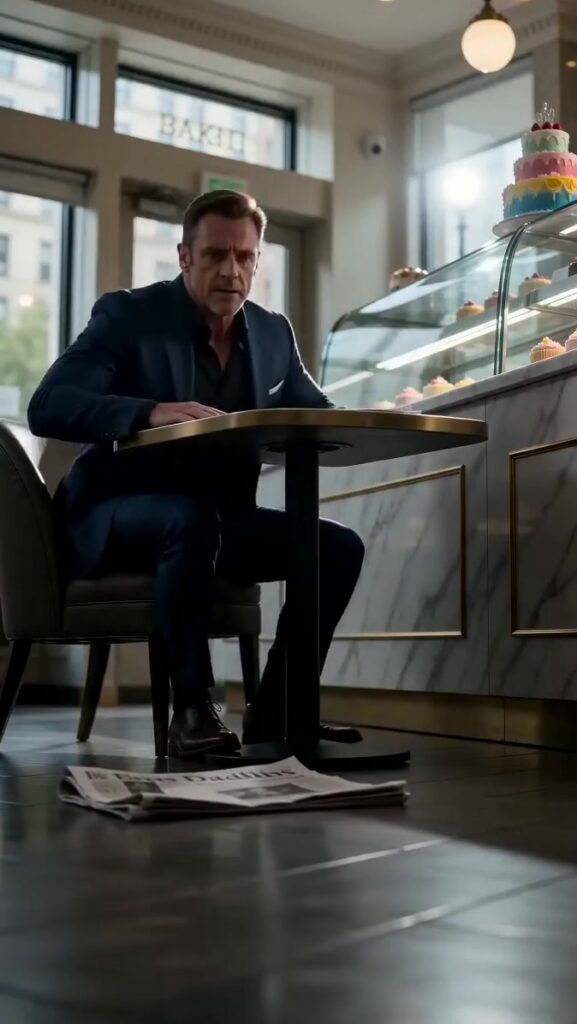
In the corner, a man in a navy suit sat alone. His newspaper had been spread carefully, like he’d come here to disappear. He had a cup of coffee he hadn’t touched in a while. He’d been reading, but now his eyes were stuck on one line, unmoving.
Theo’s folded paper slipped in his hand as he moved. It unfurled a little, just enough for the crayon drawing inside to flash its colors—blue sky, green grass, two stick figures holding hands. One tall. One small. Above them, in letters that wobbled with effort: FOR DADDY.
The suited man lowered his newspaper slowly, as if the weight of it had suddenly doubled. He stared at Theo’s hands. Not the boy’s face first—the paper. The words.
Mara didn’t notice at first. She was too focused on getting Theo out before the tears fully broke free.
Then the man stood.
His chair scraped the floor with a harsh, honest sound that cut through the bakery’s curated quiet. Every head turned. Even the woman with the bun stopped moving. The espresso machine hissed on, indifferent.
The suited man didn’t look at the employees. He walked past the marble tables and the smirking couple without seeing them, steps measured but urgent, like he was trying not to spook a wild animal.
He stopped at Mara’s side, close enough that she could smell his cologne—something clean and expensive—and something else underneath it, like sleeplessness.
“Theo?” he said softly.
Theo looked up, cautious. “Yes?”
Mara’s stomach dropped. No one knew Theo here. She pulled him closer on instinct, her body a shield. “Who are you?”
The man’s throat bobbed. He blinked hard once. Twice. His eyes were too bright, like someone had poured water into them. “I—” His voice cracked on the first attempt, which seemed to surprise him. He tried again. “I’m… my name is Daniel.”
Theo’s brows pinched. “That’s my dad’s name,” he said, like it was an interesting coincidence.
Mara’s heart began to hammer, fast and sick. She had told Theo stories, careful ones. Not lies exactly—just softened edges. She’d told him his dad had to go away for work. That grown-up problems were complicated. She had not told him about the court letters, the silence, the months when she’d stared at her phone like it might apologize.
Daniel looked at Mara then, really looked. The way his face changed wasn’t polite recognition. It was shock, followed by something heavier.
“Mara,” he said, and her name sounded like a confession.
Her mouth went dry. “No,” she whispered, because denial was easier than letting the past step fully into the present. She took a step back. “You can’t—”
Daniel’s gaze dropped to Theo’s drawing again. His hands trembled slightly at his sides, as if he didn’t trust himself to reach out. “He’s—” He swallowed. “He’s… he’s mine?”
Mara’s chest tightened. It wasn’t rage she felt first. It was exhaustion. The kind that had lived in her bones for years. “You don’t get to show up because you saw a piece of paper,” she said, and her voice was steadier than she expected. “You didn’t want to be found.”
Daniel flinched, like the sentence had a physical edge. He nodded once, sharply, like he was agreeing with a judge. “I know. I know what it looks like.” He glanced toward the counter. The employee was watching, confused and annoyed, as if the scene was ruining the atmosphere.
Daniel turned fully to him then, and the temperature in his expression dropped. Not cruel—controlled. “How much is the strawberry cake?” he asked.
The employee blinked, suddenly attentive. “The eight-inch? One hundred and ten.”
“And the chocolate one,” Daniel said. “And the fruit tart. And a dozen of the macarons. And candles.” He looked at Theo. “How old are you?”
Theo hesitated, eyes darting between Daniel and Mara. “Seven,” he said quietly.
“Seven candles,” Daniel repeated, and then to Mara, voice softer again: “If you’ll let me.”
Mara’s hands were shaking now, and she hated that the shaking felt like hope. “You can buy all the cake in the world,” she said. “That doesn’t fix what you did.”
Daniel nodded again. “I’m not trying to fix it with sugar,” he said. “I’m trying to start—” He stopped, searching for the word that wouldn’t insult her. “I’m trying to start with what I can do right now. Which is… not letting him have to pretend he doesn’t want a birthday cake.”
The couple at the marble table had stopped smirking. Their faces were blank now, uncomfortable, as if kindness had become a mirror and they didn’t like what it showed.
The employee cleared his throat, attempting to regain control. “Sir, is there a problem here?”
Daniel’s eyes lifted, calm and dangerous in a polite way. “Yes,” he said. “There is. You told a mother and her child to get out for asking a question.” He pulled his wallet out without looking and placed a card on the counter like it was punctuation. “You’ll box the cakes. And then you’ll apologize.”
The employee’s jaw worked. “We don’t—”
“Apologize,” Daniel repeated, quieter. Somehow that was worse.
The bakery’s brightness suddenly felt less like luxury and more like scrutiny. The woman with the bun was staring at the floor. The espresso machine hissed again, as if it was trying to pretend this wasn’t happening.
The employee’s face tightened. He looked around, as if seeking backup from the room, and found only silence. Finally, he forced the words through his teeth. “I’m… sorry,” he muttered, eyes not quite meeting Mara’s.
Mara didn’t accept it. She just held Theo’s hand and breathed, trying to keep herself from splintering. Theo looked up at her, then at Daniel. “Are you really my dad?” he asked, not accusing, just curious in that heartbreaking way children had, like they were willing to believe the world could still rearrange itself into something good.
Daniel crouched slightly so he wasn’t towering. He didn’t reach out. He didn’t assume. “I think I am,” he said, voice thick. “And if you want… I’d like to be.”
Mara let out a shaky breath. The bell above the bakery door stopped being the loudest thing in the room. That honor belonged to her pulse, to Theo’s quiet hope, and to the sudden, terrifying possibility that today could be more than survival.
Outside, the afternoon light slanted across the sidewalk, ordinary and forgiving. Inside, cakes were being boxed up with careful hands. Theo’s drawing—FOR DADDY—was still half open, crayon colors bright against all that marble and glass. Daniel glanced at it once more, like he was memorizing proof that he’d been missing something alive.
Mara swallowed. “We’re not doing this in a bakery,” she said, voice low. “Not like it’s some movie scene. You don’t get a shortcut.”
Daniel nodded, immediate. “Okay. No shortcuts.” He hesitated. “Can I walk you home? Or… can I at least carry the boxes?”
Theo looked up at Mara again, eyes wide and asking without words.
Mara stared at the bright display case one last time. Perfect cakes. Perfect surfaces. She’d spent years learning you could polish the outside of something and still have it be hollow.
She took the smallest step toward the door. “You can carry the cake,” she said. “And you can start by listening.”
Daniel’s shoulders sagged with something like relief and shame braided together. “I can do that,” he said.
The bell rang again as they left—still soft, still polite—but this time it didn’t sound like permission.
It sounded like the beginning of a very long conversation.