The café had been loud just seconds before. The kind of loud that felt friendly—steamed milk hissing like a tiny engine, espresso grinders growling, cutlery clinking against plates, someone laughing too hard in the corner as if their whole week had been waiting for a punchline. A barista in a beanie called out names with dramatic flair, and a dog under a table barked every time the door chimed, like it was on payroll.
Mara liked it that way. Noise meant nobody listened. Noise meant she could sit near the window with her laptop open to a spreadsheet she wasn’t really reading, sip her flat white, and pretend she belonged to a normal life.
She always picked the same seat: second table by the front, back to the wall, view of the street. She always wore her hair the same, too—pulled back, clean part, ribbon tied in a neat bow. The ribbon was pale blue with a tiny stitched pattern that, up close, looked like little curved leaves. The bow was her anchor, a small ritual that made the rest of her feel arranged.
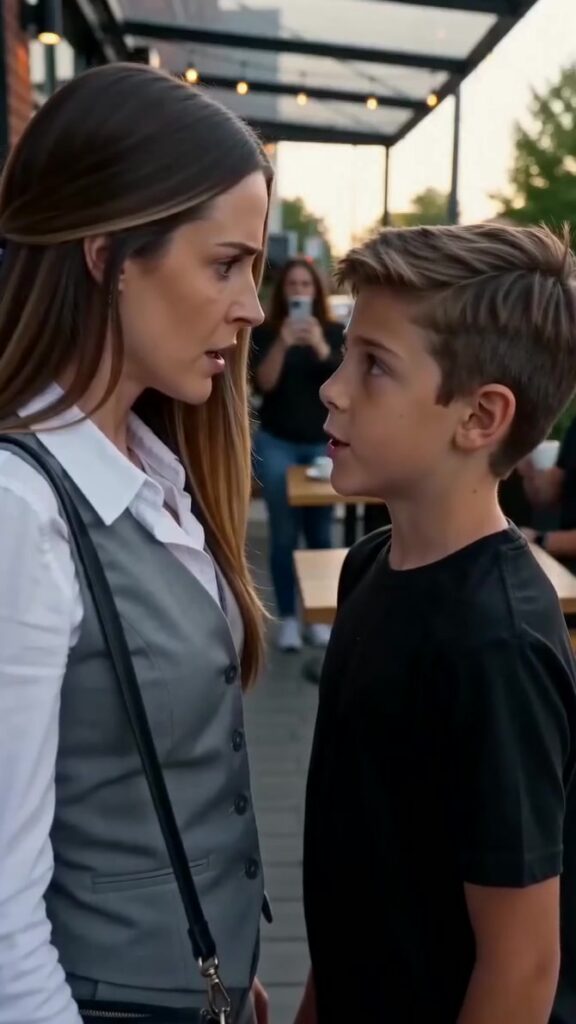
She was about to take another sip when something brushed her wrist—light, barely there. Instinct sparked hotter than caffeine. She jerked back, chair legs complaining against the tile, and the words came out sharp enough to slice the air.
“Hey—don’t touch me!”
The café stopped.
It wasn’t gradual, like a song fading. It was like someone had yanked a plug. Chairs froze mid-scrape. A cup hovered near a mouth, forgotten. Even the dog paused with its head tilted, as if it didn’t recognize the room anymore. The door chimed once from the wind and then didn’t again, like it had learned to behave.
Mara was standing without remembering she’d stood. Her palm tingled where she’d felt contact. She could feel eyes on her, and she hated that most of all—the attention. The exposure.
In front of her was a boy. Eight, maybe nine. Small enough that his hoodie swallowed him. Quiet enough that the silence made him seem even smaller. He hadn’t flinched. That was the unnerving part. Most kids recoiled when adults snapped. This one just looked up at her like he’d been waiting for her to finish.
His gaze flicked to her hair.
“…she has the same hair,” he said. Not loud. Not dramatic. Just factual, like he was confirming something on a list.
A ripple moved through the crowd—the kind of ripple made of raised eyebrows and shifting weight, everyone suddenly invested in a story they didn’t know yet. Mara’s stomach sank, but her face held steady out of habit. She’d spent years building a mask that didn’t slip.
“What are you talking about?” she asked, voice clipped. She heard it herself: too tight, too careful.
The boy didn’t step back. He didn’t reach again, either, which made her feel worse. He was here for something, and he wasn’t afraid of her.
“My mom said I’d find you here.”
For a second, Mara’s mind tried to fit that sentence into her current life, like forcing the wrong key into a lock. It didn’t go. It scraped.
“…your mom?” she asked. The words came out slower. There was a crack in them she couldn’t smooth over.
He nodded once, solemn. He reached into his pocket, and Mara’s shoulders tensed, ready for anything—phone, note, some childish prank. What he brought out was smaller than any threat. He opened his hand like he was revealing a secret coin.
Inside lay a ribbon.
Old. Faded. Worn soft by time and fingers. The same pale blue, the same stitched pattern. The same little curved leaves. It looked like it had been washed a hundred times and survived each one, stubborn and fraying at the edges.
Mara’s breath went shallow. Her own ribbon suddenly felt too tight, like it was choking her through her hair. She stared at the boy’s palm as if the ribbon could bite.
Somebody gasped—one sharp inhale that broke the frozen quiet and turned it into something trembling.
“…that’s impossible,” Mara whispered, but her voice betrayed her. It wasn’t disbelief. It was recognition. It was a door in her memory swinging open on rusty hinges.
The boy’s eyes stayed on her face, steady, almost too steady for his age. “She said you’d say that.”
Mara’s hands were shaking now. She clasped them in front of her, fingers interlaced, like she could trap the tremor. Her mask was slipping, not because of the people watching, but because of the way the ribbon pulled the past into the present without asking permission.
She forced her gaze away from his hand to his eyes. They were dark, the shape familiar. Her mouth felt dry.
“…where is she?” she asked, barely breathing, like the question itself might shatter if she spoke it too loudly.
The boy didn’t answer right away. He just looked at her for a beat, measuring her, and then turned his head.
Slowly, everyone followed his gaze, like a field of sunflowers rotating toward the same light.
Across the street, on the opposite sidewalk, a figure stood in the gray drizzle that had started without anyone noticing. The person didn’t hold an umbrella. Didn’t move like they were waiting for a bus. They were simply there—still, watching the café window as if it were a screen.
Mara’s stomach dropped so hard she thought she might throw up. Her pulse thundered in her ears. The figure wore a long coat, hair dark against the damp, face partially shadowed by the angle of the streetlight and the low afternoon sky. But Mara didn’t need the details. She recognized the outline the way you recognize a song from the first two notes.
Her chair scraped backward with a sound that felt obscene in the hush. A few people flinched like they’d forgotten noise was allowed.
“Mara?” someone behind the counter called, tentative, as if saying her name might help her remember where she was.
She didn’t look back. She couldn’t. Her eyes were pinned to the figure outside.
Across the street, the person lifted a hand—slow, not waving exactly, more like testing whether the glass between them was real. The movement was small, but it landed heavy in Mara’s chest.
For the first time in years, fear and hope arrived together, tangled, indistinguishable. Fear of what she’d buried. Hope that what she’d buried wasn’t dead.
The boy stepped closer to Mara’s table, still holding the faded ribbon like a passcode. “She told me to give you this,” he said. “She said you’d know what it means.”
Mara’s eyes stung. She blinked hard, trying to keep her composure, trying to keep herself from becoming a spectacle. But the café had already decided she was one. The silence wasn’t awkward anymore; it was attentive.
She reached out, carefully this time, like approaching a skittish animal. Her fingers touched the old ribbon. It was softer than her own, rougher at the frayed edge, and it carried something she couldn’t name—time, maybe. Survival.
Her own ribbon suddenly felt like a copy made to forget the original.
Outside, the figure took one step forward, then another, slow, as if giving Mara the choice to run. Rain dotted the window, making the person blur and sharpen with each droplet.
Mara swallowed. She looked down at the boy. “What’s your name?”
He hesitated, and for the first time his calm wavered, like he was finally admitting this mattered. “Eli,” he said. “She said you used to call her ‘Lee’ when you were kids.”
Mara’s throat closed. Lee. A nickname that tasted like summer and bikes and a promise made under a tree that Mara had broken with both hands.
She looked back at the street.
The figure was closer now, just at the curb, waiting for the crosswalk signal like a law-abiding ghost. Their face lifted slightly, and even through the rain-streaked glass, Mara saw it—eyes that were both familiar and changed, the kind of eyes that had learned to survive disappointment.
Mara’s fear spiked, not of the person herself, but of what would happen if the past reached the present and demanded to be acknowledged. She had built her life like a neat bow: controlled, intentional, tight enough to hold everything in place.
Now, with one old ribbon in her hand and one stranger-child looking up at her, the knot was coming undone.
The crosswalk light flipped.
The figure stepped into the street.
Mara didn’t realize she was moving until she felt the floor under her feet, felt the air change near the door. Eli stayed at her side like he belonged there, like this had always been the plan.
As she reached for the handle, her reflection in the glass caught her—perfect blouse, perfect hair, ribbon pinned like a badge. Except her hand was shaking, and her eyes were wide with something raw.
She pulled the door open. The bell chimed, loud in the hush, and the café’s noise didn’t return. Not yet.
Rain-scented air rushed in.
Mara stepped outside, ribbon in her palm, and for the first time in years she let herself be seen—by the boy, by the watching crowd, and by the person crossing the street toward her like a memory that refused to stay buried.
Behind her, the café held its breath.
In front of her, the past finally arrived.