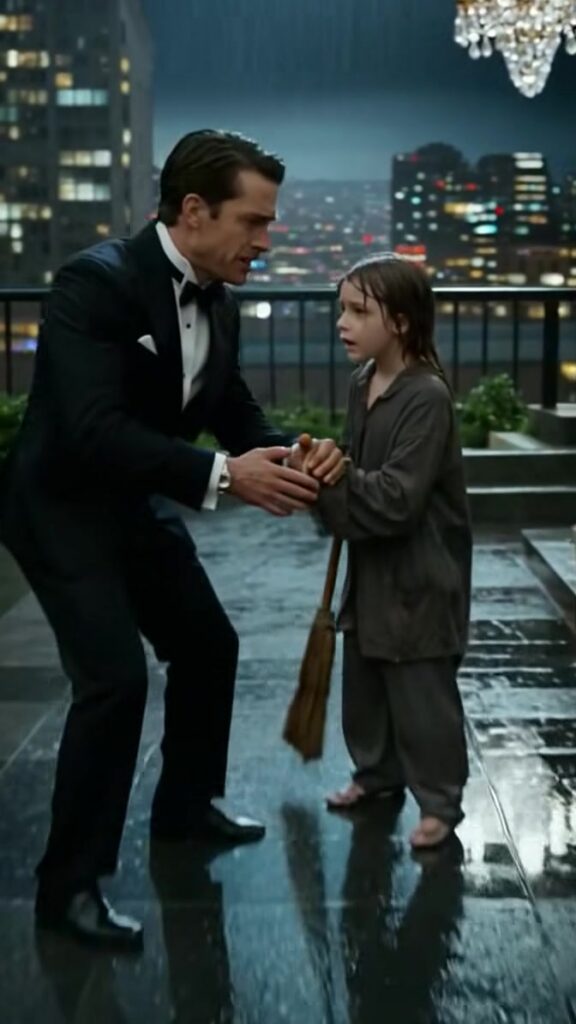
The rooftop looked like someone had tried to recreate a royal ballroom and forgot they were building it on top of a skyscraper. Crystal chandeliers dangled from sleek metal frames, swaying slightly in the wind like they were daring gravity to complain. Below, the city stretched out in perfect, glittering grids—headlights and neon signs frozen into an ocean of light. Above, the sky was clean and sharp, the kind of clear night that made you feel like you could see the math behind the stars.
Everyone who mattered (or at least, everyone who wanted to be seen mattering) was there. Black-tie outfits, designer gowns, a forest of champagne flutes, and a constant flicker of cameras. People laughed softly the way they did at expensive events, like volume itself cost money. Servers drifted around with trays of tiny, beautiful food that tasted like confidence. It was a charity gala, technically, but mostly it was a celebration of being the type of person who could attend a charity gala on a roof that had its own weather system.
In the center of it all was Ethan Cole. Forty-something, famous enough that strangers had opinions about his morning routine, and polished enough to look like he’d been engineered in a lab with a “success” setting stuck on high. His tuxedo fit like it had been poured onto him and then politely asked permission to exist. Silver cufflinks caught the chandelier light. He smiled the way he always did—controlled, clean, slightly distant—like a man who’d practiced joy in a mirror and perfected it.
When the host introduced him, the crowd leaned forward as one organism. Ethan took the stage, tapped the mic once out of habit, and looked out over the terrace. Behind him, the skyline glowed. In front of him, the donors and investors and social media royalty watched with hungry admiration. The charity tonight was about housing—affordable apartments, support services, the kind of thing that looked great in a press release and occasionally changed someone’s whole life. Ethan lifted his glass, nodded, and began. “Tonight, we are here to change lives…”
He got three words past that and stopped like someone had cut the power to his body. At first it seemed like a dramatic pause. People smiled, ready to clap at whatever came next. But the pause turned strange—too long, too silent. Ethan’s throat moved like he’d swallowed something sharp. His eyes weren’t on the crowd anymore. They were fixed over their heads, past the bar, past the photo wall, toward the far edge of the terrace where the decorative hedges met the glass railing.
His smile melted off his face. Not slid off—vanished, like it had never belonged there in the first place. His lips parted. The mic picked up a sound that wasn’t quite a word. Then, barely audible, he breathed, “No… that’s not possible…” Phones rose automatically. Whispers rippled through the guests. Someone laughed once, nervous and confused, then stopped. Ethan stepped back from the microphone like it had bitten him. His hands trembled, the first messy thing anyone had ever seen him do in public.
“I need to go… outside,” he said, which made no sense because the whole gala was literally under open sky. But he didn’t wait for logic to catch up. He pushed away from the stage and moved fast, threading between gowns and tuxedos, brushing past a photographer who shouted his name like it was a rope to pull him back. Ethan didn’t look at anyone. He was locked on the far corner, walking like the ground was turning into a trapdoor behind him.
At the edge of the terrace, near a service corridor lined with mirrored panels, a woman stood half-hidden by a potted olive tree. She didn’t fit the scene. No glittering dress. No diamonds. She wore a dark coat, like she’d come from another, colder world. Her hair was pulled back hastily. She looked too real for the gala, like the organizers had forgotten to edit her out. When Ethan saw her up close, his face did something strange—like it tried to become the man he used to be and didn’t know how.
“Mara,” he said, the name landing between them with the weight of a dropped plate. The woman’s expression didn’t change much, but her eyes flickered, as if she’d expected him to deny she existed. “Hi, Ethan,” she replied, casual in a way that didn’t match the moment. “Nice roof. You really went all in on the ‘I’m untouchable’ vibe.” His breath hitched. “You— You were dead.” He said it like an accusation, like she’d broken a contract. Mara tilted her head. “Yeah. That’s what you told everyone.”
The city hummed below them, and behind them the party stayed frozen, phones aimed like weapons. Ethan’s mouth opened, shut, opened again. His mind visibly flipped through old headlines like a frantic librarian. Ten years ago, Mara had been the only person in his life who’d spoken to him like a human being. She’d worked in community outreach, not boardrooms. She’d pushed him to fund real projects, not just shiny initiatives. Then she’d vanished after one brutal, very public scandal that Ethan survived and she didn’t. Officially, it was a tragic accident: a car that hit the river, a body that was never found, a tasteful memorial with roses and cameras. Ethan had cried on cue, donated a building in her name, and built a myth around her absence.
“Why are you here?” he asked, voice shaking harder now. Mara glanced at the chandeliers. “Because you’re about to announce a pledge that’s basically a magic trick,” she said. “The money moves in circles, the headlines make you look like a saint, and the actual apartments? They don’t happen. Not the way you promised. I tried to do this quietly.” She patted the inside pocket of her coat. “I sent letters. Emails. I called your office. Your assistant sent me a fruit basket, which was honestly impressive. But I’m out of time.”
Ethan swallowed. “You could have come to me.” Mara’s laugh was small and tired. “I did. Over and over. But you built a wall around yourself. Glass, money, security guards. And now you’re up here with the stars pretending you’re saving people while your company buys up half the neighborhoods you claim to care about.” She leaned closer, lowering her voice. “Also? Someone has been using my name. There’s a foundation account labeled ‘Mara Lorne Outreach.’ It’s been bleeding cash into places it shouldn’t. It’s not philanthropy, Ethan. It’s laundering with a sad story attached.”
Ethan’s face went pale in a way no camera filter could fix. “That’s impossible,” he said automatically, but even he didn’t sound convinced. His gaze darted back toward the party. Near the stage, his CFO stood with a hand on a donor’s shoulder, smiling too broadly. When the CFO noticed Ethan looking, his smile didn’t falter—but his eyes narrowed, just a little. Ethan felt the floor tilt. He realized, all at once, that the “controlled” life he’d built depended on keeping certain doors locked. And Mara—alive, inconvenient, uninvited—had just kicked one open.
“I’m not here to ruin you,” Mara said, softer now. “I’m here because those apartments were supposed to exist. Because real people signed up for help and got waitlists and excuses. And because I’m tired of being your ghost.” She held out a small flash drive between two fingers. “This is everything I could trace—paper trails, shell companies, signatures that aren’t yours but are close enough to make your life explode. If you want to do the right thing, take it. If you don’t, I’m walking back into that party and telling them exactly who I am. Then you can watch your ocean of lights turn into a fire.”
Ethan stared at the drive like it was both a lifeline and a grenade. Behind them, someone shouted his name again, louder, demanding he return to the microphone. The wind tugged at the chandeliers, making them chime faintly, like nervous laughter. Ethan’s hand hovered, then closed around the flash drive. He didn’t feel heroic. He felt exposed. “You shouldn’t be here,” he whispered, not as a threat, but as a confession. Mara nodded. “Yeah,” she said. “But neither should you, if you’re going to pretend this is what saving lives looks like.”
Ethan turned back toward the stage, the crowd, the cameras, the rehearsed speech waiting like a mask on a hook. He could feel the weight of a thousand eyes even before he stepped into view. The city glittered below, beautiful and indifferent. He took one breath, then another, like he was learning how to be a person again. Somewhere behind him, Mara stayed near the glass railing, watching quietly, not as a ghost—just as someone refusing to disappear.