For five years, Daniel Reed lived like a ghost in his own life. Not the dramatic kind—no rattling chains, no spooky mirrors. Just a man who kept showing up in the world without ever really arriving.
Every weekday morning he left the same narrow apartment at the same time, wearing the same charcoal suit that had started to shine at the elbows. He took the same route down Alder Street, past the bakery that smelled like cinnamon and regret, past the corner where a busker played the same three songs, and into the office where people spoke to him like he was a polite piece of furniture.
At lunch he ate alone, always. At night he walked home alone, always. He didn’t drink much, didn’t laugh much, didn’t change much. People who used to invite him to things had stopped trying after the first year. People who used to say, “I’m sorry,” stopped saying anything at all. Sympathy wears out. Silence doesn’t.
The only thing that still felt warm in his hands was the photograph he carried everywhere.
It was a small print, corners soft from being touched too often. Elena, caught mid-laugh on a summer day, hair blown sideways by wind. Sunlight hit her cheeks like it had picked her as a favorite. In the picture, she looked like she’d never even heard the word “goodbye.”
Daniel kept the photo in his pocket the way some people kept prayer beads. When meetings dragged, he’d press his thumb against the back of it. When he got home and the apartment felt too empty, he’d set it on the table and pretend it counted as company.
Elena hadn’t been declared dead by the tidy kind of tragedy. There was no funeral with a box and a hymn and closure. Just an accident five years ago—one rainy highway, one car found burned, one set of personal items scattered like proof. She had been inside, they said. She had to have been.
“It’s time,” friends had told him in different ways, after the first year, and then the second. “Move forward.” “You did everything you could.” “Life doesn’t wait.”
Daniel let them talk. He nodded. He said things like, “Yeah, I know.” He even tried—once. He went on a date with a coworker who smelled like vanilla lotion and asked him about his hobbies. He realized on the way home he didn’t have any. He’d had Elena instead.
So he kept walking his loop through the city like a clock that refused to advance.
That evening, the light was the kind that makes everything look like it belongs in a postcard. Gold spilled over the cobblestones on Alder Street, and shop windows glowed softly, pretending the world was gentle. Daniel walked with his head down, thinking about a memory he’d replayed so many times it had grooves: Elena dancing barefoot in their kitchen, sliding across the tile in socks, laughing at nothing.
He didn’t feel the photograph slip from his pocket.
Didn’t hear it land.
But someone else did.
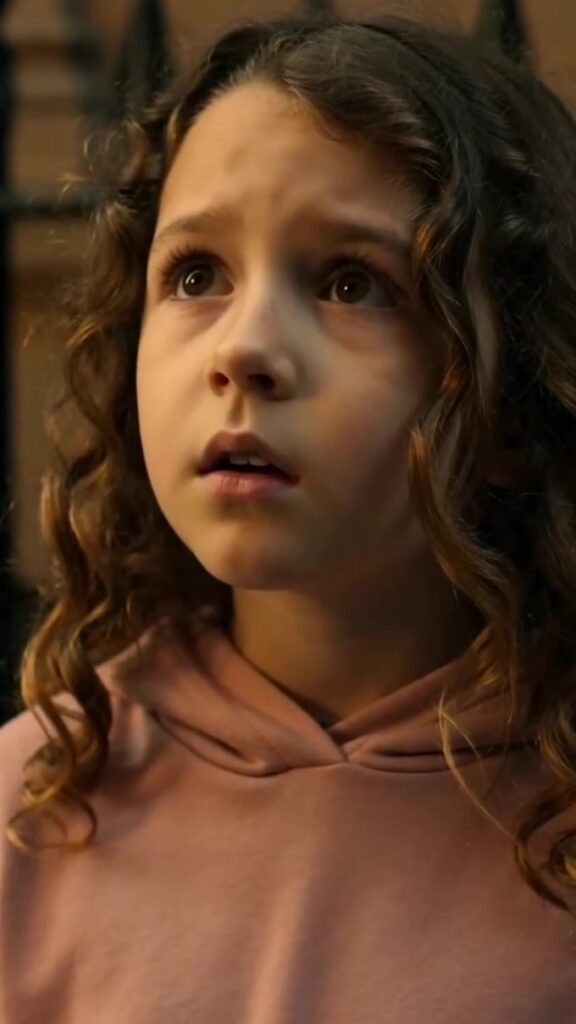
A little girl was sitting on the curb near the alley mouth, legs crossed, pink hoodie slightly too big for her. She wasn’t playing with a phone. She wasn’t shouting at anyone. She just sat there like she’d been told to wait and was taking the job seriously.
The photo skidded close to her sneaker. She picked it up carefully with both hands, like it could tear if she breathed wrong. Her eyes dropped to the face in the picture.
She went completely still.
Not the stillness of confusion. Not the pause before a question. It was recognition, sharp and immediate, like seeing your own front door in the dark.
She stood up quickly, clutching the photo against her chest, and called out.
“Mister!”
Daniel didn’t react at first. People rarely called to him. When he kept walking, she raised her voice again—small, but with an edge that cut through the street noise.
“Mister… why do you have a picture of my mommy?”
Daniel stopped so abruptly his shoes scraped stone.
The city kept moving. A couple laughed as they passed. A cyclist rang a bell. Somewhere, a delivery truck backed up, beeping in reverse. But inside Daniel, something slammed to a halt, like a door closing in a storm.
He turned slowly. “What… did you say?”
The girl stepped closer, holding the photograph out like evidence. Her eyes were a dark brown that looked too old for seven.
“My mommy,” she repeated, softer now, as if she’d realized she’d said something big.
Daniel’s throat tightened. The air felt suddenly too thin. “That’s my wife,” he managed. His voice cracked on the last word. “She died five years ago.”
The girl shook her head, not dramatically—just firmly, like she was correcting someone who’d gotten a basic fact wrong.
“No,” she whispered. “She didn’t.”
Daniel’s hands started trembling. He lowered himself to one knee in front of her, because standing felt impossible. “What’s your name?” he asked, forcing each word out carefully, like the wrong tone might shatter something.
“Lucy.”
“Lucy,” he repeated, anchoring himself to the sound. “And your mother’s name?”
She didn’t hesitate. “Elena.”
The name hit him hard, like a fist to the chest. His vision blurred for a moment. He gripped his own knee to keep from falling forward.
“Who told you that?” he asked, too fast, too loud. Fear surged up under the hope—fear of a cruel mistake, fear of a scam, fear that his grief had finally cracked his brain open.
Lucy’s expression didn’t change. “She did.”
Daniel’s breath went missing. “Where is she?”
Lucy turned and pointed down the narrow alley beside the bakery, the one Daniel usually avoided because it smelled like old trash and damp stone. “She told me to wait here,” Lucy said, voice quiet. “She said if I ever saw a man with that picture, I should ask why he still looks so sad.”
Daniel’s heart made a sound he could feel—something between a fracture and a bloom.
Only Elena would say something like that. Elena always noticed sadness the way other people noticed weather.
“When did you see her?” he whispered.
Lucy pointed again. “This morning.”
Daniel followed her finger, his body moving before his mind could argue. The alley opened onto a small courtyard hidden behind storefronts, where an old apartment building leaned slightly to one side like it was tired of standing. Second floor. A single window with a pale curtain.
The curtain moved.
Just a shift, just a breath of fabric—but Daniel felt it like a pulse.
And then there was a shape behind it.
A woman’s silhouette.
She stepped closer, and the sunlight caught her profile.
Daniel’s chest tightened so sharply he thought he might actually break in half. The slope of the shoulders. The tilt of the head. The way her hand lifted to touch the curtain, hesitant, as if she wasn’t sure she deserved to look out.
He took one step forward. Then another. His knees threatened to fold.
“Lucy,” he whispered without taking his eyes from the window. “Who is that?”
Lucy looked up at him calmly, like she’d been carrying this secret all day and was relieved to finally set it down. “My mom.”
The woman stepped fully into the light.
It was Elena.
Not a look-alike. Not a trick of distance. It was her face—older by a few years, paler, thinner around the cheeks, but unmistakable. Her hair was longer than it used to be, pulled back messily, and her eyes—those familiar eyes—were fixed on him with a kind of terrified hope.
Daniel forgot how to breathe. The world narrowed until it was just that window and the person who had haunted his pocket for half a decade.
Elena’s hand rose to the glass, fingers splayed as if she needed to prove he was real.
Daniel’s mouth opened. No sound came out.
Then Elena pressed her forehead against the windowpane and mouthed a single word he couldn’t hear but somehow understood anyway.
“Daniel.”
Behind him, the bakery door swung open and someone laughed, and somewhere the busker hit a wrong chord, and the city continued being a city. But Daniel was no longer walking through it like a ghost.
He was standing at the edge of an answer, staring at the impossible, while a little girl in a pink hoodie held out a photograph like it had finally found its way home.
And then the window latch clicked.
Slowly, Elena began to open it.