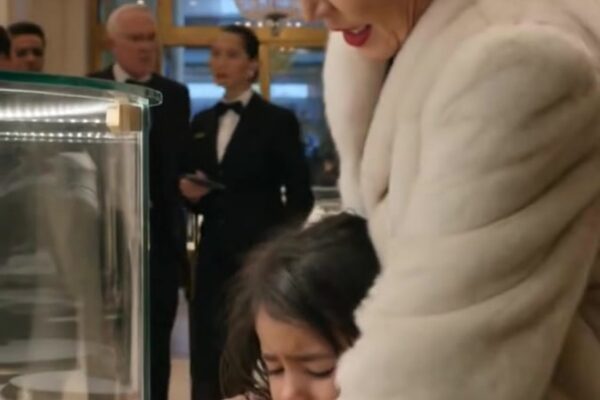
The bakery was wrapped in quiet luxury the way a scarf wraps around someone’s neck: soft, deliberate, and meant to keep out the cold parts of the world. The windows were tall and clean enough to make the street outside look like an art installation. Inside, golden chandeliers painted warm circles on marble floors, and the air tasted like butter, sugar, and cinnamon before you even opened your mouth.
People spoke in low voices here, like they were in a library that served croissants. A pianist in the corner didn’t take requests, just let smooth notes drift across the room like perfume. On the wall behind the counter, the menu was written in a neat script that made a latte sound like a lifestyle choice.
At a corner table, Mr. Valen—no first name offered, no need for one—held his espresso with the same steady grip he used for everything. He wore a black suit that wasn’t flashy, just perfectly tailored in a way that made you think of boardrooms and airport lounges. He didn’t look like a man who spent his mornings in bakeries. He looked like a man who owned buildings and had opinions about interest rates.
He wasn’t here for the pastries, though he had a plate of something glossy and almond-studded in front of him. He was here because it was quiet. The kind of quiet you could buy. The kind that told you, gently, that nothing bad happened in rooms like this.
Then the door opened, and the bell gave a small, bright ring that felt too cheerful for what walked in.
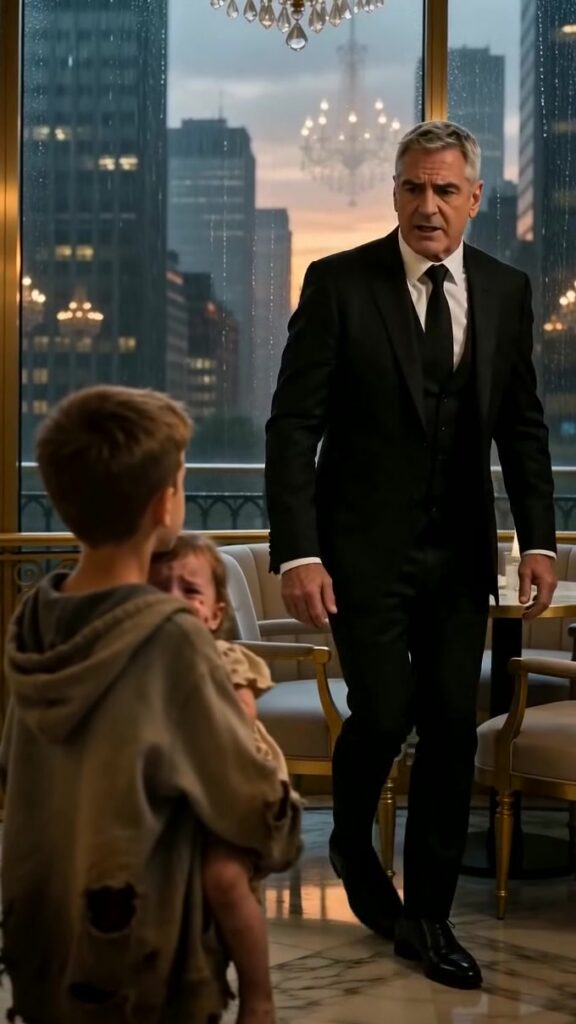
A boy came through first. Eight, maybe. Skinny enough that his oversized hoodie hung like someone else’s clothes. His hair stuck out in uneven tufts, like he’d cut it himself or slept in it for a week. His sneakers were tired, the soles peeled in places like they were giving up.
In his arms, he carried a toddler girl. She couldn’t have been more than two. Her dress was beige once, but now it was the color of old dust, and it clung to her in wrinkled folds. She was crying in quiet hiccups, her face pressed into the boy’s shoulder like she was trying to disappear into him.
The bakery didn’t know what to do with them. Conversations thinned. Cups paused halfway to lips. Someone’s spoon clinked against porcelain a beat too loud.
The boy moved with purpose anyway, like he’d rehearsed this. He approached the counter and waited until the worker looked at him. She was young, with glossy hair and a neat apron tied in a bow that looked like it had never been stained. She had the kind of polite smile that came automatically with training.
“Do you have any bread from yesterday,” the boy asked, voice small but steady, “that’s cheaper?”
The worker blinked, just once, and for a moment her expression softened. Something human flickered there—an impulse to bend the rules, to find a secret solution, to be the kind of person she’d want to remember being.
Then she glanced at the line behind him. At the chandelier reflection in the marble. At the idea of management and policies and the whole glass-and-gold illusion of the place.
“We don’t sell leftovers,” she said, careful and calm, as if kindness could be folded into the words if she spoke softly enough. “Everything is made fresh.”
The boy didn’t argue. He didn’t plead. He just lowered his eyes and tightened his arms around the little girl as she whimpered, “I’m hungry…”
That sound—two words and a broken sniff—cut through the bakery’s expensive quiet like a crack in glass.
Mr. Valen set down his cup. The porcelain met the saucer with a clean, final click. He’d been watching since the moment the boy came in. Not out of curiosity, exactly. Out of something he didn’t have a name for. The boy’s voice had scratched at an old memory in his head, the kind you keep buried under schedules and meetings.
He pushed his chair back. The legs scraped against marble, loud enough that heads turned automatically. Even the pianist’s hands hesitated for half a second before continuing, unsure if the room’s mood had changed.
Mr. Valen walked to the counter with a controlled pace. Not rushed. Not hesitant. The kind of walk that meant he expected the world to move for him.
“Pack everything,” he said.
The worker stared at him. “Sir?”
“Everything,” he repeated, still calm. “All the bread. All the pastries. The cakes. The little boxes of cookies. The croissants. The whole counter.”
Confusion rippled through the room. A woman at a nearby table raised her eyebrows like she’d just witnessed a very odd form of charity or an even odder form of flexing. The worker nodded quickly—training took over—and began calling for extra boxes, extra bags.
But Mr. Valen wasn’t looking at the worker anymore.
He was looking at the children.
He crouched slightly so he wouldn’t tower over the boy, and he softened his voice in a way that seemed unfamiliar even to him. “Come with me,” he said. “Both of you.”
The boy’s shoulders pulled back, protective. His grip on the toddler tightened like a lock. “Why?” he asked, eyes sharp and exhausted at the same time.
Mr. Valen opened his mouth to say something sensible—something about food, about help, about money—and stopped.
Because the toddler lifted her face at that moment, just enough to look around, and Mr. Valen saw her clearly.
She had a crescent-shaped birthmark near her left ear, the exact shade and curve he’d traced with his thumb years ago on a photograph he kept in a drawer he never opened when anyone was around. Her eyes were wide and dark, and even through the dirt and the tears, she had a familiar tilt to her cheekbones.
For a second, the bakery disappeared. Chandeliers, marble, piano—all of it fell away like a stage set.
Mr. Valen’s throat tightened. His hand lifted without permission, then hovered in the air because he didn’t know if he was allowed to touch this—this sudden, impossible thing. “Where,” he managed, voice rougher now, “did you get her?”
The boy flinched. “I didn’t steal her,” he said quickly, too quickly, like he’d had to say it before. “She’s my sister.”
“Your sister,” Mr. Valen repeated, and the words landed like a weight. He looked from the toddler’s birthmark back to the boy’s face. The boy’s nose was slightly crooked, like it had been broken once and never fixed. The boy’s eyes were gray-green—an uncommon color, and one Mr. Valen had seen in the mirror his entire life.
He felt something inside him crack open, not loudly, but deeply. The kind of break you don’t hear until everything starts leaking through.
“What’s your name?” he asked.
The boy hesitated, calculating risk the way children shouldn’t have to. Then, as if honesty was cheaper than fear, he said, “Milo.”
Mr. Valen repeated it like he was tasting it for meaning. “Milo.”
The toddler pressed her forehead into Milo’s shoulder again. “Brea,” she murmured, not quite a full name, just a sound she could manage. Milo rubbed her back in small circles, a gesture so practiced it hurt to watch.
Mr. Valen stood slowly, as if moving too fast might scare the moment away. He reached into his wallet and pulled out a card, then stopped. A card was too cold. Too official. Too much like the life he’d built around never needing anyone.
He looked at the worker, who had frozen mid-boxing, eyes darting between the man and the children. “Cancel the order,” he said quietly. “Not everything.” He nodded toward the shelves. “Just enough for them. And a hot chocolate.” He glanced at Milo. “Two. Extra whipped cream.”
Milo’s eyes narrowed. “We can’t pay.”
“I’m not asking you to,” Mr. Valen said. The words came out steady, but his hands weren’t. He tucked them into his coat pockets so no one could see the tremor. “I’m asking you to eat.”
He turned back to Milo and lowered his voice again. “And then,” he added, carefully, “I want to talk. Not here. Somewhere warm. Somewhere you can decide to leave if you don’t like what you hear.”
Milo stared at him like he was reading a trap disguised as kindness. The bakery’s quiet luxury waited around them, watching, judging, pretending it wasn’t curious.
Mr. Valen didn’t rush him. He just stood there, the richest man in the room suddenly looking like the poorest, because he’d found something he couldn’t buy back with a signature.
Finally, Milo nodded once—small, reluctant—and shifted Brea higher on his hip.
Mr. Valen exhaled, slow. “Okay,” he said, softer than the piano. “Okay. We’ll start with bread.”
And for the first time all morning, the bakery’s expensive quiet didn’t feel like comfort. It felt like a curtain lifting on a story that had been waiting outside the glass the whole time.