The rooftop of the Halcyon Spire was the kind of place that made you feel like you’d wandered into a perfume ad and accidentally stayed. Glass walls rose around the terrace like a crystal crown, and beyond them the city flashed and shimmered—taillights like red beads on thread, windows like tiny TV screens, the river catching all of it and tossing it back up at the sky.
Inside, everything was soft and expensive. Candlelight. White orchids. A string quartet doing a jazz cover like it was born with a tux on. Waiters floated around with trays of champagne so pale it looked like it had been filtered through moonlight. People laughed with their whole mouths but not their eyes, and every other hand held a phone like an extra organ.
I was there because I worked for the event’s PR team, which meant I wore black, smiled like a professional, and tried to keep donors from wandering into restricted areas or accidentally saying something that would trend for the wrong reason. My boss, Talia, had warned me: tonight was all about the man at the center of the room.
Julian Vale.
Tech magnate. Philanthropist. The kind of guy whose face you saw on airport billboards next to phrases like BUILDING TOMORROW. He wasn’t old, but he wore success like it had weight—tailored, crisp, perfectly in place. The charity, tonight’s big cause, was for “youth housing initiatives,” which sounded noble and safe and broad enough to make everyone feel helpful without being challenged too much.
As midnight leaned closer, the quartet softened into background shimmer and the lights dimmed, guiding attention toward the small stage near the glass doors. Cameras pivoted. A drone somewhere outside hummed like a mechanical mosquito, getting the wide shot of rich people pretending they weren’t aware of being filmed.
Julian walked up to the podium with his practiced calm. He adjusted the mic, smiled, and began the speech he’d probably delivered ten versions of already. Words like community. Opportunity. Dignity. He had the tone down perfectly—warm but authoritative, like a man who’d never had to check his bank account before ordering dinner.
Then it happened.
Mid-sentence, Julian’s voice hit a wall. His mouth stayed open, but no sound came out. His eyes drifted past the crowd, past the stage lights, toward the glass doors that led to the terrace and beyond that, down into the building’s rain-slick courtyard. For half a second I thought he’d spotted a protest or some kind of security issue. Then his expression changed into something raw, almost childlike—recognition without permission.
“No,” he said, barely audible. “That’s… impossible.”
The room didn’t just quiet. It snapped. Like a cord pulled tight. Laughter evaporated. Conversations died mid-syllable. Someone’s champagne flute clinked against another glass and sounded weirdly loud.
Phones rose, not even subtly. People didn’t look worried; they looked excited in the way only bored wealthy people can look when a live moment appears in front of them. This wasn’t a gala anymore. It was content.
Julian stepped back from the podium, his hand gripping the edge like he needed it to stay upright. He didn’t even glance at his security. He turned, abruptly, and moved toward the doors. Not a dignified walk. A rush. A stumble corrected into a sprint.
Without thinking—because my job was to stay close to whatever story was happening—I pushed through the crowd and followed, catching glimpses of bewildered faces in diamonds and cufflinks. The camera people adjusted, pivoting like birds. The glass doors swung open, and cold rain air slapped my face.
Outside, the terrace led down a set of gleaming marble steps to a courtyard that looked like it had been designed for magazine spreads: reflective stone, minimalist planters, a modern sculpture shaped like a ribbon of steel. The rain made everything shine. City lights bounced off wet surfaces until the whole courtyard looked like it was lit from below.
And there, at the bottom of the steps, was a child.
A small girl—nine, maybe ten—skinny in that way that isn’t genetic but environmental, like her body had learned not to ask for too much. Her clothes were too big and too thin for the weather, soaked at the cuffs. She held a broom like it was taller than she was, pushing dirty water and fallen petals away from the steps with quiet concentration. She was completely out of place, a stray pencil line on a finished painting.
Julian stopped in front of her so abruptly I nearly ran into him.
The girl looked up, blinking rain from her lashes. She didn’t look scared. Just tired, and maybe a little resigned, the way kids look when they’ve met too many adults who don’t see them.
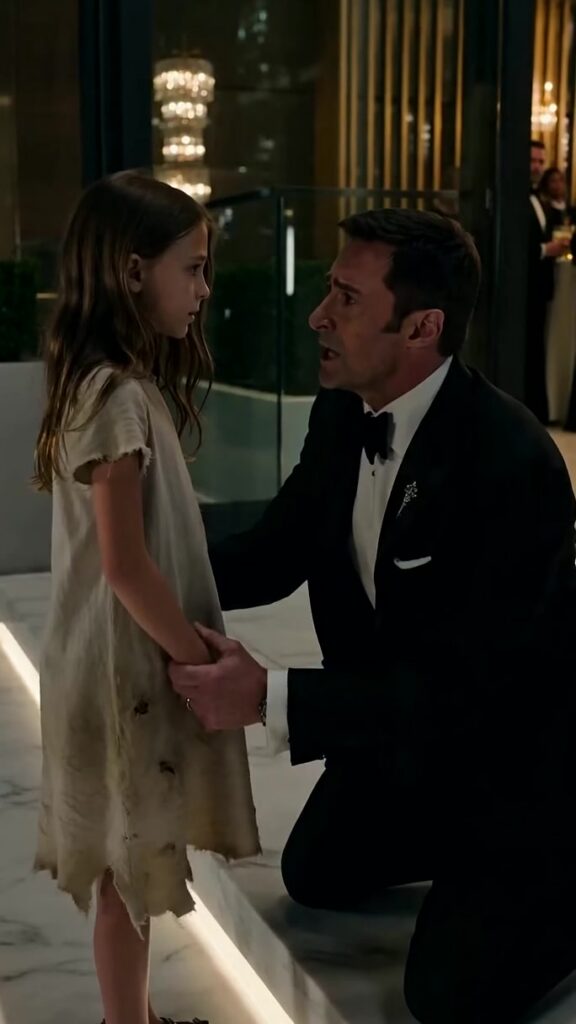
Julian’s mouth moved without sound for a beat. Then he did something that made everyone behind me inhale at once: he reached out and took her hand.
“Wait,” he said, voice shaking. “Give me your hand. Please.”
The girl hesitated, then let him. His grip wasn’t painful, but it was desperate, like he was holding onto a truth that could run away. He turned her palm upward, and his eyes locked on her fingers.
On the side of her index finger, close to the knuckle, was a dark birthmark. Not huge, but distinct—like a tiny ink spill, shaped almost like a crescent.
Julian’s face crumpled. Not theatrically. Not for cameras. It fell apart in real time, like a mask that had been glued on too long and finally lost adhesion.
“…That mark,” he whispered, as if naming it could keep it from being real.
The girl frowned, confused but calm. “Sir,” she said carefully, “I’m just working. I have to finish before—”
He dropped to his knees in the rain, still holding her hand. The marble didn’t care. His suit didn’t care. The whole world narrowed to the small space between his fingers and hers.
“What’s your name?” he asked.
The question hung there, strangely intimate. A few feet away, people continued recording, their screens glowing like tiny windows into a different version of the moment.
The girl’s lips pressed together. She looked past Julian’s shoulder toward the building, toward the bright gala beyond the glass, like she was checking how much trouble she might get in for answering. Then she said it anyway, quietly, like she was handing over a fragile thing.
“Lina.”
Julian went still. His breath seemed to catch, hard. The name landed on him like a physical blow, and I watched him swallow like he was trying not to drown in it.
“Your mother,” he said, voice thick. “What’s her name?”
Lina’s shoulders tightened. She dropped her gaze to their joined hands. “She told me never to say it,” she murmured. “Not to strangers.”
The rain kept falling, steady and indifferent. The city noise, usually a constant hum, felt far away. Even the people filming seemed to hold their breath, not because they suddenly found empathy, but because tension was addictive.
Julian leaned closer, rain sliding down his face like tears he hadn’t earned yet. “Please,” he said. “I need to know.”
For a moment, Lina looked so much older than her years that my chest ached. Then she lifted her eyes to his, and in them was something steady—something rehearsed.
“She said,” Lina began softly, “if someone ever finds me because of this mark…”
She raised her hand slightly, showing the crescent stain as if it were a key. Julian’s fingers trembled around hers.
“…then he’s my father.”
Julian’s face went blank with shock, and then—like a dam giving up—grief and hope and disbelief rushed through him all at once. His mouth opened, but whatever he meant to say didn’t make it out. Behind me, the crowd shifted, hungry and whispering. But on the wet marble steps, with the city glittering below like it was watching too, Julian Vale didn’t look like a billionaire or a keynote speaker.
He looked like a man who’d just been handed a missing chapter of his own life, written in a child’s small, rain-cold hand.
And Lina, still holding the broom in her other hand like she might have to go right back to sweeping, waited—quietly—like she’d been waiting a long time for someone to kneel instead of stepping over her.