Celeste Marlowe had mastered the kind of smile that looked warm from a distance and cost nothing up close. It was the smile you wore when you’d spent enough decades in glittering rooms to know every conversation was a transaction, every laugh a receipt. On this particular night, she stood beneath the ballroom’s chandelier—an overgrown galaxy of crystals—wrapped in a sapphire gown that made her pale hair look whiter, her posture straighter, and her age less like a number and more like a title.
The gala was for the Marlowe Foundation, which was a polite way of saying Celeste’s money was hosting everyone’s money. The city’s familiar faces drifted by in tidy waves: senators with gleaming teeth, surgeons with watch-tan wrists, philanthropists with tragic backstories neatly packaged for dessert. A string quartet played something airy and expensive. Servers moved like trained shadows. Every table glittered with glassware that looked too thin to be trusted.
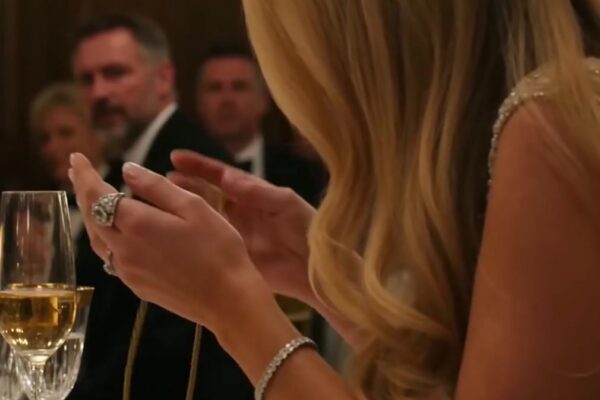
Celeste held her champagne as if it were an accessory rather than a drink—stem pinched, wrist relaxed, bubble-gold catching light. She was listening to a venture capitalist explain how his latest app was “changing lives,” when something in her peripheral vision snagged hard, like a thread pulled from a hem.
A waitress passed behind the man’s shoulder. Elegant black-and-white uniform, hair tucked into a neat bun, posture practiced. Nothing unusual—except the necklace at her throat.
It was a diamond flower, delicate as frost. Not flashy in the modern way—no chunky statement piece, no brand screaming for attention. This was old craftsmanship. Each stone arranged like petals opening. The chain sat just above her collarbone, catching the chandelier’s light and throwing it back in tiny, sharp sparks.
Celeste’s lungs forgot what they were for. The room didn’t exactly stop, but it warped around her, as if someone had turned down the speed on everything else. The venture capitalist’s lips kept moving; the quartet kept playing; laughter still rose and fell. Yet the only thing Celeste could hear was a distant rush, like blood in her ears.
Because she knew that necklace. She’d known it in a different room, under different lights—under smoke, under screaming.
Her fingers lost their grip. The champagne flute slid, tilted, and fell. It struck the marble floor with a brittle, decisive crack. Glass exploded outward in a clear, star-shaped scatter. A few nearby guests flinched, and the quartet’s bowing faltered. The music cut off as if someone had yanked the cord.
Silence spread fast. Eyes turned. In a room built for performance, any mistake became a stage.
Celeste didn’t apologize. She didn’t even look down at the broken glass. Her gaze stayed locked on the waitress, who had paused mid-step, startled, frozen with a tray balanced in her hands.
Celeste moved. Not gracefully. Not with the controlled glide she used for cameras. She crossed the space with startling speed for a woman of her age, her sapphire skirt whispering over the floor like a wave.
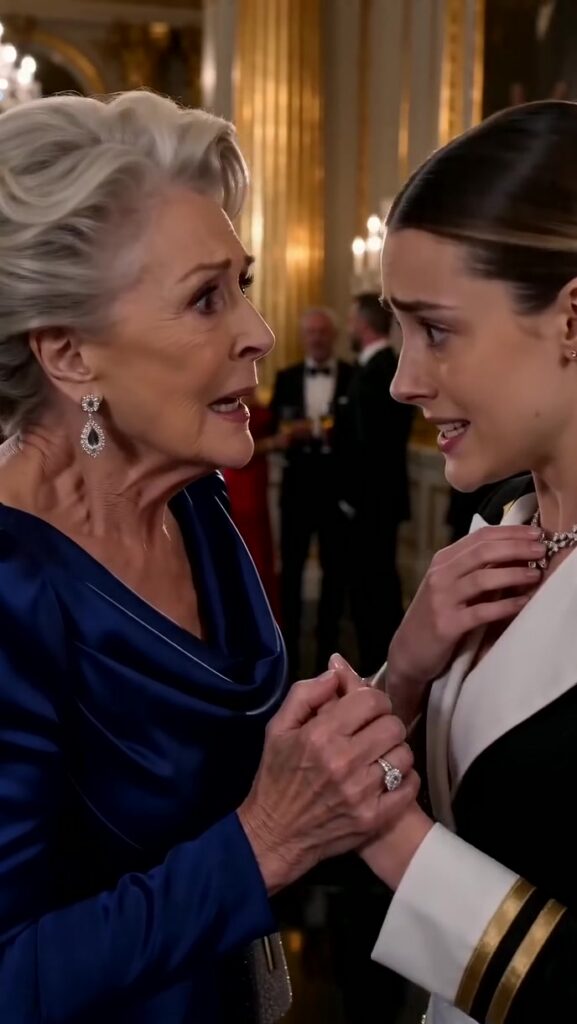
The waitress tried to step back, confusion flickering into alarm. Celeste reached her and took her hands—both of them—firmly, as if anchoring her to reality.
“Where did you get that necklace?” Celeste whispered. Her voice shook, thin and sharp. Her eyes were wide, unblinking, as if blinking might make the necklace vanish.
The waitress’s throat bobbed. She glanced around at the sudden circle of watching guests. Her cheeks flushed the color of spilled wine. “I—I didn’t steal it,” she said quickly, panic tightening her words. “I’ve had it since I was a child. It’s mine. It’s always been mine.”
Celeste’s grip softened a fraction, but her focus sharpened. She leaned closer, barely breathing. “Let me see it,” she demanded, and then, as if that sounded too harsh, she added, “Please.”
The waitress hesitated, then lifted a trembling hand to the chain. She pinched the pendant and turned it carefully, as if afraid it might cut her. The diamonds flashed, and for a moment the ballroom lights exploded into tiny suns.
On the back of the pendant, there was an engraving. Small, neat letters, almost worn smooth by time.
R.M.
Celeste’s face drained, all the polished color leaving at once. Her eyes filled so fast it looked like someone had turned on a faucet behind them. She made a sound that wasn’t quite a sob and wasn’t quite a laugh, a broken noise that startled the nearest guests into stepping back.
“Rosemary,” Celeste breathed, as if saying the name might summon someone out of the air.
The waitress went rigid. The tray wobbled. A few glasses clinked like nervous teeth.
“How do you know that?” the waitress asked. Her voice was smaller now, careful, like a child approaching a dog that might bite. “My foster mother… used to call me that.”
Celeste stared at her as if she were seeing two people at once: the young woman in a uniform, and a child in a nightgown, hair singed, eyes huge. Celeste’s lips trembled. “No,” she whispered. “That was your name. It was your real name.”
The waitress’s eyes flicked down to the necklace, then back up. “My real name is Lena,” she said, but there was no confidence in it. “That’s what my paperwork says.”
Celeste’s hands slid up to the girl’s wrists, gently now, as if afraid she’d bruise her. “Who gave you that necklace?” she asked. “Who told you where it came from?”
Lena swallowed. “No one. I don’t remember. I just… always had it. It was in a little cloth pouch with me when I went into care. They told me it was costume jewelry at first, and then someone appraised it when I was older. I never sold it. It felt—” Her voice caught. “It felt like it was the only piece of me I could keep.”
Celeste’s breath hitched. “It was a gift,” she said. “From a woman who—” Her words crumbled. She shut her eyes briefly, then opened them again, glassy and furious with sorrow. “From me.”
Lena stared at her, stunned. The guests around them murmured in low, hungry ripples. Phones lifted discreetly. Somewhere, someone whispered, “Is that Celeste Marlowe?” as if she were a mythical creature caught acting human.
Celeste reached up with shaking fingers and brushed the pendant like it might burn her. “R.M.,” she said. “Rosemary Marlowe.”
“That’s not possible,” Lena said, and the denial sounded more like a prayer than an argument. “I’m not— I don’t—” She looked around, desperate for an exit that wasn’t there. “My parents died in a fire. That’s what I was told.”
Celeste’s expression flickered—pain, recognition, and something that looked like dread. “There was a fire,” she said softly. “Yes.”
A new sound cut through the murmurs: the crisp strike of shoes on marble, purposeful and angry. Heads turned. A silver-haired man in a tuxedo pushed into the circle as if parting water. His jaw was tight, his eyes sharp as broken ice.
Celeste stiffened the moment she saw him. The air around her seemed to change temperature.
“Celeste,” the man snapped, grabbing her upper arm with a grip that looked practiced. “What are you doing?”
His name—everyone knew it—was Alistair Crowne. Board member. Old friend. Old ally. The kind of man who collected influence the way others collected watches.
Celeste didn’t pull away. She couldn’t seem to. Her fingers were still looped around Lena’s wrists, but her strength had vanished; it was like she was holding on to the last solid thing in a dream.
Alistair’s gaze dropped to the necklace. Something shifted in his face—not surprise, not confusion. Recognition. Immediate and lethal.
Lena, sensing danger without knowing its shape, tried to step back. Celeste instinctively tightened her hold again, protective now.
Alistair leaned in, close enough that only they could hear, but his voice carried anyway—cold, clear, and final as a verdict.
“She was never supposed to survive the fire.”