The restaurant was glowing the way a jewelry case glows—soft, expensive light poured out of the windows and made the sidewalk look cleaner than it had any right to. Inside, everything shimmered. Crystal stemware, brass fixtures, napkins folded like origami. The kind of place where even the ice cubes seemed trained.
People came here to be seen being fine. They laughed with their whole mouths and none of their eyes. They nodded at each other like they were all in on some private joke called “money.” A trio in the corner played lazy jazz that made every conversation sound smoother than it was.
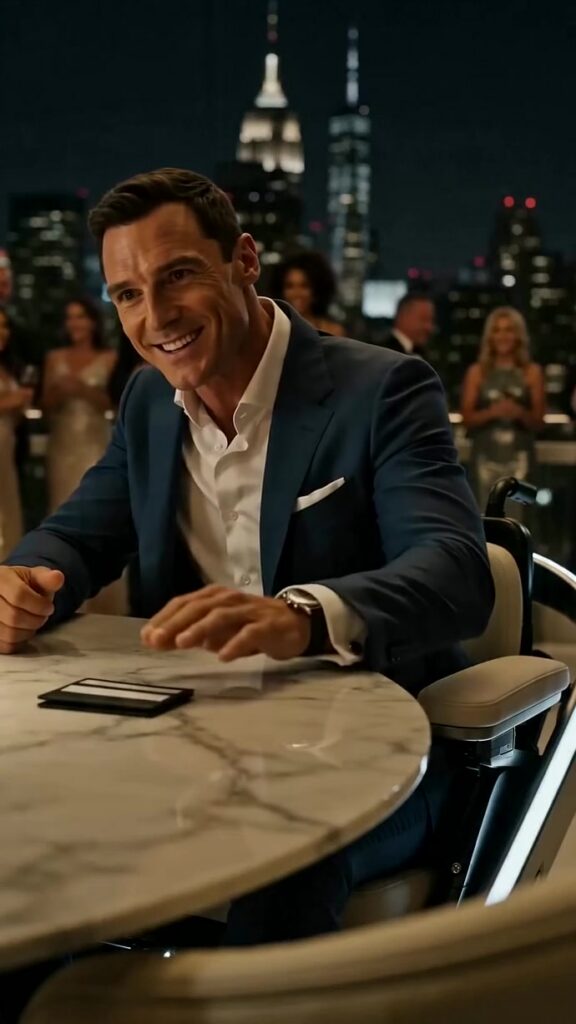
At the center table, Preston Vale held court. He didn’t need to stand to dominate a room. His wheelchair looked less like a medical device and more like a custom sports car—sleek, carbon-fiber frame, polished wheels, and a dark leather seat that matched his suit. He had the kind of face that belonged on billboards: symmetrical, controlled, unbothered. When he smiled, you felt like you’d been invited into something exclusive.
Everyone knew the story, or at least the version that made a good story. Preston had been a rising star, a dealmaker with a talent for turning air into profit. Then came the crash—late-night drive, wet asphalt, a guardrail. The doctors said “severe injury,” the tabloids said “tragedy,” and Preston said nothing at all. He just kept buying companies like he was buying time.
That night, the waiters moved around him like satellites. The guests tossed compliments the way they tossed tips—lightly, without thinking. Preston accepted it all with that perfect smile, his fingers drumming a slow rhythm on the table, as if he could conduct the room.
Then the front door opened and the temperature of the place changed.
A kid stepped inside barefoot. No shoes, no socks—just thin feet on marble. He was maybe ten, maybe twelve, in a shirt too big for him and pants cuffed like someone had tried to make them fit and failed. His hair looked like it had met a comb once and decided it didn’t care for the experience. He paused under the chandelier as if the light itself surprised him.
Heads turned. Someone near the bar let out a little laugh—more reflex than humor, like when you see a stain and can’t stop staring. A woman in a glittering dress leaned toward her friend, whispering with her hand half-covering her mouth. Phones came out immediately. In a room like this, nothing happened unless it could be posted.
The host hurried forward, posture stiff with polite panic, but the boy slipped past him like he’d practiced. He walked straight between the tables, ignoring the murmurs and the snickers, and stopped at Preston’s.
Preston looked up slowly, the way a person looks at a fly that has decided to land on their drink. His friends quieted, amused and ready. One of them—silver cufflinks, too-white teeth—said, “This some kind of stunt?”
The boy didn’t look at the cufflinks guy. He didn’t look at any of them. His eyes stayed on Preston, serious in a way that made him seem older than his face. “Sir,” he said, voice small but steady, “I can help your leg.”
The table detonated with laughter. It wasn’t gentle laughter, either. It had teeth. People slapped the table, turned to other tables as if to share the entertainment. A glass tipped and rang against another, bright and careless. Someone started recording with the sound on.
Preston leaned back, amused in a way that felt practiced. He let them laugh long enough for it to peak. Then he tilted his head. “You?” he asked, scanning the kid from hair to toes, making sure everyone saw the contrast. “And how exactly would you do that?”
“Quick,” the boy said. “Just a few seconds.”
The laughter got louder, because now it wasn’t just funny—it was ridiculous. Preston’s smile widened, but it didn’t warm his eyes. He reached into his jacket and pulled out a checkbook like he was producing a magic trick. He tore a check free, wrote on it with slow, theatrical strokes, and laid it on the table where the candlelight could kiss the ink.
“If you fix it,” Preston said, quiet enough to pull the room toward him, “I’ll pay you a million.”
The laughter didn’t just stop. It broke, like someone had cut a cable. A hush spread from table to table. Even the trio’s sax player hesitated, then slid into a lower, darker line like the music had suddenly remembered it could be ominous.
The boy nodded once as if Preston had offered him a glass of water. No celebration, no gaping. He stepped forward, then knelt beside the wheelchair with the calm of someone who belonged there more than anyone wearing cufflinks.
Preston’s friends leaned in. The host hovered, hands wringing his napkin. A waiter froze mid-step with a tray of oysters.
The boy put a small hand on Preston’s leg—just above the knee, gentle, not grabbing. His other hand rested on the chair’s metal frame as if he was grounding himself. “Count with me,” he said.
Preston let out a short laugh. “This is—”
He didn’t finish. His breath caught, sharp and involuntary. His eyes snapped down, and for the first time all evening, the mask slipped. His fingers stopped drumming. His shoulders went rigid.
A twitch ran through his leg. Small, almost nothing. The kind of movement you’d convince yourself you imagined if you were alone. But Preston wasn’t alone. Fifty phones were aimed like tiny spotlights.
“One,” the boy said.
Another twitch, stronger. Preston’s mouth opened. No sound came out at first, just air. His hand slapped the table hard enough to rattle glasses. “What… what was that?”
“Two.”
Preston’s knee lifted a fraction. A real movement. It wasn’t a miracle in the sense of fireworks; it was worse. It was precise. Specific. Like someone had reached inside him and flipped a switch that had been sealed off for years.
The restaurant erupted—people shouting, chairs scraping, someone crying out Preston’s name like they were watching a championship game. The trio tried to keep playing but the pianist’s hands were shaking.
Preston gripped the armrests and tried to push up. The chair creaked. His face filled with something raw and bright. Hope, yes—but hope the way a starving person feels it, sharp and desperate. “Who are you?” he demanded, voice cracking on the last word.
The boy leaned closer, close enough that his messy hair brushed Preston’s cuff. He didn’t look at the cameras. He didn’t look at the check. He looked at Preston like he was reading a page only he could see.
“Three,” the boy said softly.
Preston’s leg moved again, a definite bend at the knee. His whole body jolted like he’d been shocked. A strangled sound came out of him—half laugh, half sob, half scream. And then, right as the room hit maximum chaos, the boy whispered something in Preston’s ear.
Whatever it was didn’t sound like a threat from where people stood. It was too quiet to catch. But Preston heard it. His face drained of color so fast it looked like the golden light had abandoned him. His eyes widened, not with joy now, but with a fear so pure it silenced him.
He sank back into the chair as if gravity had doubled. His hands trembled on the armrests. A phone dropped to the floor and cracked, the noise loud in the sudden lull.
The boy stood, smooth and unhurried, and slid the untouched check into Preston’s breast pocket like returning something borrowed. He turned to leave, barefoot steps whispering over marble, and no one moved to stop him.
At the door, he paused and glanced back once. The chandelier light caught his face and for a second his smile looked almost kind. Almost. Then it was gone, and he disappeared into the night.
Preston stared after him, swallowing hard. When his friends rushed in with questions—What did he say? Did it hurt? Are you okay?—Preston didn’t answer. He just pressed a palm to his leg like he was making sure it was still there, still his, and whispered to himself, too low for the cameras to catch, “He remembers.”