Rush hour had a way of making everyone look like they belonged to the same exhausted species. The downtown station throbbed with it: the crush of coats, the squeal of shoes on wet tile, the sharp perfume of rain blown in every time the doors slid open. Announcements ricocheted off the glass walls in that cheery-but-hollow voice—delays, platform changes, apologies that sounded copied and pasted from yesterday. Outside, the rain tapped the big panes like impatient fingers.
Most people moved like they were being dragged by a current. One woman didn’t move at all.
She stood in the center of it—early thirties, wearing an elegant camel coat that looked too nice for this chaos. Her makeup was almost perfect, but not quite. Mascara had smudged at the corners, and her lipstick looked like it had lost an argument with a sleeve. Her hair was pinned up, neat enough to say she’d tried. Her hands, though, betrayed her. She gripped her phone like it was evidence in a trial and she was terrified of dropping it.
The moving crowd split around her without meaning to. People glanced, adjusted their paths, muttered apologies like you might to a stationary post. That’s when a man appeared on the other side of her stillness and stopped too.
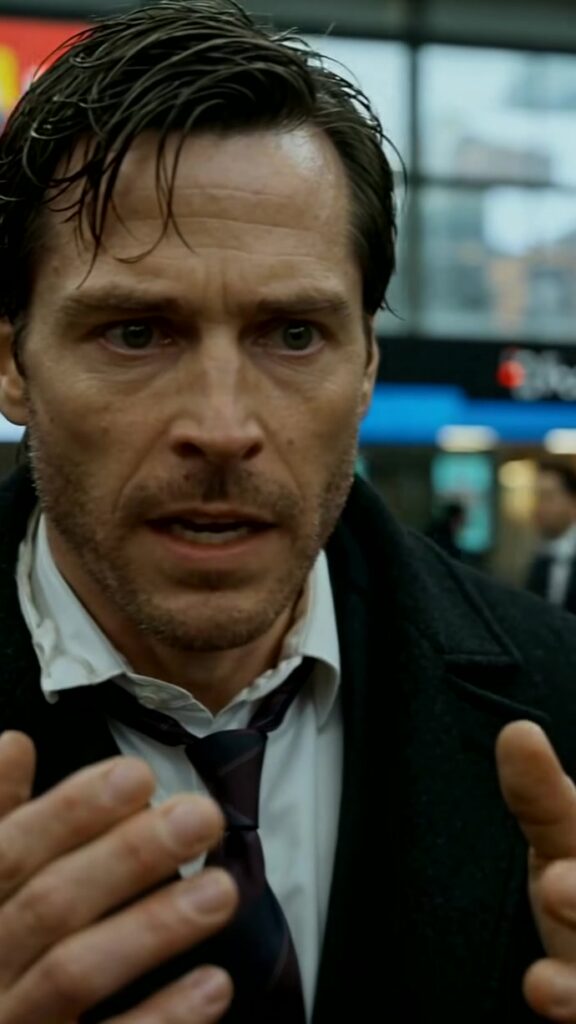
Late thirties, tall, sharp black coat, the kind of haircut that always looks intentional. He had the face of someone who’d practiced calm for years and suddenly couldn’t remember how. His breathing was uneven, and his eyes kept darting toward the exits, toward the turnstiles, toward the escalators—like there was a hidden door somewhere that only he could use.
For a second, they just looked at each other, the rest of the station roaring around them.
Then the woman lifted her phone, holding it upright like a small, bright shield.
“Don’t move,” she said. Quiet. Not dramatic. Somehow worse because of that.
The man tried to laugh. It came out wrong, like it got caught on the way up. “You’re making a scene,” he said, pitching his voice so it would sound normal to anyone nearby.
She cut him off instantly. “You already did that,” she said. “A long time ago.”
The words landed heavy. They didn’t need context to feel dangerous. People nearby slowed down, then stopped. A couple of commuters pretended to check train times but angled their bodies so they could watch. Someone’s rolling suitcase bumped into a shin and nobody even snapped about it. Like the station itself had tilted toward the two of them.
Phones came out. Not all at once—more like a ripple. One person started recording, then another noticed, then another. The crowd tightened into a loose circle, a human boundary drawn with curiosity.
The man took a step closer, leaning in as if closeness could shrink the situation. “What do you want from me?” he asked, lowering his voice. “Whatever this is, we can talk somewhere else.”
“No,” she said. “We’re talking here.”
Her thumb tapped the screen. She didn’t look down. She’d memorized where everything was, like she’d practiced it in the mirror, in her car, in the dark at three a.m. when thinking was louder than sleeping.
A crackly audio file spilled from the phone’s speaker. A voice—distorted, like it had been recorded in a pocket or behind a closed door—slid into the air between them.
“…don’t tell her anything,” the voice said. “If she finds out, everything collapses.”
It wasn’t much. It didn’t have to be. The man’s face did something small and catastrophic: the color drained, as if someone had pulled a plug. His mouth opened, then closed. He swallowed and his throat bobbed.
“No—” he whispered, and the whisper still carried because the circle had gone strangely quiet. “You weren’t supposed to have that.”
The woman’s breath shivered, but her voice stayed steady, like she’d put it in a locked box. “So it’s real,” she said.
The station noise pushed in again—an announcement about a delayed line, the clatter of someone sprinting down stairs—then fell away in the minds of everyone standing there. That half second of silence felt louder than the whole building.
She tapped again. “And this,” she said.
A second file played. A different voice this time, clearer, and unmistakably close to a microphone. It said a name. Not loudly. Almost casually, like it had been said in a room where everyone assumed they were safe from consequences.
The man’s eyes flicked to her phone like it was a live wire. He moved fast, reaching out.
She shifted her stance—not stepping back so much as bracing. Years of holding herself together had taught her a kind of balance. She raised her free hand and said, not louder, but sharper, “Don’t.”
His fingers hovered an inch from the screen.
“I also know who was with you that night,” she said.
He froze mid-motion. His eyes widened as if she’d just turned on a light in a room he’d pretended didn’t exist.
Across the circle, someone let out a small involuntary sound—an inhale that turned into a gasp. Another person whispered, “Oh my God,” like they’d walked into the wrong movie.
The man’s hand dropped slowly. His jaw worked, trying to shape an explanation, a denial, a joke—anything that could stitch his face back on. His eyes searched the crowd now, not for an exit, but for allies. There weren’t any obvious ones. Just strangers holding up phones, watching him like he was a headline writing itself.
“You don’t understand,” he started, voice hoarse. “It wasn’t—”
“Don’t,” she said again, and this time it had weight behind it, like a door locking. “You don’t get to reframe it.”
Rain hit the glass harder, a sudden drumroll. The neon information board flickered. Somewhere behind them, a train arrived with a metallic groan and a gust of warm air, but nobody in the circle moved toward the platform. The world had shrunk to this little stage of tile and fluorescent light.
The woman looked at the man like she was reading him, line by line, like she’d done for years in her head and was finally holding the actual book. “I waited,” she said, and the casual tone cracked just enough to show what was underneath. “I waited because I thought I needed proof. I thought I needed someone official to care.” She shook her head once, small. “Turns out I just needed you to hear it out loud.”
He licked his lips. “Please,” he said, and the word sounded like it had been borrowed from a different person. “Not here. Not like this.”
“Like what?” she asked. “Like you can’t control it?”
He glanced toward the escalator again. Two security guards were visible now, walking briskly, radios in hand, drawn by the stillness more than any alarm. The man’s shoulders tightened.
The woman held her phone steady and angled it slightly, so the camera captured him, her, and the ring of witnesses. Her own reflection stared back at her from the glossy screen—eyes rimmed red, chin lifted like she was daring herself to finish.
“Say her name,” she said. “Say the truth.”
His face twitched. The crowd leaned in without stepping forward, like the whole station had become one body holding its breath.
He opened his mouth to speak—
And the story, hanging on the edge of that first syllable, felt like it could tip the entire rush-hour world off its tracks.