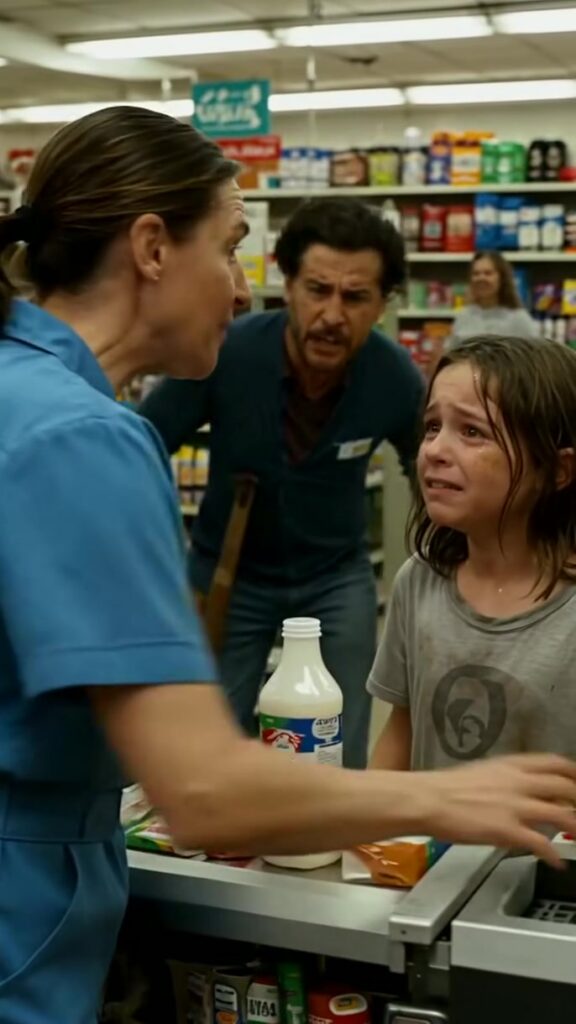
The slam wasn’t that loud, not really. It was a plastic bottle of milk, half-sweaty from the fridge, and it hit the checkout counter with a hollow thud that shouldn’t have stopped a whole line of grown-ups mid-scroll and mid-sigh.
But it did.
Mara had small hands and a too-big hoodie with the cuffs swallowed over her knuckles. Her hair looked like it had been brushed in a hurry and then lost an argument with the wind. She stood on tiptoe to see over the candy rack, eyes huge and red-rimmed like she’d been crying for hours but refused to admit it. In the crook of her elbow was a wrinkled loaf of store-brand bread and a single bruised banana, like she’d picked it up off the floor and decided it still counted as food.
“PLEASE—can I pay tomorrow?” she blurted, voice cracking on the word like it hurt her throat. “I swear I will!”
Leo, the cashier, stared at her the way you stare at a car that’s stopped in the middle of an intersection—part confusion, part dread, part hope that someone else is going to handle it. He was twenty-six, wore a name tag that kept flipping upside down, and had the kind of exhausted politeness that came from too many nights closing alone.
He glanced at the little display screen: milk, bread, banana. Not much. Still enough to get him written up if he started playing hero.
“I’m sorry,” he said quietly, leaning forward so the line wouldn’t hear. “I can’t do that.”
Mara’s shoulders jerked like she’d been slapped. She took a step forward until her hoodie nearly brushed the scanner. Her chin trembled, but her eyes stayed locked on his, stubborn as a door jammed in its frame.
“You don’t understand,” she said, words tumbling out fast. “My brother hasn’t eaten. He cries all night.”
The line behind her had been inching along with all the urgency of melted ice. Now it came alive with whispers and shifting feet.
“Oh my God,” someone murmured, half sympathetic, half nosy.
A woman in a fitted jacket with a shining purse strap huffed like she’d been personally inconvenienced by hunger existing. “This isn’t a charity,” she snapped. “Move the line.”
“She’s eight,” a man farther back shot back, voice sharp. “What’s wrong with you people?”
Someone else muttered, “Probably a scam,” and another answered, “A scam with a banana? Really?”
Leo’s face went hot. He could feel every pair of eyes pinning him in place. The store music—something cheerful about summer—suddenly felt sarcastic.
He kept his voice low, like volume could control chaos. “I could lose my job,” he told her, hating himself for saying it out loud. Like his job was the important part in a sentence about a kid’s brother crying from hunger.
Mara’s hands clenched so tight the milk bottle squeaked. When she spoke again, it came out almost like a scream. “Then let him starve?! Is that better?!”
The store went quiet so fast it felt like the air got sucked out. Even the woman with the purse stopped tapping her nails on her phone. Somewhere near the back, a kid dropped a bag of chips and nobody laughed.
Leo stared at the milk like it had become a whole moral philosophy question. He pictured his manager, Derek, with his clipboard and his rules and his favorite phrase—company policy. He pictured the security camera in the corner, the little blinking red light that didn’t care about brothers who cried at night.
Then something in him snapped. Not the dramatic kind. The quiet kind that happens after you’ve been tired for a long time and you suddenly realize you’re going to be tired anyway, no matter what you do.
He slid the items into a bag. Then, without looking at the screen, he reached under the counter and pulled out a second bag—one he’d set aside earlier with a couple instant noodle cups and a jar of peanut butter he’d bought on his break but hadn’t taken home yet.
“Enough,” he said, voice going flat and certain. “I’m not arguing anymore—take it. Take all of it.”
Someone gasped like he’d just announced a crime.
“This is against the rules!” a customer barked, indignant in that way people get when rules finally apply to someone else.
Leo didn’t even blink. “Then report me.”
For a second he expected the world to fall apart—sirens, alarms, Derek appearing out of thin air. But nothing happened. The register didn’t explode. The ceiling didn’t cave in. It was just him, a bag of groceries, and a little girl whose whole body shook as if she’d been holding her breath for days.
Mara reached for the bag with both hands like it might float away. Her fingers brushed his for a second. They were cold.
“Thank you,” she whispered. The words were so small they almost didn’t count as sound.
Then she turned and ran, hoodie flapping behind her like a cape that wasn’t convinced it had a hero attached.
The line erupted again—some people angry, some embarrassed, some suddenly pretending the candy rack was fascinating. Leo braced himself for yelling, for consequences, for that sinking feeling of doing the right thing and paying for it.
But he didn’t see the man at the end of the line until he moved.
He was tall, maybe mid-thirties, with a baseball cap pulled low and a work vest that looked like it had been worn through a hundred shifts. He’d been quiet the whole time, eyes fixed on Mara in a way that wasn’t creepy—more like he was trying to remember something important.
As soon as Mara bolted out the sliding doors, he stepped away from his cart and followed.
Leo’s stomach dropped. For one sick moment he imagined the worst—someone chasing her to snatch the bag, to lecture her, to turn her into a lesson.
“Hey!” Leo called, but his voice got swallowed by the store’s automatic doors whooshing open and shut.
He craned his neck past the entrance. Outside, the evening was windy and gray. Mara was already halfway across the parking lot, weaving between cars like she’d done it a thousand times. The man walked fast, not running, keeping a careful distance.
Mara stopped near the edge of the lot where the streetlights started. She spun around, clutching the bag to her chest, eyes wild like a cornered animal.
The man raised both hands, palms out, like he knew the gesture mattered. He said something Leo couldn’t hear through the glass. His mouth formed words slowly, gently.
Mara hesitated.
The man reached into his vest pocket and pulled out a folded piece of paper. He held it up, then pointed toward the far end of the block where an old apartment building slouched behind a chain-link fence.
Mara’s face shifted, confusion melting into a kind of shock. She took one step forward, then another, like her feet were making decisions her brain hadn’t caught up with.
Leo watched, trapped behind his register, heart hammering, while the line behind him started complaining again—people hungry for their own dinners, impatient with other people’s emergencies.
Outside, Mara and the man stood facing each other in the wind, and whatever he said made her grip on the grocery bag loosen just a little.
Then, incredibly, she nodded.
And together, they headed toward the apartment building—Mara walking fast, the man matching her pace, glancing around like he was making sure nobody else was following.
Leo swallowed hard. He didn’t know if he’d just helped a kid get dinner or stepped into the beginning of something bigger.
Behind him, the register beeped impatiently as if it could scold him back into normal life. Leo forced his hands to move, scanning the next customer’s items, but his eyes kept flicking to the doors.
Because somewhere out there, an eight-year-old girl was carrying a bag of food like it was the last solid thing in her world—and a stranger was following her into the dark, for reasons Leo couldn’t yet understand.
And it didn’t feel over. Not even close.