The first thing you noticed about La Terrasse D’Or wasn’t the chandeliers or the violinist near the fountain. It was the way the place sounded expensive—glasses clinking like tiny bells, laughter that never got too loud, forks landing softly on plates like everyone had practiced being rich in front of a mirror.
Mara had been working there long enough to tell who belonged just by the way they walked. The people on the terrace moved like they owned the air. They never looked down unless it was to admire their shoes.
So when a little girl slipped past the host stand and stepped onto the marble tiles, the whole terrace felt like someone had dropped a pebble into a still pond.
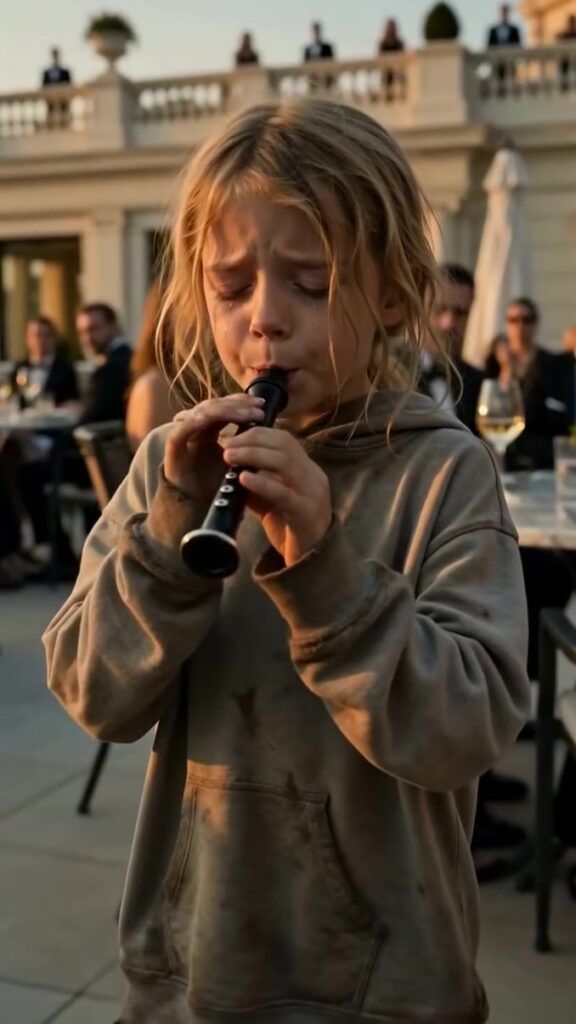
She couldn’t have been more than nine. Her sweatshirt was too big, the cuffs frayed, and her hair had been tied back at some point but had given up halfway through the day. In her hands she held a tiny flute—plastic, maybe, with tape wrapped around the middle like a bandage.
Mara started toward her automatically, the way you do when you see a kid standing too close to traffic.
But the girl beat her to the words, voice cracking and loud enough to cut through the gentle music. “Please,” she said, eyes wide and wet. “I just need money for food. Please.”
The terrace went quiet like someone had unplugged it.
Heads turned. Slowly. Not with curiosity, exactly. More like the coordinated swivel of people who didn’t want to be inconvenienced but also didn’t want to miss something dramatic.
Mara saw the host, Luc, hesitate with that polished smile stuck on his face. He looked toward Mara like, you handle this.
Before Mara could reach the girl, a man at a table near the center leaned back in his chair. He was one of those people who always looked freshly ironed—hair, shirt, even his expression. A watch the size of a saucer flashed on his wrist when he lifted his glass.
He smirked at the little girl like she was a joke someone had told at his expense. “If you want money,” he said, loud enough for nearby tables to hear, “impress us.”
A few people laughed. Not the kind of laugh that meant they thought it was funny—more like the kind that meant they were relieved they weren’t the one being stared at.
Two phones came out immediately. Someone angled one with the practiced grace of a person who’d filmed a dozen strangers on the street and called it content.
Mara’s stomach tightened. She knew what would happen next. The girl would panic, run, and everyone would pretend they’d been generous in their hearts. Mara would be the one to sweep up the shame afterward.
The girl’s shoulders rose, then fell. For a second she looked like she might bolt. Her eyes flicked toward the gate, toward the street beyond where the evening smelled like warm asphalt and bus exhaust.
Then she stared down at her taped-up flute.
“Okay,” she whispered. It wasn’t brave exactly. It was more like someone making a deal with the universe.
She lifted the flute to her mouth with shaking hands.
Mara stopped walking.
The first notes came out thin and uncertain, like they were afraid to exist here among the oysters and champagne. A couple of people shifted, clearly ready to endure a few seconds and then go back to talking about vacation homes.
But the girl kept going.
The melody wobbled, then steadied. It wasn’t a polished performance. She missed a note, recovered, missed another, and somehow that made it worse—in a way that felt more real. Like she wasn’t showing off. Like she was telling the truth.
And then something changed.
The sound grew full, as if the little plastic flute had secretly been a wooden instrument all along and had just been waiting for the right hands. The tune threaded itself through the terrace and pulled at everything: the fountain’s quiet splash, the distant hum of traffic, the rich people’s breath.
It was beautiful in a way that didn’t feel polite.
One by one, the tables stilled. Forks hovered midair. A man with a napkin tucked into his collar stopped chewing and didn’t even seem to realize it. The phones that had been held up for entertainment lowered like the owners suddenly felt embarrassed to have been caught trying to capture someone else’s hunger.
Mara felt her eyes sting. She didn’t even know why at first. The melody sounded like cold mornings and warm hands. Like being told you were safe and then finding out you weren’t, and still choosing to believe it anyway.
The girl played with tears sliding down her cheeks, but she never wiped them away. They just fell, silently, onto the marble tiles.
At a table near the far edge of the terrace, a woman in a cream coat slowly stood up.
Mara knew her. Everyone in the city did, even if they pretended not to. Celeste Armand—patron of museums, donor to children’s hospitals, the kind of name that showed up on buildings. She was elegant in a way that made people around her adjust their posture without thinking.
But right now Celeste didn’t look elegant. She looked like she’d been hit in the chest.
Her face had gone pale. Her mouth parted as if she’d forgotten how to keep it composed. Her hand lifted—just slightly—then dropped again to the edge of the table.
She stared at the girl like she was seeing a ghost walk out of the fountain.
When the melody reached its final turn, the air itself seemed to hold on. The last note didn’t end so much as it disappeared, like a light going out in another room.
Silence followed.
No one clapped. It didn’t feel like a performance you applauded. It felt like something you survived.
The girl lowered the flute, breathing hard. She blinked at the terrace like she’d forgotten she was still in front of everyone. Then her gaze landed on Celeste, because Celeste was the only person standing.
“My mom taught me,” the girl said softly, voice hoarse from crying and playing.
Celeste took one step forward, heels clicking too loud on the marble. “That melody…” she said, barely audible. Her voice wasn’t the warm, practiced one Mara had heard on charity gala livestreams. This was a voice scraped down to something raw. “Where did you learn that?”
The girl swallowed. “She said it was… ours,” she murmured, like she was revealing a secret. “She called it the lullaby for when the lights go out.”
A small sound escaped Celeste—half laugh, half broken breath. Her fingers trembled as she reached for her wineglass, like she needed something to anchor her. But she missed. The glass tipped, rolled, and dropped off the table.
It hit the ground and shattered with a sharp crack that made several people flinch.
The terrace finally exhaled. A few gasps. A chair scraping. Someone whispering, “What is happening?”
Celeste didn’t look down at the broken glass. Her eyes stayed locked on the little girl. “That’s impossible,” she whispered.
The girl blinked, confused. “What is?”
Celeste’s throat bobbed as she swallowed. “That song,” she said, stepping closer, hands open like she was approaching something skittish. “Only one person ever played it for me. A girl named Anna.”
The little girl’s grip tightened around her taped-up flute. She looked down, then back up, and when she spoke her voice went very small. “My mom’s name was Anna,” she said. “She told me if I ever got lost, I should play it because… because someone would remember.”
Celeste’s eyes filled fast, like the tears had been waiting behind a locked door for years. “No,” she said, shaking her head, but it wasn’t denial so much as shock trying to protect her from itself. “Anna… Anna didn’t—”
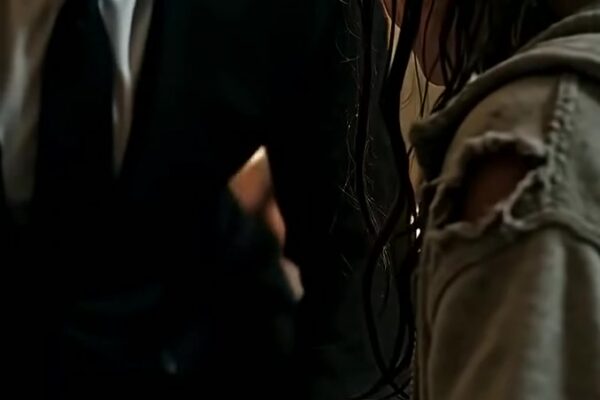
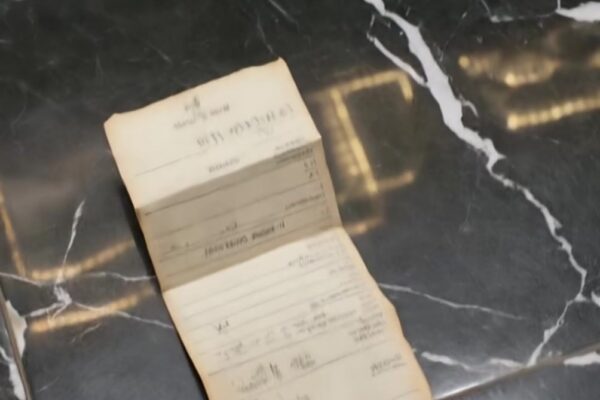
Her words tangled. Her breath hitched. She reached into her coat pocket with trembling fingers and pulled out a folded photograph, worn at the edges like it had been opened a thousand times. Mara couldn’t see it from where she stood, but Celeste held it out anyway, as if the image needed air.
The girl leaned in, hesitant. Her eyes widened, then flicked up to Celeste’s face with something like recognition that didn’t make sense.
“That’s her,” the girl whispered. “That’s my mom.”
Celeste made a sound that wasn’t a word. Her knees seemed to soften, and for a second Mara thought she might fall. Instead, Celeste grabbed the back of a chair for support and stared at the little girl like she was the answer to a question she’d stopped asking because it hurt too much.
“What’s your name?” Celeste asked, voice shaking now, the polished world around her cracking at the seams.
The girl wiped her cheek with her sleeve, leaving a damp streak, and lifted her chin in a tiny imitation of courage. “Lina,” she said. “My mom called me Lina.”
Celeste’s hand flew to her mouth. “Lina,” she repeated, like the name was both a blessing and a bruise. She took a step closer, then stopped as if she was afraid that getting too close would make the girl vanish.
Mara felt the entire terrace leaning in, rich and silent and suddenly uncertain, like they’d wandered into the wrong story.
Celeste looked at Mara then, eyes frantic. “Call my driver,” she said, voice barely controlled. Then she looked back at Lina and whispered, “And tell me where you’ve been living.”
Lina’s shoulders tightened. “Anywhere,” she admitted. “Under the bridge sometimes. Behind the market. I came here because… because the lights are bright and people have food.”
Celeste’s face hardened—not at Lina, but at the world. She knelt on the marble tiles, right beside the shards of her own shattered glass, and held out her hands again. “You’re not leaving with empty hands,” she said, voice low and fierce. “Not tonight. Not ever again.”
Lina stared at her, unsure whether to trust a woman in a cream coat who smelled like perfume and money. “Do you… do you know my mom?” she asked.
Celeste’s eyes squeezed shut, and when she opened them again they were full of something like grief and relief fighting for space. “I knew her,” she said. “And I’ve been looking for her for thirteen years.”
The terrace remained frozen, but in the stillness Mara could feel the story pivoting, like a door opening into a room no one knew was there. Celeste reached for Lina’s taped-up flute with a kind of reverence, not taking it—just touching the edge lightly, as if confirming it was real.
“Anna always said,” Celeste whispered, “that music is how you find your way back.”
Lina’s lower lip trembled. “She said that too,” she said, and her voice broke on the last word.
Mara finally moved again, stepping forward with her apron and her heart in her throat, as if she could somehow be useful in a moment that felt too big for restaurant service. Around them, the terrace was still silent, but it was a different silence now—less judging, more stunned.
Celeste looked up, eyes burning. “Someone,” she said, scanning the tables, “tell me who brought this child into the city. Tell me who let Anna disappear.”
No one spoke. Even the smirking man had gone very still, his confidence evaporating like spilled champagne.
Lina clutched her flute again, small fingers white at the tape. She looked at Celeste and asked the question that made Mara’s chest tighten the most. “If you were looking for her,” Lina whispered, “why didn’t you find us?”
Celeste’s face crumpled, and the answer sat there between them like thunder waiting to break.
Then the gate at the front of the terrace swung open, and the sound of footsteps approached—fast, urgent—and Mara realized this wasn’t ending with a plate of bread or a handful of bills.
This was the moment before the truth, when the whole world holds its breath and decides what it’s willing to admit.
And Lina, with her broken little flute and her mother’s melody still hanging in the air, stood at the center of it.