Everyone walked past him like he was a pothole that had learned to breathe. People on this street were good at not seeing things: the busted sidewalk, the stray dogs, the flicker of the broken streetlight even at noon. And especially the small boy planted beside a rusted trash bin with a plastic bucket at his feet.
He didn’t look like the kind of kid anyone wanted to make eye contact with. No shoes. Shirt hanging in tired strips. Dust clinging to his cheeks like it was part of him. But his eyes didn’t match the rest. They weren’t empty. They were busy.
Waiting.
Every time a car rolled into view, his shoulders tightened. Every time it was black—dark paint, dark windows—his pulse did the dumb thing where it tried to run away without him. He’d whisper it like a spell, barely moving his lips.
“Please… let it be this one.”
He’d been here since morning. He’d missed school on purpose. The day before he’d missed school by accident—because nobody came to get him after the hospital.
Not “nobody,” exactly. The social worker did. She had peppermint gum and a clipboard and a face that tried to be kind in a way that never quite landed. She told him grown-up words that meant the same thing over and over: there wasn’t enough. Not enough beds. Not enough doctors. Not enough help. Not enough time.
And he’d heard something else, the part the adults thought kids didn’t catch: a man in a hallway saying, flat and tired, “They’re not going to help you.”
His mom didn’t yell. She didn’t beg the staff. She just cried silently, like her body was trying to keep the sound inside so it wouldn’t bother anyone.
Outside that memory, the street was loud again. Vendors arguing. A bus exhaling at the corner. Someone laughing too hard. The boy kept his spot by the bin. People stepped around him the way water moves around a rock.
Then, after hours of nothing but regular cars and motorcycles and the occasional honk meant for someone else, it appeared: a sleek black sedan gliding like it owned the air. Too clean for this neighborhood. Too perfect, like it had taken the wrong turn on purpose.
His chest tightened so fast it felt like somebody had yanked a string inside him.
It wasn’t just that it was black. It was the kind of black that reflected the world back without showing its own scratches. The kind of car that didn’t belong on this road, not unless it was passing through without stopping.
He stared at the plate. His eyes snagged on the numbers like they were barbed.
He’d memorized them the way you memorize a nightmare so you can’t pretend it didn’t happen.
His fingers curled around the handle of the bucket. It was full of gutter water he’d collected from a broken pipe down the block. Dark, oily, honestly gross. He’d almost dumped it earlier, when a dog tried to drink from it. But he’d held onto it because he didn’t know what else to hold onto.
For a second he froze. Not because he was scared. Because his brain played the scene again: his mom on the road, sitting up with her arm raised, palm open, face gray with pain. Cars passing. One car slowing just a little, then moving on like the road was contagious.
That black car.
He tightened his grip until the thin plastic handle cut into his palm.
“They have to see me now,” he whispered, more to his own legs than anyone else.
Then he ran.
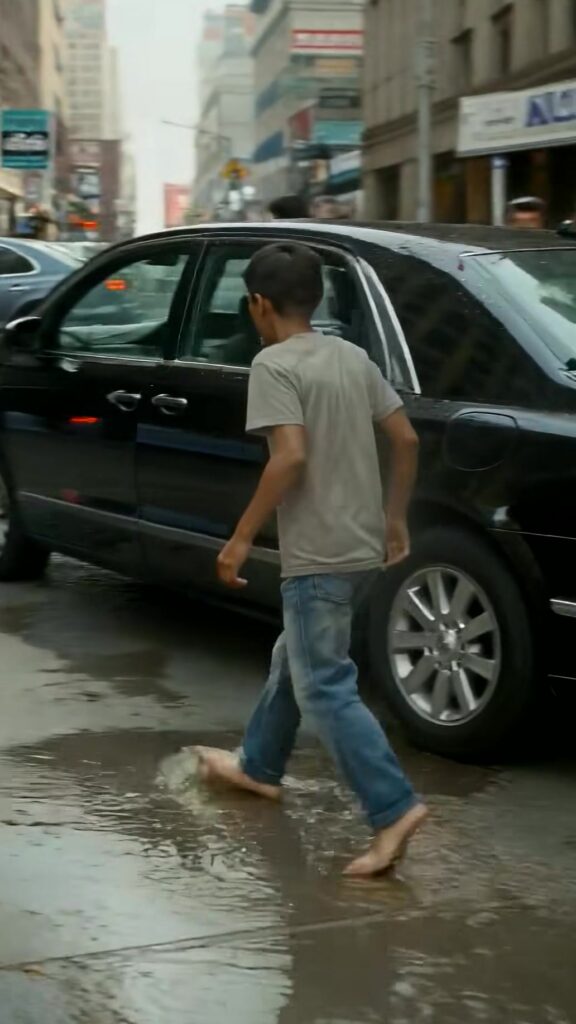
He darted off the curb like a small, determined shadow. Someone shouted—maybe his name, maybe just “Hey!”—but it didn’t matter. The bucket swung with him, heavy and sloshing, and when he reached the sedan he threw the water with everything he had.
It smacked the side of the car with a wet, violent sound, like a balloon bursting. Dirty water exploded across the glossy paint and streamed down the windows in ugly rivers.
Time did that weird thing where it slowed down but also got sharper. People gasped. A man with a bag of oranges froze mid-step. Someone’s phone slipped out of their hand and clattered on the pavement. Even the dogs stopped barking, as if they were watching a show.
The sedan stopped. The engine purred like it wasn’t even annoyed.
Slowly, the driver’s door opened.
A woman stepped out like she’d been edited into the scene. Crisp blazer. Hair perfect. Shoes that probably never met dirt on purpose. She looked expensive in a way that made the street around her look like it should apologize.
Her eyes were pure anger as she walked toward the boy, water dripping behind her like a trail of insult.
“What have you done?” she snapped, voice carrying like a siren. “Are you out of your mind?”
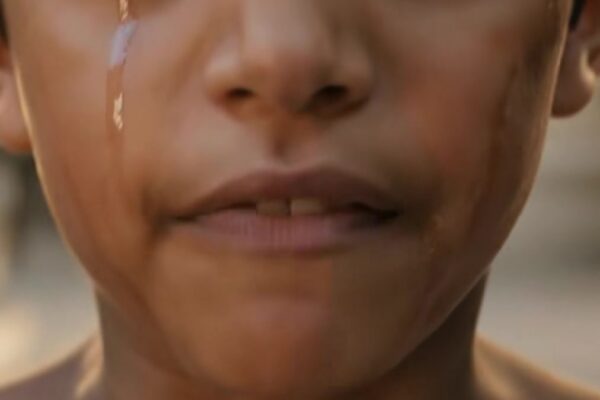
The boy didn’t back up. He didn’t even flinch. His whole body went still, except for his chin trembling. Tears started spilling and carving clean lines down his dusty cheeks.
“You didn’t stop,” he said. His voice shook but it didn’t break. “You didn’t look. You just drove away.”
The woman paused as if his words hit her more than the water did. Confusion flickered over her face, fast and annoyed, like a pop-up ad.
“What are you talking about?” she demanded.
“My mom,” he said. The words came out ragged. “She was on the road. Begging for help.” He swallowed hard. “You drove past her.”
The crowd tightened closer, people suddenly interested now that there was drama. A kid in a school uniform stared with wide eyes. An older man frowned like he was trying to remember a headline.
The woman’s expression changed, just slightly. The anger didn’t leave, but it got rearranged. “That’s not possible,” she said, slower. “I would remember that.”
“You had music on,” the boy whispered. “You were smiling.”
Silence landed over the street like a blanket dropped from a balcony.
The woman stepped closer, close enough that the boy could see tiny flecks of water on her sleeve. Her voice lowered, not softer—just sharper. “That wasn’t me,” she said.
The boy blinked, lost for a second. “What…?”
She leaned in like she was about to share a secret and didn’t care who heard it. Her eyes locked onto his, and for the first time her face looked less like anger and more like calculation.
“So tell me,” she said, “why does the car you’re describing have your father’s license plate?”
Everything inside the boy seemed to tip sideways. The street noises warped. His stomach dropped like he’d missed a step. “No,” he breathed, barely a sound. “No… my dad—”
He hadn’t seen his father in months. Not since the shouting got too big for their apartment and his father started disappearing for “work.” Not since his mom stopped saying his name and started just staring at the door.
The woman straightened, watching his face like it was an answer sheet. “This car,” she said, gesturing, “is registered to my company. I’m the one who rides in it. But I’m not the only one who drives it.”
He couldn’t speak. His fingers, still wet, curled into fists at his sides. The numbers on the plate swam in his vision. He’d been so sure. He’d built his whole waiting around those numbers.
From inside the car, a phone started ringing.
The sound was bright and cheerful and completely wrong for this moment. It kept ringing, stubborn, like it didn’t know how to stop.
The woman turned, reached in through the open door, and picked it up. The screen lit her face for a second. Her eyebrows twitched.
She didn’t answer right away. She looked at the boy again, this time like he wasn’t invisible at all—like he was a missing piece someone had just found under the couch.
Then she pressed the phone to her ear.
“Hello,” she said, her voice calm in a way that made it scarier. “Where are you right now?”
She listened. Her jaw tightened.
The boy’s throat hurt. “Who is it?” he whispered.
The woman covered the microphone with her palm and met his eyes. “It’s the driver,” she said. “The one who had this car yesterday.”
His breath caught like it didn’t want to keep going. In his head, his mom’s silent crying in that hospital hallway connected to this ringing phone, like two ends of a wire finally touching.
“Put it on speaker,” he said, surprising himself with how steady he sounded.
The woman hesitated for the first time, as if she hadn’t expected him to ask for anything. Then she tapped the screen and held the phone out between them.
A man’s voice poured into the open air, casual, impatient. “I told you I got stuck. What’s the big deal?”
The boy’s knees went weak. He knew that voice the way you know the sound of your own door closing.
His father.
The crowd inhaled all at once, like a single lung.
The woman didn’t look away from the boy. “It’s a big deal,” she said into the phone, each word clipped. “Because a child is standing in front of me who says you drove past his mother while she was bleeding on the road.”
On speaker, there was a pause. A tiny crackle of silence. Then a laugh that tried to be normal and failed. “What? Don’t be dramatic.”
The boy’s tears stopped. Something else took their place—something dry and hot. He stepped closer to the phone like he could climb into it.
“She raised her hand,” he said, voice shaking again. “She called for help.”
More silence. The kind where you can hear everybody thinking.
The woman’s eyes narrowed. “Tell me what happened,” she said, not loud but not asking either. “Now.”
On the phone, his father exhaled. “I didn’t want trouble,” he muttered. “I had… things. I couldn’t stop.”
The boy’s whole body felt like it was vibrating. “You couldn’t stop,” he repeated, tasting the words like poison. “For Mom.”
The woman looked at the boy, then at the crowd watching, then down at the dirty water still sliding off her car. Her face didn’t soften, but it shifted into something that looked almost like decision.
She put the phone back to her ear. “You’re coming here,” she said. “Right now. And if you don’t, I’ll send someone who will.”
The boy stared at her, confused by the sudden turn. “Why would you help me?” he asked, small again.
She glanced at him like she’d forgotten she was allowed to be human and then remembered. “Because,” she said, “I don’t like being lied to. And I don’t like my car being used for someone else’s cowardice.”
She looked down the street, like she could already see the future arriving. “Also,” she added, quieter, “because nobody should be walked past like they don’t exist.”
The boy’s fingers loosened at his sides. The bucket lay on the road, tipped over, empty now. For the first time all day, he wasn’t waiting for a car to pass.
He was waiting for one to come back.
And this time, everyone on the street was looking right at him.