The street had a way of shrugging. It didn’t matter if you were late, broke, heartbroken, or twelve years old with dust on your ankles and a stomach that sounded like a bad engine. It just kept doing what streets do—pushing cars along, pouring people out of buses, swallowing cigarette butts, catching gum like barnacles. It was loud without being interested.
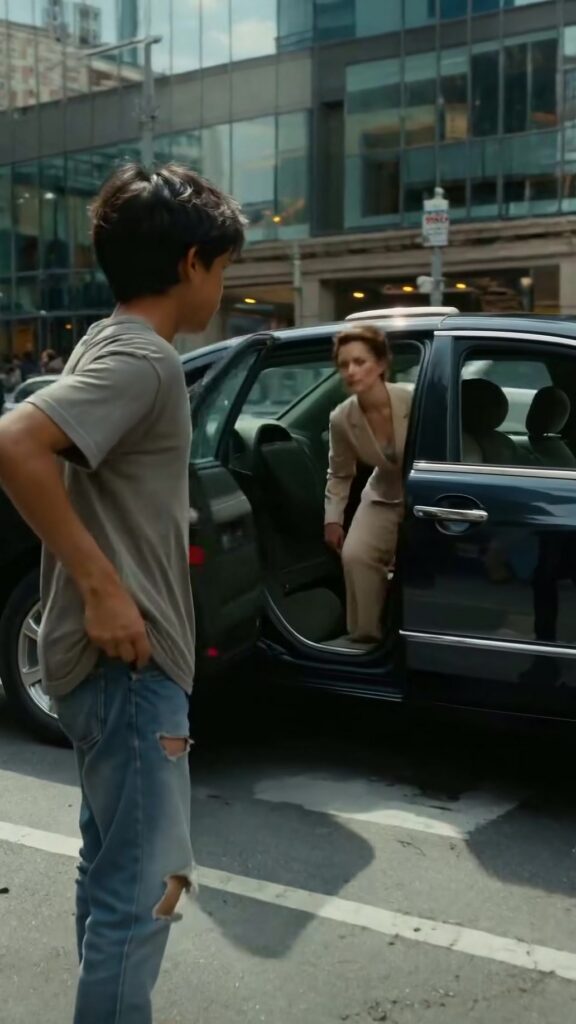
That morning, Milo stood right in the middle of it like someone had paused him. Not the sidewalk—dead center of the lane where the paint used to be. Barefoot, toes curled against sun-warmed asphalt, his shirt too big and his shorts too short, like he’d grown overnight and nobody updated the inventory. His eyes didn’t track the traffic. They didn’t do anything you could call seeing. They were fixed on a point a few feet ahead of his face, like he was watching a door that only he could see.
Cars threaded around him the way water goes around a rock. People leaned on horns and then kept rolling. A delivery guy shouted something that was probably rude. A woman dragging a rolling suitcase clucked like Milo was a pigeon in the way. Nobody stopped. Nobody got out to check on the barefoot kid in the street. The street didn’t care, and the street trained everyone else not to care either.
Milo didn’t move. He held something in his fist, knuckles tight like he could crush it into usefulness. Every once in a while he blinked like his brain remembered to do maintenance. That was it.
Then the black car arrived, slick as a lie.
It was too clean for this block, too shiny for the gritty air that smelled like fried onions and hot brakes. It didn’t look like it belonged near the pawn shop or the laundromat with the flickering sign. It glided forward like it had its own rules about friction. The windows were dark. The body was the kind of black that didn’t reflect—just absorbed.
The car slowed when it saw him. Not a sharp brake like everyone else did, more like the driver’s foot hesitated on a thought. The engine quieted into a purr that sounded expensive. Milo’s eyes finally shifted, not to the driver’s side window, but to the hood ornament: a simple, sleek emblem that felt out of place on a street with potholes.
He took one step forward. His heel landed soft, toes spreading. Another step, closer, close enough that the car’s heat kissed his shins. He raised his fist and tapped the hood once. Not a punch. Not a slap. Just a tap. Like knocking on a door.
The black car stopped.
The driver’s window slid down a crack and then up again, like it had changed its mind. A second later, a door opened. The woman got out in a way that made the whole car look like it was trying to stand straighter.
She was tall and dressed for a different neighborhood—tailored jacket, sunglasses that didn’t match the weather, hair pulled back with a kind of precision that required either patience or control issues. Everything about her said she was used to being obeyed, even by objects. Even by air.
She looked at Milo’s feet first, like she couldn’t help it. Her expression tightened—disgust, or concern, or both trying to wear the same face. Then she looked at him like he’d personally interrupted her schedule.
“What are you doing?” she asked, voice clean and sharp.
Milo didn’t answer. He didn’t even swallow. He just stood there, holding his fist out like a small, stubborn offering.
“Kid,” she said, turning her head as if scanning for parents who weren’t there. “Get out of the road. You want to get killed?”
Still nothing.
Traffic behind her began to stack up, a line of irritated people who would shout in a minute. She was already irritated enough for all of them. She sighed, took two steps forward, and flicked her gaze to his hand.
“What is that?”
Milo slowly opened his fingers.
In his palm sat a watch. Not a fancy one. Not even a good one. The glass was spiderwebbed, the leather strap cracked and darkened with sweat and time. The face was yellowed, numbers faded. The hands were stopped at some random hour like it had given up mid-sentence. It looked like something you’d find in a junk drawer and throw away without thinking.
He held it out like it was heavier than it looked.
The woman’s posture changed, almost imperceptible. Her shoulders stopped being armor for a moment. She leaned in a fraction, then another. Behind the sunglasses, you couldn’t see her eyes, but you could feel them focusing, narrowing, grabbing at details.
She lowered her chin. “Where did you get that?”
Milo’s lips parted like he might finally speak, but he didn’t. He just kept holding it out, arm starting to tremble from the effort.
The woman reached out, then stopped herself. Like touching it would mean admitting it was real. She took off her sunglasses with a quick motion and there it was—her face, suddenly unprotected.
Her eyes were not irritated anymore. They were confused. And under the confusion, something older and sharper: recognition.
She took the watch from his palm with two fingers, like it might burn. She turned it over. On the back, beneath scratches and grime, a small engraving caught the light: two letters and a date worn thin by years of rubbing against skin.
The woman’s breath stuttered. Her mouth opened, closed. A second ago she looked like a person who made decisions and never doubted them. Now she looked like someone who had just walked into a room she’d bricked up from the inside.
“No,” she whispered, so quiet Milo almost didn’t hear it. “That can’t…”
She looked up at him—really looked. His ears were too big, his hair the wrong kind of brown, his nose a little crooked like it had once been hit. But then her gaze landed on the small half-moon scar at his temple, pale against his skin.
Her lips pressed together hard, like holding back a sound. “Milo?”
It wasn’t a question. It was a name she hadn’t said in a long time and didn’t know how to carry anymore.
Milo’s face didn’t change, but something behind his eyes did. A flicker of motion, like a curtain lifting just enough to show the room behind it. He stared at her as if she’d spoken in a language he used to know and forgot on purpose.
“Who told you that?” he asked finally, voice flat, too steady for a kid. Like he’d practiced being calm because panic never helped.
The woman’s throat moved. “I—” She swallowed. “It’s me. It’s—”
She stopped, and for a second her confidence tried to come back, tried to put its jacket on and pretend it was fine. It couldn’t. Her hands were shaking. She held the watch like it was a key that had been missing from her pocket for years.
She stepped closer, lowering her voice. She said something then—something meant only for him. The street noise swallowed most of it. Milo caught just a few words: “not supposed to,” “after the fire,” “I thought—”
Whatever the full sentence was, it hit him like cold water.
His shoulders tensed. His jaw tightened so hard it made a small muscle jump near his cheek. His eyes didn’t fill with tears. They went empty again, only now the emptiness had a new shape: disappointment.
“So you knew,” he said, the calm cracking at the edges. Not anger, exactly. More like the sound of something inside him giving up on being held together.
“Milo, listen,” she said, reaching for his arm. Her hand hovered, unsure if she was allowed to touch him. “I didn’t—”
He pulled his hand back fast. The motion knocked the watch from her fingers.
For a heartbeat, it hung in the air, catching sunlight. Then it dropped.
The crack when it hit the asphalt was absurdly loud. Glass splintering. Metal tapping once and rolling toward the curb. The sound sliced through the honking and the engine noise like the street itself had flinched.
The woman stared down at it, frozen. She looked like someone watching a bridge collapse while still standing on it.
Milo didn’t flinch. He didn’t scramble for the pieces. He didn’t curse. He just stared at the broken watch for a moment like he was confirming something he already suspected.
Then he turned away.
He didn’t run. He didn’t limp. He walked with a steady, tired pace, bare soles slapping the asphalt softly as he crossed to the sidewalk and blended into the moving crowd like a shadow deciding to be ordinary.
“Milo!” the woman called, voice cracking now, control falling apart in public. A few heads turned. Nobody stopped.
She took a step as if to follow, then stopped because she didn’t know how to chase something she’d once thrown away. She stood by her spotless car with the dirty street reflecting in its paint, suddenly unsure which world she belonged to.
At her feet, the watch lay in pieces, hands still stuck at the same meaningless time.
Cars began to inch forward again, the line behind her impatient. Someone leaned on a horn long enough to make it personal.
The street kept moving.
And for the first time since she stepped out of that black car, the woman looked small—like the city could pass around her the way it passed around the barefoot boy, like she was just another obstacle the world had learned not to care about.
Milo didn’t look back. Not once.