The street was doing its usual performance—bus brakes squealing, someone yelling into a phone like it owed them money, a blender of languages and laughter spilling out of cafés. Even the pigeons sounded annoyed. But right in the middle of it all, on a bench outside a bakery that always smelled like warm sugar, there was a pocket of quiet that didn’t make sense.
It started with the woman.
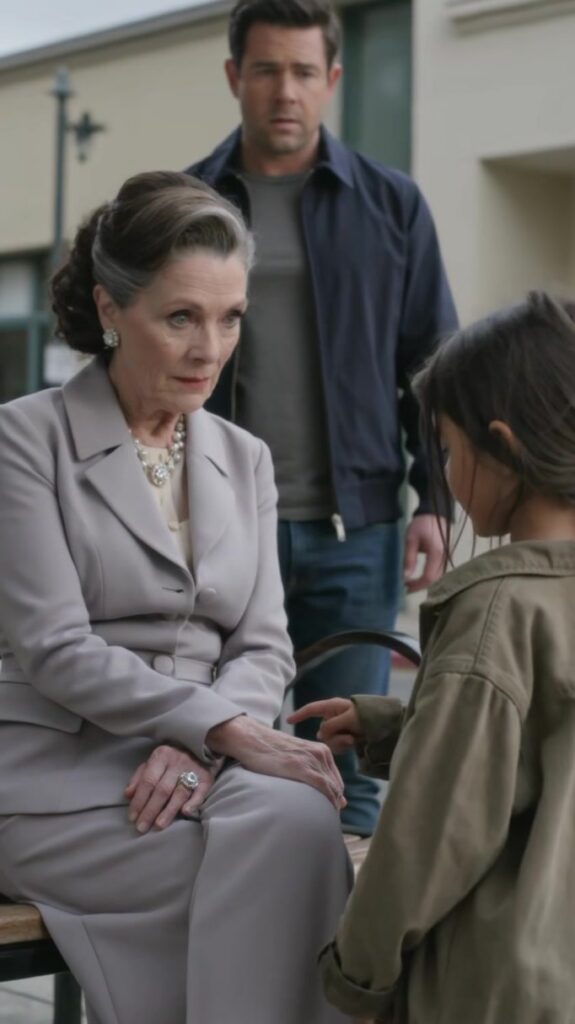
She looked like she’d stepped out of a different decade and refused to apologize for it. Gray hair pinned into a tidy twist, pearl earrings, a coat that was probably heavier than my rent. She sat with her ankles crossed, hands folded, and a posture so straight it felt like an opinion. Like the world could do whatever it wanted around her, but it was not allowed to touch her.
On her right hand, though—there was this ring. Not subtle. A big stone that caught daylight and threw it back like a dare. Every time she shifted her fingers, it made a tiny flash, like it wanted to be seen.
I was waiting for the crosswalk, half-scrolling, half-listening to my stomach argue with me about lunch, when I noticed the little girl.
She came in from the side, barefoot on the gritty sidewalk like it didn’t hurt. Her clothes were the kind of worn that wasn’t fashion—thin and smudged and too big in the wrong places. Hair knotted into something that used to be braids. She moved carefully, not sneaky exactly, just… practiced. Like she knew where she was allowed to exist and where she wasn’t.
Nobody looked at her. Not the guy selling roasted nuts. Not the tourists taking pictures of the mural. Not the woman with the designer stroller who made a whole show of turning away from anyone who didn’t match her vibe. The girl was a ghost in broad daylight.
She stopped in front of the bench and stared at the elegant woman’s hand. Her eyes stayed on the ring like it was a lighthouse.
Then she lifted her own hand, small and grimy, and pointed. Her voice came out soft, so fragile it made the noise of the street sound rude.
“My mommy had a ring like that.”
It wasn’t loud. It didn’t need to be. The bench, the bakery window, the space between them—it all went still, like somebody paused the world with a remote.
The woman’s face changed so fast it was like watching a mask slip. Her calm cracked at the edges. Her eyes widened, and her lips parted as if she’d forgotten how to arrange them.
“What?” she said, leaning forward. Not the clipped “What?” of someone offended, either. More like the word got yanked out of her by surprise.
Behind them, a man in a wrinkled blazer had slowed down mid-walk. He’d been carrying a paper cup and looked like the kind of person who always wore his office badge even when he wasn’t at the office. Something about the girl’s sentence hooked him. He stopped near the bench, pretending to check his phone while his attention stayed locked on them.
The girl didn’t flinch. She didn’t ask for money. She didn’t reach for the ring. She just stared at it, blinking like she was trying to hold onto a memory that kept slipping away.
“It had… a star,” she added. “Not a real star. Like a little scratch, right there.” She pointed again, closer this time, not touching. “Mommy said it was a secret mark.”
The elegant woman’s hand jerked back reflexively, as if the air had bitten her. But then she hesitated. Slowly—like she was scared of what she’d find—she turned the ring, angling it toward herself. The sunlight hit the stone, then slid off the metal band.
Her breath caught. Even from where I stood, I could see her mouth go tight, the way people look when the floor suddenly isn’t where they thought it was.
The man in the blazer took an unconscious step closer. “Ma’am?” he said, as if he was asking permission to exist in the moment. “Is everything—”
“Not now,” the woman snapped, but her voice wobbled on the last word. She looked back at the girl. “Where did you see that? Who is your mother?”
The girl shrugged, but her shoulders didn’t rise evenly. One side was stiff, like it hurt. “I don’t know where she is,” she said. “I used to know the street. I don’t anymore.” She frowned, like the idea annoyed her. “She said if I got lost, I should find the lady with the sun ring.”
“The sun ring,” the woman repeated, almost whispering. Her fingers tightened around the bench’s edge. “That’s… that’s what he called it.”
“He?” the man in the blazer echoed, and this time he didn’t pretend to be casual. He was all the way in it now.
The woman shot him a look that could have cut glass. But then it softened, as if she remembered how to be human. She swallowed hard and looked at the girl again. “Sweetheart,” she said, and the word sounded like it cost her something, “what’s your name?”
The girl hesitated. “Mara,” she said finally. “My mommy called me Mara-Bean when she wasn’t mad.”
The woman’s eyes glistened, just for a second, like light on water. She blinked it away fast. “Mara,” she repeated, tasting it. “How old are you?”
“Six,” the girl said. Then, after a pause that felt too old for her face, she added, “Maybe seven. I had a birthday somewhere. There was a candle. I remember the smoke.”
The man in the blazer cleared his throat. “Ma’am, I’m sorry, but… should we call someone? Security? The police? Social services?”
The woman didn’t answer him. She looked at the girl like she was trying to match her to a picture in her head. “Do you remember your mother’s name?”
Mara frowned again, digging through her mind like it was a pocket full of broken things. “People called her Lia,” she said. “Sometimes she said not to. Sometimes she said it wasn’t her real name anymore.”
The elegant woman’s face went pale. She lifted a hand to her throat, fingers pressing lightly as if she needed to confirm she was still there. “Lia,” she whispered, and her voice cracked like old paint.
The street noise crept back in around us—someone laughing too loud, a bus exhaling, a bicycle bell—but it all sounded far away, like it was happening in another room. The bench was still its own little universe.
“Mara,” the woman said carefully, “did your mother ever… talk about a grandmother?”
The girl’s eyes flicked up, cautious. “She said her mom was… fancy.” She squinted, searching. “She said she sat straight like a ruler. She said she didn’t like messy things.”
That landed like a slap. The woman flinched, and for a second her refined posture faltered. Her shoulders rounded inward, small and suddenly old in a way her coat couldn’t hide.
The man in the blazer looked between them, slowly realizing he wasn’t just overhearing a random sad conversation. Something deeper was unfolding, something with history and sharp edges.
“Where did you come from today?” the woman asked.
Mara pointed vaguely down the street. “There’s a place with loud doors,” she said. “They give soup if you wait and don’t talk too much. A lady there said I should stay inside, but I saw your ring in the sun and… I remembered.” She lifted her chin with this stubborn little pride. “I’m good at remembering important stuff.”
The woman stared at her ring again, as if it had turned into an accusation. Then she did something that surprised me: she pulled a handkerchief from her coat pocket—of course she had one—and she slid over on the bench, making space.
“Come sit,” she said, quieter now. “Please.”
Mara didn’t move right away. Trust wasn’t free. But her feet were red from the pavement, and she was tired in that way kids shouldn’t be. Slowly, she climbed onto the bench, leaving a faint dusty smudge on the woman’s perfect coat.
The woman didn’t even glance at the stain.
She reached into her purse and pulled out a small cardholder and a phone that looked like it had never been dropped in its life. Her fingers trembled as she unlocked it. “I’m going to make a call,” she said, more to herself than anyone else. “To someone who can help us find your mother.”
The man in the blazer leaned in slightly, voice gentle. “Ma’am, if you need a witness, or help, I’m—”
She held up one finger without looking at him. A polite command. Then she tapped a contact, and when it rang, she stared straight ahead at the chaos of the street like it might swallow her if she blinked.
When someone answered, her voice dropped low, raw around the edges. “It’s Evelyn,” she said. “I need you to listen carefully. A child just walked up to me and recognized the ring.”
Mara watched her face with intense focus, like she could read the truth in the wrinkles and pauses. The ring flashed again in the daylight, bright and hard and impossible to ignore.
And for the first time since I’d noticed that quiet pocket forming around a public bench, I understood why it felt so still: it wasn’t peace. It was the moment right before a buried story claws its way back into the open.