In a city that never ran out of noise, you could still disappear. Not in a dramatic, spy-movie way. More like an accidental erasure—like the world had a permanent smudge over your face and nobody bothered to wipe it clean.
That’s what being “the barefoot kid by the trash bin” meant.
People saw the bin. They saw the pigeons fighting over a wilted sandwich. They saw the sidewalk, the crosswalk timer, the ad screen looping a diamond commercial with people who smiled like they’d never had to choose between food and soap. But they didn’t see the boy leaning against the metal can, knees knobby, toes black with city grime, hair too long because haircuts were a luxury and mirrors were a joke.
He wasn’t holding a sign. He wasn’t humming for coins. He wasn’t wandering, looking confused. He stood still like he’d been planted there.
Waiting.
The intersection was one of those places where the city got impatient. Cars honked before the light even changed. Delivery bikes threaded through gaps that didn’t exist. Someone’s ringtone screamed from a pocket and got ignored. The air tasted like exhaust and fried onions from the cart on the corner.
The boy’s name was Eli. That wasn’t the name on any school roll, any doctor’s chart, any mailbox. It was the name his sister used when she wanted him to listen—Eli, don’t do that, Eli, come back, Eli, please. It stuck because it came with a voice that mattered.
His sister wasn’t here anymore.
His father wasn’t either. Not really. There was still a man shaped like his father somewhere, a body in an overworked hospital bed, a mouth that had forgotten how to form words after the stroke. But the father who made pancake faces on Sundays and pretended to be an angry dragon during baths had vanished in the same week the landlord changed the locks and the lights went out.
Eli pressed his hand against the side of a dented bucket beside him. It was half full of water that looked like it had been filtered through a gutter. A rainbow sheen floated on the surface. Bits of something—paper, maybe—clung to the rim.
He’d carried it four blocks without spilling much. His arms still trembled from it, not from weakness exactly, but from a kind of electric determination. He kept glancing at the street like he was counting time by the gaps between cars.
He was waiting for a specific engine note.
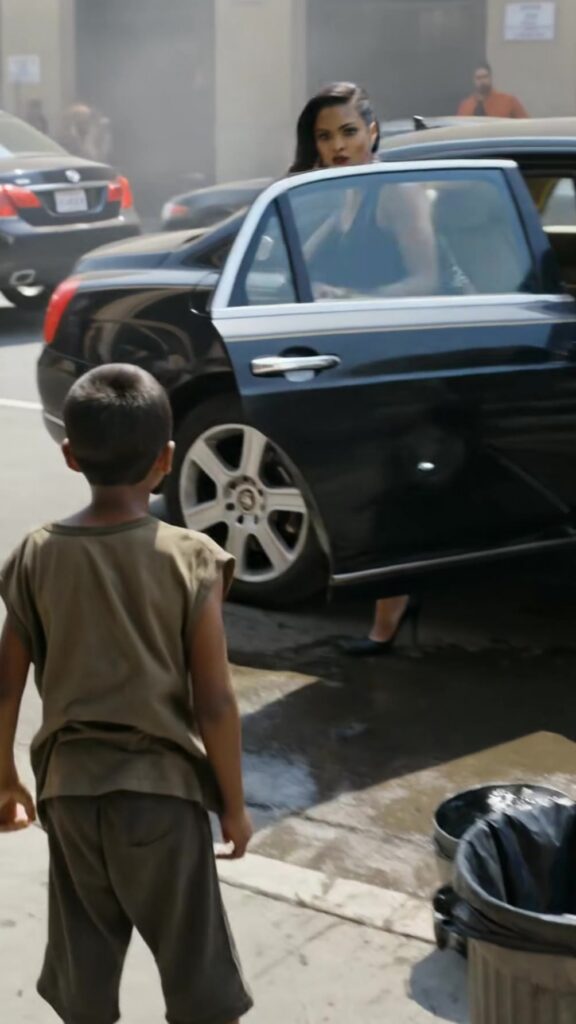
The first time he’d seen it, he thought it was a joke the city played on the poor. A black car so polished it reflected the sky like a private lake. It moved through traffic with the confidence of someone who didn’t believe in consequences. The windows were tinted deep enough to hide any life inside.
A luxury car like that didn’t belong to the street; the street belonged to it.
Eli had learned the schedule by accident at first. The car passed this intersection around noon most weekdays. Sometimes it slowed for the light. Sometimes it rolled right through, like it had an agreement with the color red.
Today, the car came right on time.
It slid into view as if it had been edited into the world. Black paint, chrome details, a subtle emblem that screamed money without needing to shout. The driver’s posture was crisp behind the wheel, almost military. The backseat was where the real power sat. Eli could feel it even through the glass.
His heart didn’t thump. It tightened. Like a fist closing around something precious and fragile at the same time.
His eyes locked on the car and everything else blurred. The honking faded. The crowd became shapes. His fingers curled around the bucket handle, and the metal cut a line into his palm.
“Don’t,” a small part of him whispered. The part that remembered hiding under the stairs when his mother’s voice got sharp. The part that knew adults could turn you into a problem with one phone call.
Another part of him—the bigger part—answered, “They already did worse.”
He stepped off the curb.
A businessman in a gray suit nearly walked into him and swore without looking down. Eli didn’t flinch. He crossed two lanes like the cars were suggestions, not threats. A horn blared. Tires squealed. Someone yelled, “Kid!” with that annoyed tone people use when they think your existence is an inconvenience.
Eli reached the car just as it eased to a stop at the red light.
He raised the bucket.
For a split second, he saw his reflection in the car’s side—an unwashed kid with haunted eyes holding dirty water like it was a weapon. He almost laughed. It was ridiculous. It was perfect.
One breath.
Then he swung.
The water smashed across the hood and windshield in a brown, oily sheet. It splattered up the glossy black paint and dripped in thick rivulets. Some of it hit the driver’s side window with a slap, sliding down like a slow insult.
The entire intersection stopped being an intersection and became a stage.
Gasps popped like fireworks. A cyclist planted a foot down hard. Phones rose in unison, little rectangles ready to turn a human moment into a trending clip. Even the traffic seemed to pause, engines idling, as if the city itself leaned in.
Eli stood there with the empty bucket hanging from his hand, water dripping from the rim. His chest rose and fell fast, but his face stayed set. Like he’d practiced being brave in a mirror he didn’t have.
The black car sat there, filthy now, marked, no longer untouchable.
The driver’s door cracked open, then closed again. A voice inside said something sharp. Then the back door swung open.
A woman stepped out.
She was the kind of woman who looked expensive without trying—tailored coat, sleek hair, shoes that clicked with authority. Her face was beautiful in the way a blade is beautiful: clean lines, controlled edges. Rage flashed in her eyes the second she saw the mess.
She strode around the car like she owned the air around it.
“What have you done?” she snapped, each word like it came with a fine.
Her voice carried across the street, commanding attention the way sirens did. People whispered her name under their breath, or maybe they just whispered like they knew they should recognize her. Eli didn’t know her name, not exactly. He knew her face from billboards, news clips playing silently in shop windows, the kind of face that smiled beside ribbon cuttings.
Powerful. Protected. Polished.
She stopped a few feet from him, gaze raking over his dirt, his bare feet, the tear tracks that had carved clean lines down his cheeks when he didn’t realize he was crying.
Eli lifted his chin. His voice came out small but steady, like a match refusing to go out.
“You destroyed my family.”
The words landed heavier than the water had.
For a heartbeat, the woman’s expression stayed angry out of habit. Then something shifted, like someone had yanked the rug out from under her certainty.
Her eyes narrowed, not with suspicion, but with a sudden attempt to focus. She looked at his face again, really looked—like she was searching for something she’d misplaced years ago and didn’t want to admit she’d ever owned.
The noise around them dulled. Even the phones seemed to wobble.
She took one step closer, then another, until her perfume—sharp and clean, like money and winter—mixed with the smell of street garbage and dirty water.
Her voice dropped. “Where did you get that line?”
Eli swallowed. The plan had been simple: make her stop, make her see him, make the world pay attention. He hadn’t planned for what it would feel like to be this close to the thing he’d blamed for months.
“It’s not a line,” he whispered. “It’s what happened.”
The woman’s jaw tightened. Her eyes flicked toward the driver, then back to Eli. It looked like she was doing math in her head, but the numbers were made of memories.
She leaned down until her face was level with his. The cameras zoomed. People held their breath. Eli’s fingers clenched around the bucket handle like he could anchor himself with it.
The woman spoke into his ear, so soft the crowd couldn’t hear. Her lips barely moved.
Whatever she said was not an apology.
It wasn’t a threat either, not the obvious kind.
It was something that made Eli’s entire body go cold.
His eyes widened. His mouth parted, but no sound came out. Recognition hit him with the force of a door slamming. His mind raced backward—his mother’s frantic phone calls, the papers his father hid in a drawer, his sister’s whispered warnings at night, the way certain names made adults suddenly go quiet.
Fear, sharp and immediate, replaced the anger he’d been living on.
The woman straightened slowly, her face rearranging itself into something unreadable. Her rage was gone, replaced by the look people wear when they realize the story isn’t going to go how they planned.
Behind her, the driver’s hand hovered near his jacket, like he was ready to pull out something worse than a phone.
Eli stood frozen in the middle of the road, holding an empty bucket like it was the only proof he hadn’t dreamed this whole thing.
He had succeeded. The whole city was looking now.
And suddenly he understood exactly why that might be the most dangerous thing he could’ve done.
The traffic light changed to green.
No one moved.
The woman glanced at the crowd—at the phones, the witnesses, the attention Eli had forced into existence. Then she looked back at him, and her voice returned to its public volume, smooth as glass.
“Get in,” she said.
Eli didn’t know if it was an order, an offer, or a trap.
He only knew the world had finally seen him.
And now it couldn’t unsee him.