Lila had practiced her scream in the mirror exactly zero times. It just came out of her—thin and raw—when the lemonade exploded across the sidewalk like somebody had tipped a bucket of sunshine onto the concrete. For a second, she stood frozen behind her little folding table, hands still hovering near the plastic pitcher like she could unspill it by sheer will.
Then the cups started rolling.
They weren’t the fancy kind with lids, just plain clear ones she’d counted and stacked in neat towers. Now they pinballed off the curb and tumbled into the street, where a passing car sent one spinning like a tiny wheel until it landed in a gutter full of old leaves.
Her sign went next. She’d made it on poster board from the back of a cereal box taped together, marker letters so big they wobbled: LEMONADE $1 — HELP MY DAD GET BETTER. She’d drawn a sun with sunglasses in one corner. A big heart in the other. When it fell face-down into the sticky puddle, the heart soaked up lemonade and turned the paper a bruised brown.
Lila dropped to her knees in her simple blue dress before she even realized she was moving. The sidewalk felt gritty and hot through the thin fabric. She tried to scoop up the coins with both hands like she was collecting scattered marbles, but the pennies and nickels were slippery, glued to the wet concrete. A dime clung to her palm, lemon-sweet and filthy.
“Clean this mess,” a voice said above her.
She looked up. Mr. Brandt stood over her with a smile that didn’t belong on a face in daylight. His sneaker was wet around the sole. He wasn’t even pretending he hadn’t kicked the table leg hard enough to tip it.
Lila’s throat tightened. She tried to speak and it came out broken, like she’d swallowed a handful of sand. “It was for Dad.”
Mr. Brandt laughed, like she’d told him a joke at a party. “Then get a real job.”
She blinked hard, trying to keep the tears from falling because tears made her vision blurry and she needed to find quarters. Quarters meant a whole extra hour of whatever medicine Dad needed, at least in her math. “I’m eight,” she said, like that should be the end of the argument.
Mr. Brandt tilted his head. “And?”
Across the street, old Mr. Evers had been watering his hydrangeas. He’d been doing it slow, like he was reading a long book and didn’t want to miss anything, the hose draped over his arm. When Lila screamed, he’d lowered the nozzle until the water stream faded to a dribble and then stopped completely. Now he stood very still, watching.
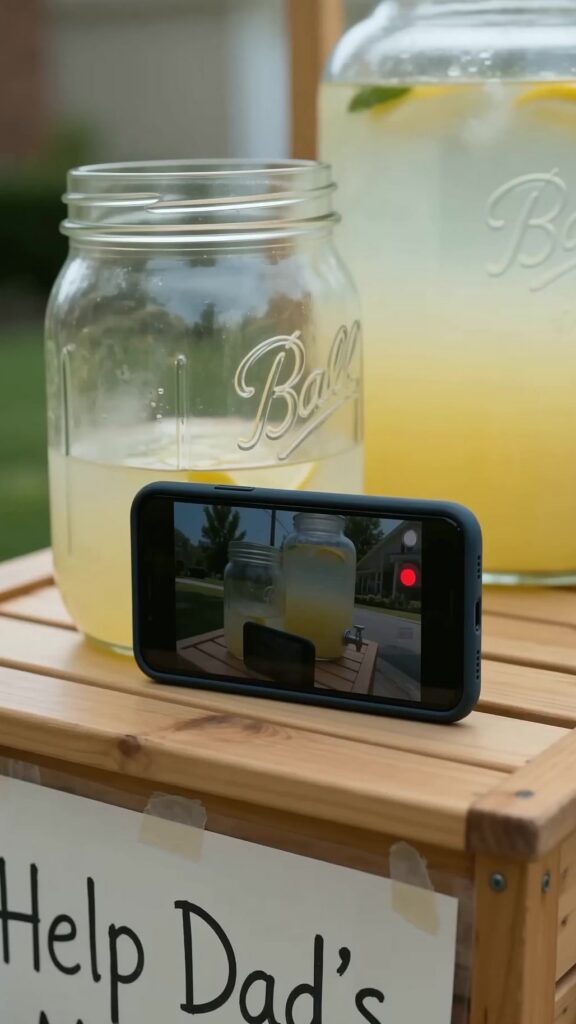
His eyes moved past the ruined cups, past the sad little sign, and then they caught on something behind the lemonade jar. Lila had tucked her dad’s old phone there earlier that morning, mostly because she was scared someone would steal her money. But she’d also turned on the camera the way Dad showed her before he got too tired to be the “show you how to fix everything” version of himself.
A tiny red light blinked.
Mr. Evers set the hose down on the grass with the kind of careful respect people used for sleeping cats. He walked toward the sidewalk, his knees creaking with each step, face calm but eyes sharp.
“Why did you kick it?” he asked.
Mr. Brandt’s smile stayed on, but his cheeks tightened around it. “Mind your business, old man.”
Lila hugged the soggy sign to her chest like it was a stuffed animal. Lemonade soaked the front of her dress. The smell, usually happy, made her stomach hurt. “It recorded,” she whispered, and then she couldn’t hold it in anymore—her tears slipped out and slid down her cheeks.
Mr. Brandt’s smile didn’t just fade; it fell off his face entirely. “Recorded what?”
Mr. Evers leaned down with a slow, deliberate motion and picked up the phone from behind the jar. The jar had toppled but miraculously hadn’t shattered; it sat on its side like it was too shocked to break. Mr. Evers wiped the phone on his pant leg, thumbed the screen, and held it up. “This,” he said.
The video began with a shaky view of Lila’s hands setting the phone down. Then her own voice: “Okay, it’s recording. Dad says if something happens, it’s always good to have proof.” The camera caught the edge of her sign, the bright marker letters, and the first few customers—Mrs. Patel from three houses down, who bought a cup and pressed a five-dollar bill into Lila’s hand and told her to keep the change.
Then the footage jumped as someone’s shadow fell across the table.
Mr. Brandt’s voice came through loud and clear, not the polite voice he used at neighborhood meetings, but the one he used when he thought nobody important was listening. “Cute setup,” he said on the video. “That your dad’s idea?”
Lila’s recorded voice answered, small but proud. “It’s mine. Dad’s sick.”
And then, in the recording, Mr. Brandt leaned closer, close enough that his face filled the frame. His smile looked different on camera, flatter and colder. “Make sure her father never gets the money,” he said.
There was a second voice too—someone on the other side of him, barely off-screen. A laugh. “You serious?”
“I’m serious,” Mr. Brandt said. “If he can’t pay, he’ll have to sell. And when he sells, I get the lot.”
Mr. Evers paused the video. The sidewalk felt suddenly quieter, even though cars still passed at the end of the block and somebody’s dog barked in a backyard. Lila could hear her own breathing.
Mr. Brandt lunged for the phone.
Mr. Evers didn’t move like an old man then. He stepped back with surprising speed and lifted the phone high, out of reach, his arm steady. “Don’t,” he said, voice low but hard, like a judge bringing down a gavel.
Mr. Brandt reached again, and Mr. Evers raised his other hand. “I’m calling the police. And your employer. And your wife, if she’s the type who likes to know what kind of man shares her kitchen.”
Mr. Brandt’s eyes flicked around, finally noticing what he should’ve noticed from the start: curtains shifting in windows, a stroller paused mid-walk across the street, Mrs. Patel stepping onto her porch with her phone already held up like she’d been waiting for the right moment.
Lila stared at Mr. Brandt like he’d turned into something she didn’t recognize. She’d always thought of him as the guy who complained about chalk drawings on the sidewalk and who told kids to stop bouncing basketballs after dinner. Annoying, sure. But this? This was different. This was planned.
“My dad isn’t a lot,” she said, voice shaking but louder now. “He’s a person.”
Mr. Brandt swallowed. His mouth opened like he had a speech ready, but nothing came out. He looked at the puddles, the spilled lemonade, and maybe for the first time he understood what Lila had screamed about: not a drink, not a stand, not a mess. Medicine. Time.
Mr. Evers handed the phone to Mrs. Patel without taking his eyes off Mr. Brandt. “Save that,” he told her. Then he crouched down slowly next to Lila, knees protesting, and began picking up coins with his big, careful fingers. “Hey,” he said, softer now, just for her. “We can’t unspill the lemonade. But we can make sure it doesn’t become the end of your story.”
Lila sniffed, wiped her nose with the back of her hand, and nodded, even though her heart still felt like it was sliding around in her chest. She pressed her wet sign flatter, trying to smooth it out. The sunglasses sun was smeared.
Mrs. Patel’s voice carried from the porch. “I’m sending this to the neighborhood group. And the police. And I’m tagging the news station my cousin works at.”
Behind her, more doors opened. A teenager from the corner house walked over holding a roll of paper towels. Another neighbor brought a new pack of cups. Someone else—Mr. Evers’ granddaughter, maybe—ran out with a handwritten note that said FREE LEMONADE TODAY, DONATIONS FOR LILA’S DAD, and taped it to a lamppost like it was the most obvious thing in the world.
Lila looked at the sticky sidewalk, at the coins glittering like tiny suns in Mr. Evers’ palm, and then at the phone—proof blinking quietly in the hands of adults who suddenly seemed very awake.
Her scream had started as a sound of loss. Now it echoed into something else entirely: a signal that the neighborhood couldn’t ignore, even if someone had tried to kick it over.
And as Mr. Brandt backed away, face pale and jaw clenched, Lila tightened her grip on the ruined sign and whispered to herself, like a promise she could carry home: “Dad’s going to get his medicine.”