The bell over the diner door didn’t jingle. It screamed, like it was offended someone had the nerve to come in during weather like this.
A kid came in sideways—more sliding than walking—skidding across the slick tile on his knees. Rainwater sheeted off his red hoodie and pooled around his palms. His sneakers made that awful squeak-squeak sound, and then he just… stopped, like the floor had punched the breath out of him.
He looked up once, wild-eyed, and made a beeline for the counter without actually standing. He crawled. Full-on crawled, elbows and knees, leaving a watery trail behind him like a snail.
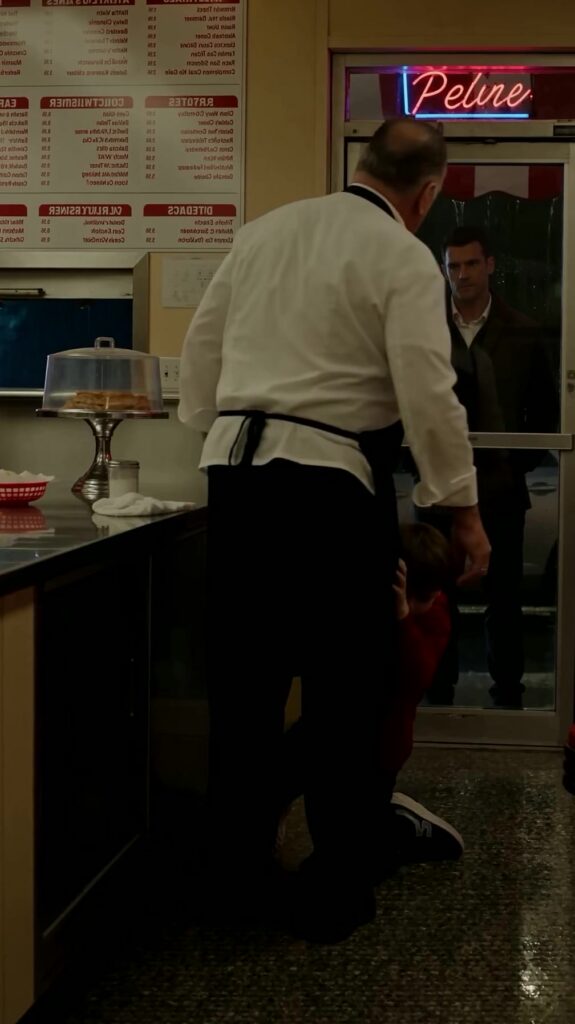
And then he tucked himself behind the only man in the room who looked like he’d chew nails for fun.
The cook was built like an old refrigerator—broad, square, hard edges softened by time. He had a black apron crusted with grease and flour, and his forearms were tattooed with faded shapes you couldn’t quite read anymore. One cheek had a thin scar that split his beard line, and there were burn marks on the backs of his hands like he’d argued with fire and lost. He’d been flipping burgers like it was his whole religion, but the moment the kid grabbed a fistful of his apron, the spatula paused mid-air.
“Please,” the boy rasped. His voice sounded like he’d swallowed rain. “Please hide me.”
The cook’s eyes flicked down. They weren’t soft eyes, but they weren’t stupid, either. “Kid,” he said, like the word was heavier than it looked. “Who hurt you?”
The boy pressed his face into the cook’s side, knuckles white where he clutched the apron. “He followed me.”
Outside, through the fogged-up glass, a man stood in the rain as if the rain had been asked not to touch him. Clean-cut. Dark coat. No umbrella. Hair neat. Shoes probably expensive. His posture was the kind you got from never having to apologize.
He stared in like he was picking a table.
Then he raised his hand and knocked. Slow. Polite. Like he was at a neighbor’s house returning a borrowed ladder.
The diner had been half-asleep before that. Two truckers in a booth with coffee refills and tired eyes. A couple sharing fries and an argument. A lone woman near the window reading a paperback with the kind of intensity you use as a shield. Everybody froze around their plates when that knock landed.
The cook set the spatula down carefully. “Mara,” he called, not loud, but sharp.
The waitress—Mara—looked up from her notepad. She was young, but her face had that old, “I’ve seen nonsense,” look. “Yeah, Gus?”
“Don’t open that door.”
The bell screamed again anyway, because the door didn’t care about instructions. The clean-cut man stepped inside as if he owned the air. Water dripped from his coat, but he didn’t shake it off. He just scanned the room with calm, measuring eyes.
His gaze landed on Gus behind the counter. Then it dipped, like he could already see the boy hiding.
“That child is mine,” the man said.
It wasn’t a shout. It wasn’t even mean. It was worse—flat, certain, like gravity.
Gus moved with the kind of slow that tells you he’s trying hard not to move fast. He stepped in front of the boy, blocking him from view. “If he’s yours,” Gus said, “then why’s he shaking like he just got chased by a wolf?”
The man’s mouth twitched into something that wanted to be a smile but forgot the steps. “Children get scared. They imagine things.”
Behind Gus’s leg, the boy whispered, so thin only the closest tables caught it. “He’s not my dad.”
The trucker nearest the counter shifted in his booth. The paperback woman stopped pretending to read. Even the fries couple went quiet, like their argument had suddenly lost the plot.
Gus’s jaw flexed. His voice dropped. “Mara.”
“Yeah?”
“Lock the door.”
Mara hesitated for exactly one heartbeat, then slid off her stool and clicked the lock on the glass. The sound was small, but it hit the room like a gunshot.
The clean-cut man’s eyes flicked to the lock. For the first time, he looked annoyed. “This is unnecessary.”
Gus didn’t budge. “Maybe,” he said, “but so is you scaring a kid into crawling across my floor.”
The man exhaled slowly. His hand slid into his coat like he was reaching for a wallet. But the way he did it—the relaxed angle, the lack of hurry—made it worse, not better.
Gus saw it. Mara saw it. The trucker saw it and muttered a curse under his breath.
“Don’t,” Gus said, quiet.
“You don’t understand what you’re inserting yourself into,” the man replied, still calm. “I am authorized.”
“Authorized by who?” Mara asked, voice sharper than her uniform suggested.
The man’s eyes cut to her like a blade noticing a new direction. “By people you don’t want to meet.”
Gus leaned his weight forward onto his palms on the counter. “Funny,” he said. “I’ve met most kinds of people. The ones who say stuff like that are usually the ones I don’t like.”
In the silence, the boy shifted behind Gus. Gus felt the kid’s small hands trembling against his apron, like a bird trying to keep its wings from showing.
Gus lowered his head slightly, not taking his eyes off the man. “What’s your name, kid?”
“Owen,” the boy whispered.
“Owen,” Gus repeated. He nodded once, as if filing it away somewhere safe. “Why’s he after you?”
The man answered before the kid could. “He’s been taken. I’m retrieving him.”
“I wasn’t taken,” Owen blurted, then immediately flinched like he’d spoken too loud. “I ran.”
The man’s calm finally cracked enough to show teeth. “You ran because you were confused.”
“No,” Owen said, voice shaking but louder now. “I ran because you told me not to tell anyone about the room with the red light.”
The words hung there, heavy and wrong.
Mara’s face drained of color. One of the truckers sat up straighter, like his spine had been yanked by a hook. The couple with fries both put their hands on the table, palms down, as if grounding themselves.
Gus’s eyes hardened into something old. Something that had been waiting for an excuse.
“Red light?” Gus echoed. He kept his voice even, but his hands weren’t steady anymore. “What room?”
Owen swallowed. “In the building where he said my dad was. He said my dad was there and I had to be quiet. But my dad’s name is Ben and he smells like motor oil and he calls me ‘O.’” Owen’s voice hitched. “That guy doesn’t call me anything. He just… tells me to listen.”
The clean-cut man’s expression went empty. Not angry. Not panicked. Empty, like he’d decided the conversation was over.
His hand came out of his coat holding something dark and compact.
“Everybody stay calm,” he said. “This ends if you cooperate.”
Gus didn’t duck. Didn’t flinch. He just reached down out of sight, slow as a sunrise, and came up with a cast-iron skillet.
“Buddy,” Gus said, and his voice had that casual diner tone that makes it scarier, not friendlier. “You’re in my kitchen.”
Mara slid a hand under the counter and hit a button Gus had installed years ago after a different kind of bad night. It didn’t ring a bell. It didn’t flash. It just sent a silent scream to the sheriff’s office two miles away.
The man saw the movement anyway. His eyes narrowed. “Don’t make this worse.”
Gus shifted his stance, placing himself more fully between the gun and the kid. “You already did,” he said. “Now you’re gonna sit down, put that thing on the counter, and tell me where you got that boy.”
The man’s gaze darted, calculating. He was alone. He was armed. But he was also surrounded by witnesses, and the only exit was locked, and the cook in front of him looked like he’d been built specifically to ruin someone’s evening.
For the first time since he stepped through the door, the man looked uncertain.
Outside, sirens started to wail, faint at first, then closer, braided with the storm.
Owen pressed his forehead into Gus’s hip and whispered, “Are you scary?”
Gus snorted softly, like it almost hurt. “Yeah,” he murmured back. “But not to you.”
The sirens grew louder, and the rain kept hammering the windows like it was trying to get in and see how this ended.
Gus lifted the skillet a fraction, just enough to make a point. “Last chance,” he told the man. “Sit. Down.”
The clean-cut man’s jaw tightened, and for a second it looked like he might do something stupid.
Then he slowly, carefully, set the gun on the counter.
Gus didn’t relax. Mara didn’t breathe. The whole diner held still around them, caught between coffee refills and catastrophe.
And behind the counter, Owen stayed hidden, soaked to the bone, clinging to the one place in the room that felt like it could stop the storm.
Not the weather outside.
The other one.
The one that walked in wearing a dark coat and a polite smile.
When the deputies finally burst through the door, Gus didn’t move his eyes from the man until handcuffs clicked and the clean-cut calm was replaced by cold steel.
Only then did Gus look down at Owen and say, “You hungry, kid?”
Owen nodded so fast water flew off his bangs. “Yeah.”
Gus gave a grim little smile. “Alright,” he said. “We’re gonna start with pancakes. The big kind. And then we’re gonna figure out where your real dad is.”
Owen’s lower lip wobbled. “Promise?”
Gus glanced toward the rain-streaked window, toward the world that had just tried to swallow this kid whole, and he tightened his grip on the skillet like it was a vow.
“Yeah,” he said. “Promise.”