The day it happened, the plaza looked like it was trying too hard.
Someone had strung white banners between the palm trees like it was a wedding. A stage had been built in front of the fountain, and the fountain—usually just a sad, spitting thing with coins stuck in the drain—had been dyed a ridiculous shade of blue, like melted candy. There were speakers on tripods and a ring light aimed at the podium so whoever stood there would glow with that “I’m a good person” shine.
On the corners, people actually hungry kept to the shade. They learned to stay out of the frame.
I was one of them.
Most folks in the plaza called me Nico because it was easier than my full name and because “hey, kid” gets old when you hear it all day. My shoes didn’t match, my hair had a mind of its own, and I owned exactly one hoodie that smelled like rain and old smoke. Still, I knew how to disappear when I needed to and how to pay attention when it mattered.
That morning, I was behind Tano’s cart, crouched low, half hidden by stacked crates of oranges and a dented cooler. Tano wasn’t really supposed to be there. The city had been pushing vendors out for years. “Cleanliness,” they said. “Order.” Tano’s idea of order was lining up his sauce bottles by height and wiping his cart down with a rag that had lived several lives.
But he fed us. Not as a charity stunt—no forms, no photos, no speeches. At night, when the plaza emptied and the rich cars stopped circling like sharks, Tano would heat rice and beans on a portable stove and split it into paper bowls. Sometimes he’d add shredded chicken if a restaurant had extra. Sometimes it was just rice and a joke. It was enough to make your stomach stop yelling at your brain.
He fed us every night, like it was a normal thing to do.
So when the “Bright Tomorrow Foundation” rolled in with their rented tents and matching shirts, we all watched from the edges. The foundation’s organizer, Álvaro Serrano, stepped out of a black SUV and immediately started smiling like he’d practiced in a mirror. He had hair that didn’t move in the wind and shoes that probably had their own insurance.
People with clipboards ran around him, nodding like bobbleheads. A camera crew in clean sneakers followed his shoulder like it was attached. I could hear them saying things like “Hold your chin up” and “We want the logo in the shot.”
They set up tables with trays of food covered in plastic. It smelled fine, honestly. But it was all arranged like a display at a mall: perfect, untouched, and a little too shiny. Serrano took the mic and said all the right words—community, compassion, partnership—while a volunteer handed out wristbands to kids who’d been told where to stand.
I didn’t plan to stand anywhere. I planned to eat later, after the speeches, after the cameras were done and the food “left over.” That was how it usually worked with events like this: the organizers took their photos and then disappeared, leaving scraps behind like a treat tossed to a dog.
Except Tano was there, and that changed things.
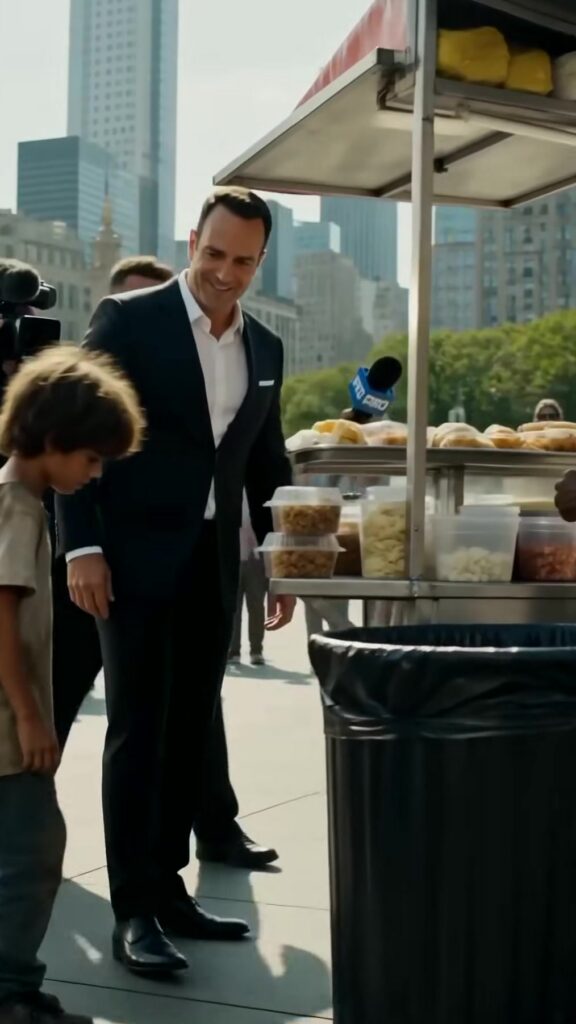
He’d parked his cart near the fountain, off to the side, where he always parked. He wasn’t trying to compete. He was just… present. His rough hands moved automatically, checking his warmer, adjusting the lids on his pots, wiping the edge of the cart as if the plaza itself might judge him.
Then Serrano noticed him.
It was small at first—Serrano’s smile tightening, his eyes flicking toward the cart like it was a stain on his white sneakers. He leaned toward a woman in a blazer who looked like she’d never sweated in her life. She nodded sharply and spoke into a little headset.
Two security guards started drifting closer, like dark clouds.
“Sir,” one of them said to Tano, voice flat. “You can’t set up here today.”
Tano blinked, like he’d been pulled out of a dream. “I’m not blocking anything,” he said, holding up his hands. “I’m just—”
Serrano walked over before Tano could finish. The cameras followed, of course, and suddenly the whole plaza was watching a new show.
“Friend,” Serrano said, loud enough to sound kind, “we appreciate your… initiative. But this is an organized event.”
Tano’s jaw moved like he was chewing on the right words. “Those meals,” he said quietly, nodding toward Serrano’s shiny trays, “they’re for children. Mine are for them too. I feed them every night.”
Serrano’s smile didn’t leave his face, but it changed. It got sharp at the edges.
“Today,” Serrano said, adjusting his jacket like he was on a runway, “is my charity.”
He said it like he was claiming a parking spot.
And then—like it was nothing—he gestured at Tano’s cart. One of the guards grabbed the edge. The cart lurched. A pot lid slid. Warm rice and beans, still steaming, tipped and poured straight into a nearby trash bin that had been placed there for “cleanliness.”
The sound wasn’t dramatic. It was just a wet, heavy slap. But the smell hit, and my stomach did something ugly inside me. Around me, a few kids sucked in their breath. Someone whispered, “No.”
Tano didn’t yell. He just stood frozen behind his cart, shoulders rounding in on themselves, his hands shaking like they didn’t know what to do if they weren’t feeding someone. His eyes went wet, and he stared at the trash like it had swallowed his dignity along with the food.
“That was for children,” he said, voice small.
Serrano kept smiling for the cameras. “Remove this cart,” he said, sweet as syrup.
The guard started to push it away.
Something in me went cold and clear. I’d been recording for weeks, not because I thought I was a hero, but because the plaza taught you to collect proof. Proof that you were harassed. Proof that you were chased. Proof that you weren’t lying when you said somebody kicked you “for no reason.” Proof was power in a world where people decided your story for you.
My proof wasn’t a phone. Phones got stolen too easy. Mine was a little action camera a tourist had dropped during some guided “authentic street life” tour. The screen was cracked. The battery was moody. But it recorded sound like a snitch.
I’d taped it under Tano’s cart the night before, because there’d been talk that the foundation was coming and I didn’t trust anyone who needed a ring light to be generous.
I stepped out from behind the crates.
I wasn’t tall. I wasn’t clean. I was the kind of kid people looked through. But I walked straight up like I belonged in the middle of their perfect little event.
“He feeds us every night,” I said, loud enough that the nearest microphones caught it.
Serrano’s smile flickered. Just a blink. But I saw it.
“Be quiet,” he hissed, leaning in, still smiling outward. “This isn’t your place.”
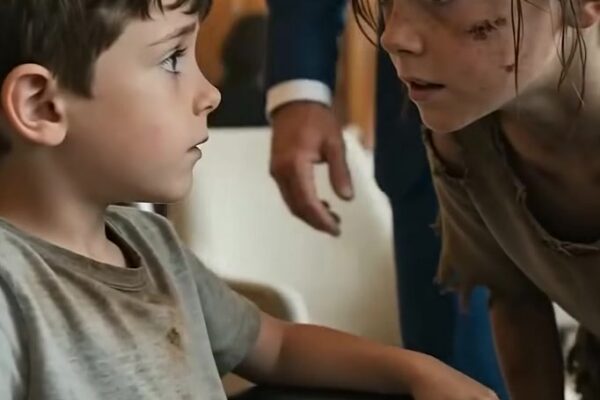
Behind me, other kids drifted closer—Mara with her braids, little Javi with his too-big shirt, twins who never spoke but always listened. Their faces were thin and tired, but their eyes were locked on Serrano like they were finally allowed to look.
I crouched by the cart, reached under the metal frame, and peeled back the tape. The camera felt warm in my palm.
Tano stared at it like it was a magic trick. “What is that?” he whispered.
“The reason I don’t believe in speeches,” I told him.
Serrano’s face shifted again, a little panic trying to climb through his expensive calm. “Turn that off,” he said, too fast.
I stood, held the camera up where everyone could see, and pressed play.
At first, it was just plaza noise—feet, wind, distant traffic. Then Serrano’s private voice cut through, not the stage voice, not the charity voice. This one was low and annoyed, the kind of voice people use when they think no one poor is listening.
“Keep the donations tight,” the recording said. “We’ll show the trays full for the shots, then pack most of it back up. Sponsors don’t pay for leftovers.”
A murmur rolled through the crowd like a wave.
The camera kept talking.
“And get that old vendor out of the frame,” Serrano’s voice continued. “It makes us look… messy. This is about branding. We’re not running a soup kitchen.”
Tano made a sound like he’d been punched without being touched.
Serrano reached for the camera, his smile gone now, replaced by a tight, furious line. “Give me that,” he snapped.
I took one step back and held it higher. “No,” I said, and it surprised me how steady my voice sounded. “The camera heard you. Everyone heard you.”
The crowd had changed. People who’d been clapping ten minutes ago were staring now. A woman with a wristband lowered her phone, eyes narrowing. One of the volunteers looked like she was trying not to cry. Even the camera crew hesitated, like they didn’t know which story they were filming anymore.
Serrano tried to recover, smoothing his jacket like fabric could fix a lie. “This is… edited,” he said, too loud. “This child is—”
“Hungry,” Mara said from behind me, simple and deadly.
And then something weird happened: the plaza stopped being a set. It became real.
People started talking over Serrano. Questions flew. Someone demanded to see the food storage. Someone else asked why donations weren’t being distributed. One of the guards looked at Serrano like he’d suddenly realized who he worked for.
Tano, still trembling, put a hand on my shoulder. His palm was rough and warm. “Nico,” he murmured, like my name was a prayer he didn’t know he had.
I didn’t feel brave. I felt tired. But I looked Serrano straight in the face anyway.
“You can toss food in the trash,” I said, “but you can’t toss your words away once they’re recorded.”
Serrano opened his mouth, maybe to threaten me, maybe to buy me off, maybe to pretend he’d misunderstood his own voice. But he didn’t get the chance.
Because the plaza—our plaza—had finally started listening to the kids it usually stepped over.
And for the first time in a long time, Serrano looked like the one who didn’t know where to stand.
Not in the frame. Not in the story. Not anywhere.