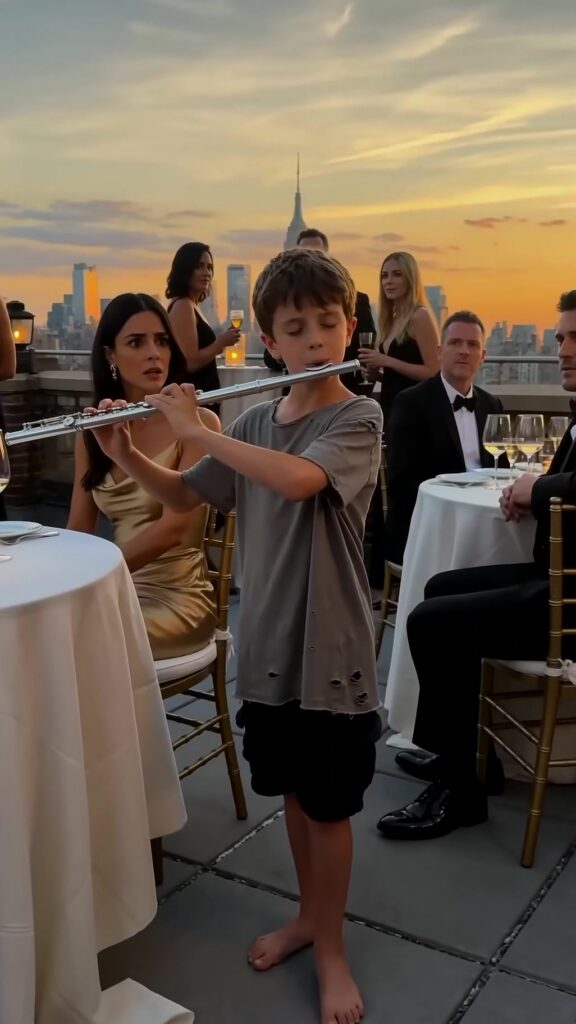
The rooftop terrace looked like it had been designed specifically for sunsets. Everything was warm and expensive—golden light on pale stone, glass rails catching the last sun, and the city below blinking awake like it was clearing its throat before the night shift. A round table sat in the center like a stage: linen so white it almost hurt, wine bottles sweating in ice, bowls of olives no one touched, and the kind of candles that never drip because somebody, somewhere, spent money solving that problem.
The guests were the usual mix of polished and bored. Men in jackets they’d take off the moment the photographer left. Women in dresses that made soft, controlled swishes when they moved. A few people held their phones up in that lazy way—half recording, half signaling to anyone watching their story that yes, they were exactly where they were supposed to be. Laughter floated, practiced and brief, like a currency traded in small amounts.
That’s why the child looked unreal.
Bare feet on stone. Clothes that had clearly survived some arguments with pavement. A face too old in the eyes and too young around the mouth. The kid stood a few steps away from the table, not begging, not smiling, not doing the adorable street-performer routine. Just standing there with a silver flute, the instrument catching the sunset in sharp flashes like a secret.
Someone at the table—an investment guy with a watch that could probably pay for a semester—laughed under his breath. “Security is slipping,” he said, and tilted his phone for a better angle, like the kid was part of the entertainment package.
The child lifted the flute with hands that trembled, and for a moment the whole terrace held its breath, not because anyone cared, but because humans still pause when something unfamiliar starts.
Then the kid played.
It wasn’t a song. It wasn’t even a full melody. Just a handful of notes, soft and thin at first, then steadier, like the child was remembering how to trust air. The phrase curled through the rooftop like smoke. It didn’t belong here. It had no business being this sharp, this sad, this specific.
Conversation stumbled. One laugh stopped mid-exhale. Several phones kept recording out of pure habit, but the smiles behind them collapsed into confusion.
At the far side of the table, a woman in a gold dress went rigid. She looked like she’d been sculpted for this kind of evening—hair pinned perfectly, earrings that caught the light, lipstick applied with a decision. Her eyes widened, and before anyone could ask what was wrong, she shoved her chair back so hard it scraped across stone with a sound like a warning.
“That melody,” she said, and it wasn’t really a question. It came out ragged, like she’d been running.
The child lowered the flute slowly. In the changing light you could see a red mark on one cheek, the shape too deliberate to be an accident. The kid’s eyes lifted toward her—tired, guarded, and weirdly steady, like someone who’d learned early that crying doesn’t always help.
The woman took one step, then another, not caring that the table behind her had gone silent. She moved like she was afraid the kid would vanish if she blinked too hard.
The child swallowed. “She taught me,” the kid whispered.
“Who?” The woman’s voice cracked on the single word.
The child’s fingers tightened around the flute. “My mom.”
Phones began to lower, one by one, as if the air had finally changed temperature. Even the guy with the expensive watch stopped filming and frowned like he’d just realized this wasn’t a funny clip.
The sunset flared off the flute again, a warm flash that made the instrument look almost alive. The woman stared at it like she recognized it. Her hand, still holding a wine glass, started to shake, the red wine trembling inside like a small warning sign.
“What’s her name?” she asked, but her voice was already breaking apart.
The child didn’t hesitate. “Anna.”
The glass slipped from the woman’s fingers and hit the stone with a clean, violent sound. It shattered and sent a dark splash across the pale floor like spilled ink. Several guests jumped. Someone cursed softly. A couple of people finally remembered they had hands and started moving napkins around like that could fix what was happening.
The woman didn’t even look down. Her face was doing something public and messy—undoing itself in real time. She reached toward the child, stopped halfway like she wasn’t sure she was allowed, then tried again.
“Anna… what?” she whispered.
The child’s throat worked. A tear slid down the kid’s cheek and cut through the dust. The flute shook in both hands, and the kid glanced past the woman for a second, toward the doors that led inside, like expecting someone to burst out and drag them away.
“Anna Rios,” the child said finally.
The woman made a sound that didn’t fit into language. Her knees looked like they might give. She pressed one hand to her mouth, and her other hand reached out and touched the flute—not grabbing it, just touching the metal like she needed proof it existed.
“That’s—” she started, and then she stopped because the sentence had too many landmines. Around them, the guests sat frozen, watching their evening become a story they didn’t know how to laugh at.
The woman took a breath so shaky it looked painful. “Where is she?”
The child’s eyes dropped to the stone. “I don’t know. We got separated.”
“When?”
“A while.” The kid’s voice hardened around the edges. “People keep saying ‘a while’ like it means something. Like time fixes stuff by itself.”
The woman’s eyes flicked to the child’s cheek. “Who did that?”
The child shrugged, and it was the kind of shrug that held too much weight. “Does it matter?”
It did, but the woman swallowed whatever she wanted to say. She crouched carefully, gold dress pooling around her like liquid light, and tried to make her face gentler, smaller. “My name is Celeste,” she said. “I knew Anna.”
The child looked up, suspicious. “Everyone knows my mom,” the kid said, but there was a tremor in it, like hope trying not to be seen.
Celeste nodded, too quickly. “Not like that. We… we grew up together. We played music together.” She glanced at the flute again, and her eyes flooded. “That’s her flute.”
“It’s mine,” the child said instantly, pulling it close. Not rude—protective. The only valuable thing in the kid’s world, and valuable in a way that didn’t involve money.
Celeste’s mouth twitched with something like a smile and heartbreak at the same time. “Yes,” she said softly. “You’re right. It’s yours.” She looked up at the table then, at the people who were suddenly very interested in their own glassware. “Can someone get the manager? Now.”
A man in a navy blazer blinked like he’d been slapped. “Celeste, what—”
“Now,” she repeated, and the word had the kind of authority money buys and fear sharpens.
Someone stood, hurried toward the doors. Another guest started to pick up the biggest pieces of broken glass, then stopped, unsure if cleaning was appropriate when a stranger’s life was cracking open in front of them.
Celeste turned back to the child. “What’s your name?”
The child hesitated, then said, “Milo.”
Celeste’s face changed at that, like another door had opened somewhere behind her eyes. She didn’t ask why. She didn’t say, I remember. She just nodded, slow and careful. “Milo,” she repeated, as if setting the name down gently between them. “Okay. Okay. You’re safe up here. No one is going to touch you.”
Milo’s gaze darted around the terrace anyway—at the phones that had finally vanished, at the expensive shoes, at the city below that looked so close and so far. “People say that a lot,” Milo muttered.
Celeste took her own phone out, but not to record. Her thumb hovered over the screen, shaking. “I’m calling someone,” she said. “A lawyer. And a friend at the shelter network. And—” She stopped, swallowing. “And I’m calling Anna’s last number, even if it’s pointless. I just… I have to.”
Milo watched her, searching for the trick. “Why do you care?”
Celeste looked at the flute again, at the small hands holding it, at the red mark on the cheek. “Because I didn’t,” she admitted, and the honesty in it made her voice go thin. “Not enough. Not when it mattered.”
The manager arrived with security a moment later, breathless and overly polite, ready to remove the problem. Celeste stood and held up a hand. “No,” she said before anyone could speak. “Not like that. Get us a private room. Warm food. Water. And I want you to pull the footage from every camera that covers the elevator and stairwell for the last two hours.”
The manager looked startled. “Of course, Ms. Vale.”
Milo flinched at the name like it meant something dangerous. Celeste noticed. “You know who I am,” she said quietly.
Milo’s chin lifted in defiance. “Everyone knows who you are. My mom used to point at your billboard and say, ‘That’s what happens when you choose the easy song.’”
Celeste closed her eyes for a second, as if the sentence hit a bruise she’d been pretending wasn’t there. When she opened them, she didn’t look angry. She looked… relieved to finally be seen properly.
“She always hated my commercials,” Celeste said, a shaky laugh catching in her throat. “Even when she needed the money.”
Milo’s eyes widened. “You gave her money?”
Celeste nodded once. “Years ago. A loan. She promised she’d pay it back with interest, because Anna was dramatic like that.” Celeste inhaled. “Then she disappeared. I told myself she just didn’t want to be found.”
Milo’s voice went small. “She wanted to be found. She wrote letters.”
Celeste’s face went very still. “Letters?”
Milo reached into a pocket that looked like it had been repaired a dozen times. The kid pulled out a folded envelope, soft at the edges from being handled too much. The front had a name written in careful handwriting: CELESTE VALE. The paper looked like it had been loved and feared.
Celeste took it like it was fragile glass. Her fingers hovered over the seal, then paused. “Did you bring this… for me?”
Milo shrugged again, but there was a tremble in it. “She said if I ever got really stuck, to find you. She said you’d recognize the song.”
Celeste pressed the letter to her chest, right over her heart, like she was trying to stop it from breaking. The city lights below seemed to brighten, the sky deepening into the first blue of night. Around the table, no one spoke. Even the terrace seemed to quiet, as if the building itself was listening.
Celeste looked down at Milo, and when she spoke again, her voice was steady in a way it hadn’t been since the first notes. “Okay,” she said. “We’re going to find her. And until we do, you’re not alone. Not for one more night.”
Milo didn’t smile. Not yet. But the child lifted the flute again, almost absentmindedly, and played the same small phrase—softer this time, less like a warning and more like a door being opened. Celeste, letter in hand, stood in the gold light and listened like it was the only thing that had ever been real.