The bikers were laughing in the midday heat when the boy ran into the yard.
It was that kind of laughter that belonged to people who’d been through enough to stop flinching at life. It rolled out under the shade of a sun-bleached awning, bounced off the cinderblock walls of Mercy’s Auto & Salvage, and mixed with the lazy ticking of engines cooling down. A couple of the guys were arguing about whose carb was the bigger pain. Someone had a soda sweating in their fist like it was working overtime.
Then a kid burst through the gate like the ground behind him was on fire.
He was small—eight, maybe nine—and filthy in a way that wasn’t just “played outside.” Dust stuck to his cheeks where tears had dried. His shirt hung on him like he’d borrowed it from an older cousin. He was shaking so hard his knees looked like they might fold the wrong direction.
He made it into the middle of the yard, right where the club’s bikes formed a black ring of chrome and shadow, and he dropped to his knees as if the gravel had yanked him down.
In both hands, he held out something tiny and silver.
“Please,” he rasped, like the word had scraped his throat raw. “Please buy it.”
The laughter didn’t just stop—it evaporated, leaving a weird silence that made the whole yard feel louder. A wrench clinked as someone set it down too carefully. A crow somewhere in the power lines gave a single caw and then shut up like it knew better.
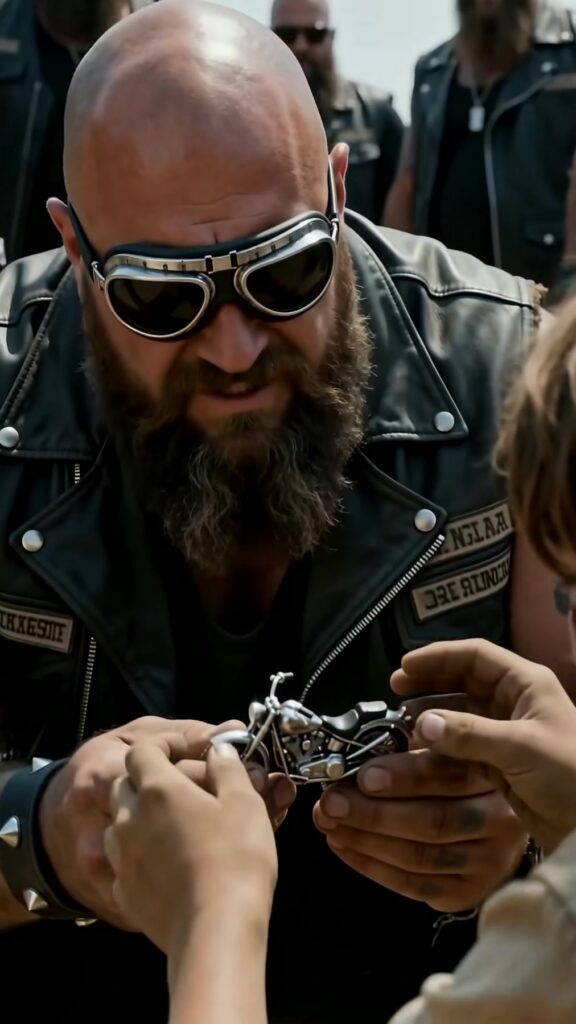
Hank “Rook” Marlow stepped forward first, because he always did. Biggest in the Rust Saints, broad as a refrigerator, beard like he’d been born wearing it. His vest was black and heavy, patched and scuffed, a second skin against the bright cruelty of noon. He looked annoyed at first, the way men look when the world keeps placing its problems in their path without asking.
“What is this, kid?” Rook asked, voice dry as grit.
The boy’s fingers tightened around the little object like he was afraid it would float away. He stared down at it as if it might start talking and tell him what to do next.
“My dad made it,” he said, barely louder than the engines cooling in the shade.
Rook’s gaze dropped to the thing in the kid’s hands.
It was a miniature motorcycle, maybe six inches long, but it had weight to it. Not plastic. Not store-bought. Little pieces of metal fitted together with the kind of patience you didn’t see much anymore. Tiny pipes curved along the side. The seat looked like it had been worked with something finer than a file. Even the spokes were detailed, thin as needles, catching sunlight like they were proud.
Rook’s annoyance thinned into something else—attention. He crouched, boots cracking on gravel, and held out a hand.
“Let me see that.”
For a heartbeat, the boy didn’t move. He clutched the model tighter, knuckles whitening, like letting go would make something inside him snap for good.
Then, slowly, he placed it into Rook’s palm.
Rook turned it over. He did it careful, too careful for a man who’d once cracked a guy’s jaw with a helmet and then finished his beer. The yard blurred at the edges. The sun hammered down. A warm wind pushed through the chain-link fence and carried the smell of hot rubber and spilled gas.
There, on the frame near the tiny engine casing, was an engraving. Not a name, exactly—more like a mark. A small symbol: a rook chess piece inside a rough circle, the lines shallow but precise.
Rook went very still.
Behind him, the rest of the Saints went quiet in a way that had nothing to do with politeness. Lean and sharp-eyed Vince shifted his weight like he was ready for trouble. Old Cal, the club’s mechanic, squinted as if he recognized the pattern but didn’t want to admit it out loud. A few men stared at the kid, then at Rook’s hand, then back at the kid, as if a door had opened where there wasn’t supposed to be one.
Rook’s jaw flexed, one muscle working on its own. “Why are you selling it?” he asked, but his voice had changed. It was lower, rougher, and it didn’t sound annoyed anymore. It sounded careful.
The boy looked up. His eyes were swollen, red around the rims like he’d rubbed them raw. He tried to speak once, and nothing came out except a shaky breath. Then the words spilled, broken and jagged.
“My dad…” He swallowed hard. “He won’t wake up.”
Rook’s fingers tightened around the tiny motorcycle, not enough to hurt it, but enough to show the tremor that started at his knuckles and traveled up his wrist like electricity.
“Where is he?” Rook asked.
“At home,” the boy whispered. “On the couch. I… I shook him. I yelled. He didn’t—” His voice snapped. He pressed his lips together, but the tears forced their way out anyway. “I don’t know what to do.”
Rook stared at the engraving again, like the symbol had taken on a weight that bent light. Then he looked at the kid, really looked at him, taking in the grime, the trembling, the way his shoulders were pulled tight like he was bracing for a hit.
Rook reached up with his free hand and slowly slid off his sunglasses. His eyes weren’t the hard gray people expected. They were the kind that had seen a long time and still hated surprise.
The boy stared back at them, startled, like he’d been waiting for an answer and hadn’t expected it to have a face.
“My dad said… you’d know,” the boy said, voice cracking thin. He lifted one shaking finger and pointed, first at the tiny bike, then at Rook’s chest, right where the rook patch sat on his vest. “He said if anything happened, to find the rook.”
The yard didn’t just quiet—it held its breath.
Rook’s throat worked like he was swallowing something too big. He looked at Vince and Cal without turning his head, a silent order passing through the air. Vince was already moving toward the clubhouse door to grab a phone. Cal was slipping into the garage, probably for the first-aid kit even though, if the kid was right, they were far past bandages.
Rook kept his focus on the boy. “What’s your name?”
“Eli,” the boy said. It came out small. Like he didn’t feel allowed to take up space.
“Eli,” Rook repeated, testing it like a bolt, making sure it fit. “I’m gonna need you to take me to your place. Right now.”
Eli blinked fast. “Will you… will you buy it?” he asked, nodding at the miniature motorcycle still in Rook’s hand. “I need money. I think… I think they charge you when someone—” He stopped, face twisting up like pain. “I don’t have—”
Rook leaned closer, and his shadow fell over the boy like shade on a scorched sidewalk. He reached into his vest, not for a weapon, but for a battered wallet that looked like it had been through wars. He pulled out a stack of bills thick enough to make Vince whistle under his breath, even from across the yard.
Rook placed the money gently in Eli’s dusty hands.
“You keep that,” he said. “And no—this isn’t me buying it.” He lifted the tiny motorcycle between them. “This is me bringing it back.”
Eli’s mouth opened, confused. “Back?”
Rook swallowed again, and for a second the big man’s face looked older than leather, older than all his scars. “Your dad and I,” he said slowly, “we used to know each other. Before I was anything worth patching onto a vest.”
Eli’s hands trembled around the money. “He… he never said your name.”
“He wouldn’t,” Rook murmured. He stared at the engraving like it was a time capsule. “He was the kind of man who fixed things quiet.”
Something shifted in Rook’s expression, like a door unlatched. He stood and extended his other hand to Eli—palm open, patient.
“Come on,” he said, voice turning into something that could carry a kid through a disaster. “You did the right thing. You found the rook.”
Eli hesitated, then put his small grimy hand into Rook’s huge one. His fingers disappeared in the grip, but Rook didn’t squeeze hard. He held on like Eli was something that could break if handled wrong.
As they started toward the gate, the Saints parted without a word. Black bikes gleamed in the sun like watchful animals, and somewhere an engine started—low, steady, ready.
Rook tucked the tiny silver motorcycle carefully into the inside pocket of his vest, right over his heart, like it belonged there.
“Which way?” he asked.
Eli pointed toward the far end of town, toward the rows of small houses where the lawns burned yellow in summer and secrets sat behind curtains. “That way,” he whispered. “Please hurry.”
Rook nodded once, sharp and certain. “We’re gonna hurry,” he said. Then, under his breath, so only he and the heat could hear it, he added, “Hold on, Mason. Don’t you dare check out on me like this.”
Eli looked up at him. “Who’s Mason?”
Rook didn’t answer right away. He just opened the passenger door of his battered truck—because not every job called for chrome and thunder—and lifted Eli inside like the kid weighed nothing.
Then he closed the door, rounded the hood, and climbed in, his hands shaking as he started the engine.
“Your dad,” he said softly, and there was something in his voice that sounded like regret trying to become a promise. “And an old friend I owe a lot more than money.”
Behind them, the Rust Saints rolled out, not laughing anymore, the midday heat pressing down on the yard as if the whole day had just changed its mind.