The café looked like it had been designed to forgive everyone. Honey-colored light dripped through the plane trees and turned the marble tables into little stages. The menus were thick, the spoons were heavy, and the people were carefully polished—linen shirts, neat hair, quiet laughter. Even the city noise seemed trained to keep its distance. It was the kind of place that made you believe nothing ugly could happen within a ten-foot radius of a cappuccino.
Iris sat by herself at a corner table where the shade was flattering. She wore a black sleeveless dress that made her look like she belonged to the expensive world around her, and she held her coffee cup the way you hold a secret: close, steady, like you’re afraid someone might snatch it and read what’s inside. She’d picked this café on purpose. It was neutral ground. It was safe. It was where she could practice being calm.
She was halfway through pretending she could taste the notes of chocolate and citrus when something brushed her hair. Not the wind. Not a leaf. A small hand—dry, gritty, too warm. Iris reacted before she could think. Her chair screeched against the stone and heads turned in synchronized disapproval.
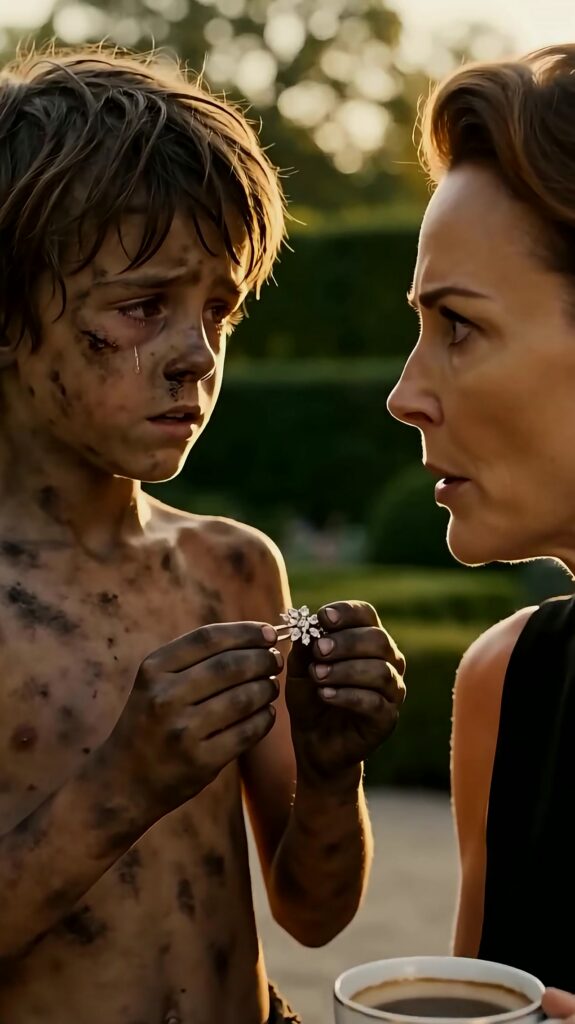
“Hey. Don’t,” she snapped, harsher than she meant, but not by much. The kid froze. He couldn’t have been more than eight or nine. He was all elbows and knees, barefoot, with soot streaked into his skin like someone had tried to erase him and given up halfway. His shorts were a size too big, held up by luck. His chest rose and fell too fast, like he’d been running from something that didn’t get tired.
“Sorry,” he said, voice thin as paper. He took a step back, but he didn’t leave. He stared at her hair like it was a sign he couldn’t read but desperately wanted to understand. Iris felt the familiar flare of embarrassment—the kind that comes when you realize people are watching you be human in a way you didn’t plan. Around them, conversations slowed to a hush. A woman at the next table adjusted her sunglasses like she was hiding from discomfort.
“What do you want?” Iris asked, trying to make her tone smaller. The boy swallowed and then said something so quiet Iris almost leaned in to catch it. “It’s the same,” he murmured, nodding at her hair. “Same as hers.”
Iris’s annoyance snagged on the word. “Hers?” she repeated. The boy’s mouth trembled. “My mom,” he said, like the phrase hurt to touch. And then, from his grimy fist, he opened his fingers slowly. In his palm sat a silver hair clip with tiny stones set in it—old-fashioned and delicate, the kind of thing you buy because you want to feel like your life has a story. The clip caught the golden light and flashed once, sharp as a memory.
Iris’s coffee cup hovered midair and then lowered to the table without a sound. She knew that clip. Not just the style—the exact nick on the clasp, the tiny missing stone on the left side. Her throat tightened so hard it felt like someone had grabbed her from the inside. “No,” she breathed. “That can’t be…”
The boy watched her face like he’d been trained to look for cracks. A tear traced a clean line down his cheek through the dirt. “She said you’d say that,” he whispered. Iris leaned forward, suddenly aware of her own hands shaking. The world around her—spoons clinking, leaves rustling, the soft jazz playing from somewhere—dimmed, like someone turned the volume down on everything except this table.
“Where did you get that?” Iris asked. The boy’s fingers curled around the clip like it might fly away. “She gave it to me,” he said. “Told me to find you. Told me you come here when you don’t want anyone to ask questions.” He hesitated, then added, “She told me to look for the black dress. She said you’d try to be invisible, but you’d look like you’re holding your breath.”
Iris felt heat behind her eyes, the kind that arrives before tears and makes you angry at your own body. “Where is she?” she asked, and her voice betrayed her. It wasn’t the crisp, controlled voice she used at work. It was something older, rawer.
The boy didn’t answer right away. He just turned his head, slow and careful, and pointed with his chin toward the edge of the garden where the hedges were trimmed into perfect geometry. Iris followed his gaze and saw a woman standing half in sunlight, half in shade. Beige suit. Sensible shoes. Hair pulled back. Still as a statue, like she’d been placed there and forgotten. Her face was angled toward the café, toward Iris, as if she’d been watching the whole time and counting the seconds it took for Iris to recognize her.
For a heartbeat, Iris couldn’t connect the sight to reality. The woman looked… older, yes. Thinner. But the bones of her face were familiar in a way that made Iris’s stomach flip. And then the woman in beige took one small step forward, and Iris saw the limp—subtle, practiced, the kind you develop after learning how to move through pain without letting it show.
Iris stood so fast her knees knocked the table. Her chair toppled and nobody rushed to help. People were recording now, pretending it was just curiosity, not entertainment. Iris didn’t care. Her chest felt too tight for air. She walked, then stumbled, then basically ran between tables, dodging a waiter holding a tray of sparkling water like the scene wasn’t happening. The boy trailed behind her, clutching the silver clip like a passport.
When Iris reached the hedge, she stopped a foot away from the woman. Up close, the beige suit wasn’t new. The seams were slightly frayed. There was a faint bruise-yellow shadow under one eye covered with careful makeup. The woman’s hands were clasped in front of her, and Iris noticed the knuckles—scarred, scraped, the hands of someone who’d been holding on to rough things.
“You’re dead,” Iris said, because it was the only sentence that made sense. It came out cracked. “They said you—”
The woman’s mouth twitched as if she didn’t know whether to smile or apologize. “I know what they said,” she replied. Her voice was quieter than Iris remembered, but it was the same voice—warm at the edges, firm at the center. “I didn’t have a choice.” She glanced past Iris to the boy. “Milo,” she said gently, and the kid flinched like the sound of his own name could knock him over.
Iris stared at Milo. “That’s your son?” she managed, like the words were heavy. The woman nodded. “He’s the reason I’m standing here,” she said. “And you’re the reason he’s alive.” Iris shook her head, confused and furious. “I don’t even know him.”
“You don’t know a lot of things,” the woman said, and there was no accusation in it—just exhaustion. “I didn’t come to ruin your life. I came because I ran out of places that would hide us. People who would look away. You always loved places like this, Iris. Places that pretend suffering doesn’t exist.”
Iris felt the sting of that, because it was true. She’d built her entire adult life around controlled surfaces. Around not needing anyone. Around never being the person who begged. And here she was, hands trembling, eyes wet, with an entire café watching her like she was a show.
Milo stepped forward and held the clip out to Iris with both hands. “She said it’s yours,” he whispered. Iris took it carefully, like it might cut her. The metal was cool, familiar, and suddenly she wasn’t in the café anymore—she was seventeen again, in a cramped apartment bathroom, watching the woman in beige pin her hair back and tell her, softly, that sometimes people disappear not because they want to, but because the world gives them no other move.
Iris looked up. “What do you need?” she asked, and she hated how simple it sounded, like a business transaction. The woman’s eyes shone. “I need you to see us,” she said. “Not for a minute. Not as a story. I need you to stop pretending you don’t recognize suffering just because it makes your coffee taste bitter.”
Behind them, the café kept humming, trying to absorb the scene back into its golden softness. But Iris had the clip in her palm, Milo at her side, and the woman she’d buried alive standing in front of her. For the first time in a long time, Iris let the golden light hit her face without using it as cover. “Okay,” she said, voice trembling. “Okay. Start talking. All of it.”