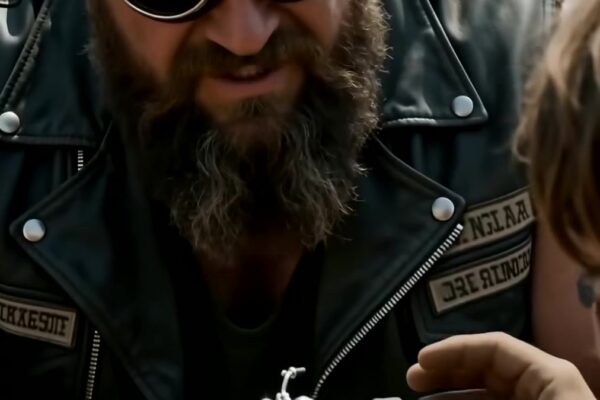
Hank “Hound” Mercer had exactly two rules when he rolled into a small town: don’t stay long, and don’t get involved. He’d been breaking both of them more often lately, which annoyed him almost as much as the lukewarm coffee in front of him.
The diner was the kind of place that smelled like bacon grease that had outlived three presidents. Vinyl booths, a pie case that looked like it was holding a hostage situation, and a waitress who called everyone “hon.” Hank liked it. Quiet. Predictable. Nobody cared about the dent in his knuckles or the faded ink crawling up his forearms. They just cared that he paid and didn’t smoke inside.
He was halfway through a plate of chicken-fried steak when it happened—something light and careful at his elbow, like a moth landing. Hank’s hand paused over his fork.
“Sir…”
The voice was so small it didn’t fit in the room. Hank looked up fast, expecting maybe a teenager asking for change or some bored kid daring herself to poke the big scary biker.
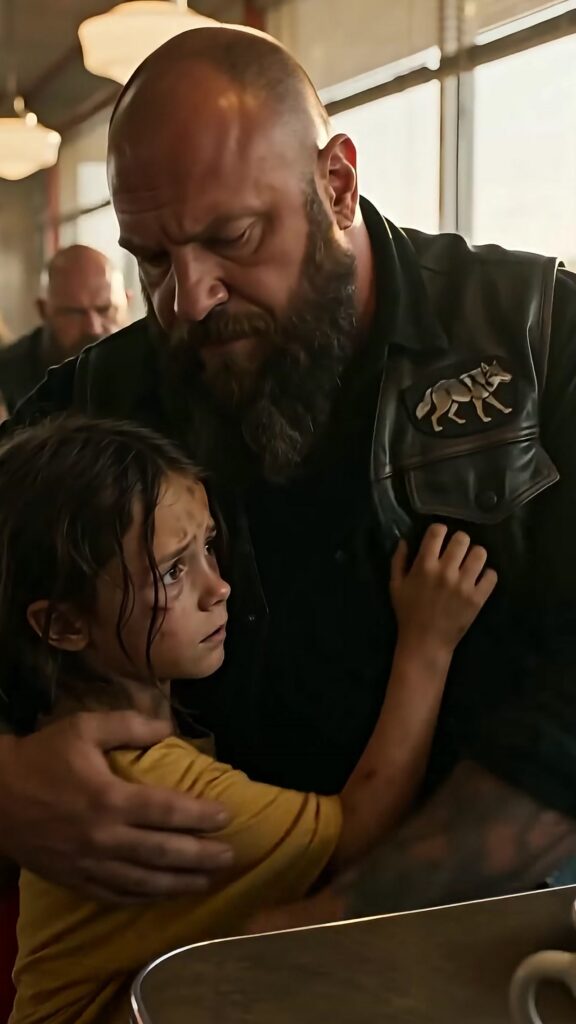
Instead, there was a little girl. Six, maybe seven. She wore an oversized yellow T-shirt that hung to her knees like she’d borrowed it from a much larger universe. Her cheeks were smudged with dirt, and her eyes kept flicking past him like she was tracking the exits. Her hands shook like she was trying to hold water in them.
“Hey,” Hank said, and his voice came out softer than he meant it to. He was used to making his voice sound like gravel. “You okay?”
She didn’t answer. She leaned in—too close, like the booth was the only safe place left on earth—and angled her mouth toward his ear.
Her whisper barely made it to him.
“That’s not my dad.”
For a second, even the diner’s clatter seemed to fade. Hank’s throat tightened as if someone had hooked a finger behind his collar. He followed her gaze without turning his head too obvious.
At the counter sat a young man with a ball cap pulled low, one boot on the chrome rung, stirring cream into coffee that was already pale. He looked like he belonged in a catalog called “Generic Guy You’d Forget Immediately.” Which, Hank knew, was exactly the point.
Hank put his fork down gently. He reached out and—slow, no sudden moves—lifted the girl into the booth beside him, tucking her between his body and the wall. She startled but didn’t fight it. She clung to the back of his leather vest as if it was a handle on a life raft.
“Stay behind me,” Hank murmured.
Across the diner, the man at the counter turned his head. Not startled. Not confused. Just… watching, like he’d been expecting this.
Hank slid out of the booth and stood. His chair scraped the floor hard enough that a couple at the next table looked up. The waitress froze mid-step with a pot of coffee in her hand.
Hank didn’t raise his voice. He didn’t need to. He just spoke the way thunder speaks when it’s still deciding where to land.
“We need to talk.”
The man’s eyes flicked toward the little girl. Hank stepped sideways, blocking the line of sight. The kid’s fingers tightened on Hank’s vest, finding the big patch stitched across his back: a wolf head, mouth open in a silent snarl, ringed by worn thread. It wasn’t a fancy design. It looked like it had been sewn on a hundred times, as if the jacket itself refused to let it go.
The girl went rigid.
Her breath caught so sharply Hank felt it through the leather.
“Mom said…” she whispered, voice wobbling like a loose tire. “If I ever saw that patch… I should run to you.”
Hank’s blood went cold, then hot, then cold again. He turned his head just enough to see her face. Tears gathered at her lashes, making her eyes look too big for her skull.
“What’s your mama’s name?” he asked.
The diner seemed to tilt. Hank hated how much he needed the answer. He hated how fast his heart started trying to break out of his ribs.
“Rose,” she said.
Hank didn’t move. He couldn’t. The name landed like a punch he’d been carrying around for years and finally decided to throw.
Rose Halstead. Rose with the laugh like a hiccup. Rose who could change a tire in the rain without cussing, just humming to herself. Rose who’d looked at Hank once—really looked—like she saw the good parts he never believed in.
Rose, who’d vanished from his life in a single letter and a single sentence: Don’t look for me.
Hank lifted his eyes to the man at the counter, and something ugly and sharp clicked into place. Recognition didn’t come from the man’s face, exactly. It came from a memory of a hospital hallway, a plastic bracelet on Rose’s wrist, and a shadow of a guy asking too many questions with a too-friendly smile.
The man stood slowly, keeping his hands visible as if that would make him innocent. He started to talk, but Hank beat him to it.
“You’re not her dad,” Hank said, loud enough that the waitress gasped. “So who are you?”
The man’s jaw tightened. His gaze darted to the front door, calculating distance, witnesses, odds.
“Buddy,” he said, voice slick, “you’re making this a big deal. Kid wandered off. I’m just trying to—”
“Don’t,” Hank said, and the word came out like a door slamming. He took one step forward. “Not with me.”
Behind him, the girl pressed her forehead into Hank’s shoulder blade. He could feel her shaking, tiny tremors traveling through the jacket into his bones. It wasn’t just fear. It was trust, and that scared Hank more than any knife ever had.
Hank didn’t throw punches. Not yet. He’d learned the hard way that fists solve problems and create new ones faster than you can blink. Instead, he did the thing people never expected from a biker built like a bear—he thought.
He looked at the waitress, who was still frozen with the coffee pot.
“Call 911,” Hank said, calm but absolute. “Tell them there’s a child here, possible abduction. Give them the address.”
The man at the counter laughed once, short and fake. “You can’t just—”
“Watch me,” Hank said.
The waitress blinked, seemed to reboot, and nodded hard. She hustled toward the phone behind the counter.
The man’s smile slipped. His hand moved toward his pocket.
Hank didn’t flinch. He shifted his stance so his body still blocked the booth, one foot angled to cut off a path to the door. He’d been in enough bad rooms to recognize the moment when a situation turns from talk to action.
“Don’t reach,” Hank warned quietly. “This is a diner. Not an alley. Let’s keep it that way.”
For a half-second, Hank saw the man’s real face: the calculation, the impatience, the belief that he could bully his way out because most people would rather avoid trouble than do what’s right.
Then the man made his choice.
He lunged sideways, not at Hank—at the booth, at the little yellow shirt, grabbing for her like she was a dropped wallet.
Hank moved faster than he had any right to at his age. He hooked the man’s wrist, twisted, and pinned him against the counter with a sound like wood cracking. The man yelped, more surprised than hurt, and that was Hank’s small mercy. Hank didn’t break him. He just made sure he couldn’t run.
Chairs screeched. Someone shouted. The cook appeared in the kitchen window holding a spatula like it was a weapon of war.
Hank leaned in close to the man’s ear. “You picked the wrong town,” he said. Then, quieter, the words that mattered most: “You picked the wrong kid.”
Behind him, the girl’s voice came out as a trembling breath. “Hank?”
He froze at his own name, like it had been pulled from the past and wrapped around his throat. He turned his head just enough to see her peeking over the edge of the booth, eyes huge.
“Yeah,” he said, and his voice cracked in a place he didn’t know was still tender. “It’s me.”
Sirens started faint in the distance, growing louder. Hank kept the man pinned until red and blue lights washed across the diner windows.
When the police came in, Hank didn’t let go until a deputy took control. He finally stepped back, hands raised, chest heaving like he’d been running for miles instead of holding a liar in place.
The little girl slid out of the booth and stood near Hank’s leg, close enough that her sleeve brushed his jeans. She looked up at him like she was trying to memorize his face.
“My name’s Lyla,” she whispered. “Mom said you’d be scary, but… safe.”
Hank swallowed hard. Somewhere in his head, years rearranged themselves into a new shape. Rose hadn’t told him to stop looking. Rose had told him to wait until it was safe to be found.
He crouched so he was eye level with Lyla. His knees complained. He ignored them.
“I’m safe,” he said. “And so are you. I promise.”
Lyla’s lower lip trembled. “Can you… can you call her?”
Hank glanced toward the deputy taking statements, then back at the kid. “Yeah,” he said, because whatever his rules were, they didn’t matter anymore. “We’re gonna call Rose.”
Outside, the sirens faded into the parking lot. Inside, the diner kept breathing again—coffee poured, murmurs resumed, plates clinked like normal life trying to stitch itself back together.
Hank stood with Lyla beside him, the wolf patch heavy on his back like a history he couldn’t outrun.
For the first time in a long time, he didn’t want to.
He wanted to go find Rose.
And he wanted to bring their kid home.