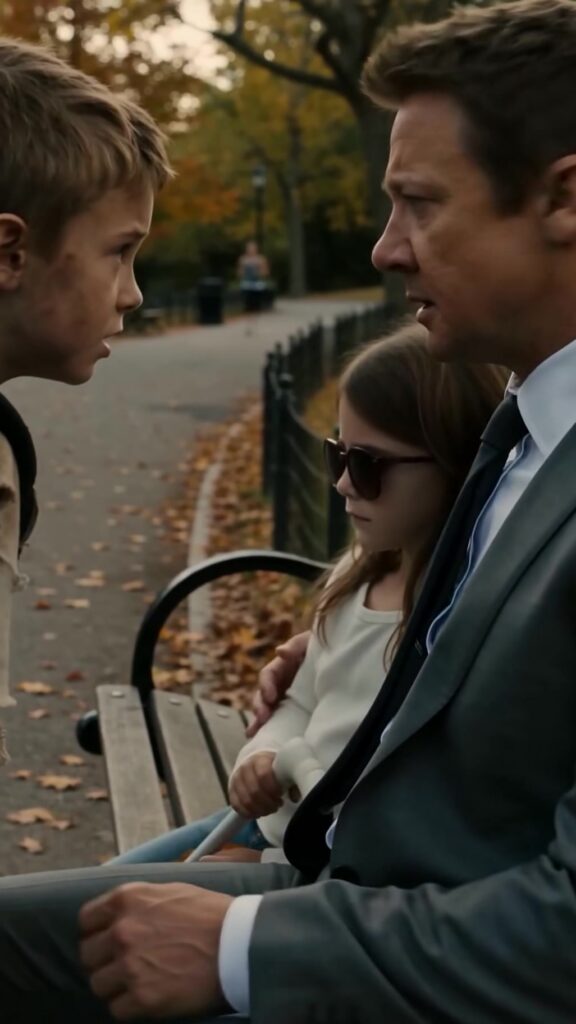
The father sat on the wooden bench like it was his assigned post in the universe, the kind of place you return to without thinking because it’s become part of the routine. His little girl was tucked against his side, so close her jacket bunched under his arm. He kept his arm around her shoulders the way he’d been doing since the hospital, since the diagnosis, since the word “blindness” started showing up in every conversation like an uninvited guest. Her white cane lay across the bench slats, the tip hanging over the edge like a question mark.
It was one of those days where the park felt like it had been turned down to half volume. Leaves skittered across the path with a soft shushing sound. A couple of people passed by and did that thing where their faces shift into sympathy as soon as they notice the cane. The father hated that look, even when he knew they meant well. He watched the leaves more than he watched the people, because the leaves didn’t pity anybody. They just moved.
“You comfy?” he asked, leaning his mouth near his daughter’s ear so she wouldn’t have to project. He’d learned to treat her world like it was made of delicate glass.
“Mhm,” she said, the sound small and practiced. Her dark sunglasses covered most of her face, making her look older than she was, like a tiny celebrity hiding from cameras.
He was about to suggest ice cream—because ice cream was his go-to solution for literally everything—when something collided with his reality.
A boy appeared at the edge of the bench, like he’d been launched out of the bushes. He was skinny in that way that didn’t look like a growth spurt, more like missed meals. His hair stuck up in clumps, and his backpack looked like it had been in a fight and lost, the zipper yawning open. Dirt streaked his cheeks as if he’d wiped away tears with muddy hands. He grabbed the father’s sleeve with a trembling grip, and his eyes were wild with urgency.
The father jerked, instantly protective. “Hey—”
“Sir,” the boy blurted, breath snagging, “your daughter isn’t blind.”
For a second the sentence didn’t land. It hovered in the air like a bad joke someone forgot to laugh at. The father stared at him, irritation rising first because irritation was easier than confusion. “What did you just say?”
The boy didn’t smile. Didn’t flinch. Just held on like if he let go he’d disappear. “I’m not messing with you,” he said. “I saw her. She can see.”
The father felt his jaw tighten. Strangers said weird things all the time—miracle cures, prayers, conspiracy theories about doctors. He’d heard every version of “maybe it’s not that bad” from well-meaning people who had never sat through an MRI. “Listen,” he started, voice low, “you don’t—”
Then it happened. A leaf broke loose from a tree above them and drifted down in slow motion, spinning like it was showing off. It floated right in front of his daughter’s face.
Without thinking, she turned her head and tracked it. Not a random twitch. Not a vague movement toward sound. Her chin followed the leaf’s lazy spiral with a quiet precision that made the father’s stomach drop through the bench and into the dirt. Her cane slid, the handle slipping off the slat.
Her hand snapped out and caught it before it hit the ground.
The park noise came rushing back like someone turned the volume up. The father’s heart hammered. He kept his arm around her shoulders, but his grip changed—less comfort, more restraint. His mouth tasted like pennies. “Mia,” he said, carefully, “honey… did you just—”
She froze. Her whole body locked like a kid caught with a cookie inches from their mouth.
The boy swallowed hard. “I told you,” he whispered. “I saw her look.”
The father stared at the boy again, and the irritation cracked open into something colder. “How would you even know us?” he asked. “Who are you?”
The boy’s fingers loosened on the sleeve, but he stayed close like distance was dangerous. “I’m Eli,” he said. “I sleep behind the hedge by your street sometimes. Near the big garage with the keypad. I didn’t mean to spy, I just… I hear stuff. Your house is loud when the windows are open.”
The father went still. Their house. Loud windows. His brain tried to reject it, tried to file it under “creepy kid making things up,” but the timing of the leaf had cracked his certainty wide open. “What did you see?” he asked, voice rough.
Eli glanced down the path like he was checking for someone. A jogger passed in the distance, ponytail bouncing. Eli’s shoulders flinched anyway. “Your wife,” he said, and the word came out like it hurt. “She does something when you’re not looking. She opens a bottle from the medicine cabinet and puts drops in Mia’s food. Like, not every time, but enough. I saw it last week. And I saw her do it again yesterday. She thinks nobody’s watching.”
Everything inside the father tried to slam shut. He could take bad luck. He could take cruel biology. But this? This was a different universe.
He tightened his arm around Mia without meaning to. “That’s not… my wife wouldn’t…” He couldn’t even finish the sentence because his mind produced images he didn’t ask for: his wife slicing strawberries, stirring soup, smiling as she set a plate down in front of their daughter like a peace offering. Mia eating quietly. His wife saying, “It’s okay, sweetie, you’re safe.”
Mia’s lips parted, then closed again. Under the sunglasses, her face was pale.
The father forced his voice to stay calm because panic was contagious. “Mia,” he said gently, “can you see me right now?”
Silence.
Eli leaned in, urgent again. “She told you doctors said it was permanent, right? But it started after the accident? That’s what she tells people.” He sucked in a shaky breath. “Sir, I don’t know why she does it. Maybe she wants you to feel sorry for her. Maybe she wants you to stay. But it’s wrong. It’s messed up. And… and Mia looks scared when she thinks nobody can tell.”
Mia’s shoulders trembled. “Dad,” she whispered, and the tiny word broke something open inside him. “Please don’t be mad.”
He swallowed hard. “I’m not mad at you,” he said quickly, because that was the one truth he could grab. He shifted so he could see her better. “Sweetheart… why didn’t you tell me?”
Her fingers curled around the cane handle like it was her only anchor. “Mom said,” she began, voice thin, “Mom said if I told you, you’d leave. And then we’d be alone. She said it was easier if you thought… if you thought I couldn’t see, you’d stay home more. You wouldn’t go on trips. You wouldn’t look at your phone all the time. You’d be here.”
The father felt nausea rise. He had been home more. He had canceled work travel. He had rearranged his entire life around protecting Mia from darkness he believed was real. And his wife had watched him do it. Encouraged it. Fed it.
“When did you start seeing again?” he asked, barely breathing.
“I never stopped,” Mia admitted, and the shame in her voice wasn’t hers to carry.
The father’s hands went cold, then hot. His mind raced, grabbing at action because action was easier than feeling. He looked at Eli. “You’re sure about the drops?”
Eli nodded fast. “I’m sure. I saw the label once when she left it on the counter. It said something about eyes. Like… dilation? I don’t know. But Mia would get sleepy after she ate. And her pupils—” He faltered, realizing he was talking like an adult when he was just a kid with dirt on his face.
The father stood, still holding Mia close, and dug his phone from his pocket with a shaking hand. He didn’t call his wife. He didn’t ask for explanations. He called the pediatrician’s emergency line, then, when he couldn’t get through quickly enough, he called 911 and said the words he never imagined saying: “I think my child has been drugged.”
Mia gripped his shirt. “Dad, what’s going to happen?”
He kissed the top of her head, right where her hair smelled like shampoo and sunshine and all the normal things she deserved. “You’re going to be safe,” he said. “That’s what’s going to happen.”
Eli stepped back like he was ready to bolt the second anyone looked at him too hard. The father caught his sleeve this time. “Hey,” he said, voice steadier now. “You did the right thing. What you did just… you just changed everything.”
Eli’s face crumpled, not quite crying, not quite not. “I didn’t want her to get hurt,” he mumbled.
“Neither did I,” the father said. He looked at the park path, at the leaves sweeping themselves along like nothing in the world had changed. Then he looked down at his daughter’s sunglasses and understood, in a flash of awful clarity, that blindness wasn’t just the absence of sight. Sometimes it was the stories you let people tell you because you loved them.
As the sirens began to swell in the distance, the father guided Mia toward the street, one hand on her shoulder, the other holding the cane like it was evidence. Behind them, Eli hovered uncertainly, a dirty little boy with shaking hands who had walked into their lives like a gust of wind—and had finally, painfully, forced the truth into the light.